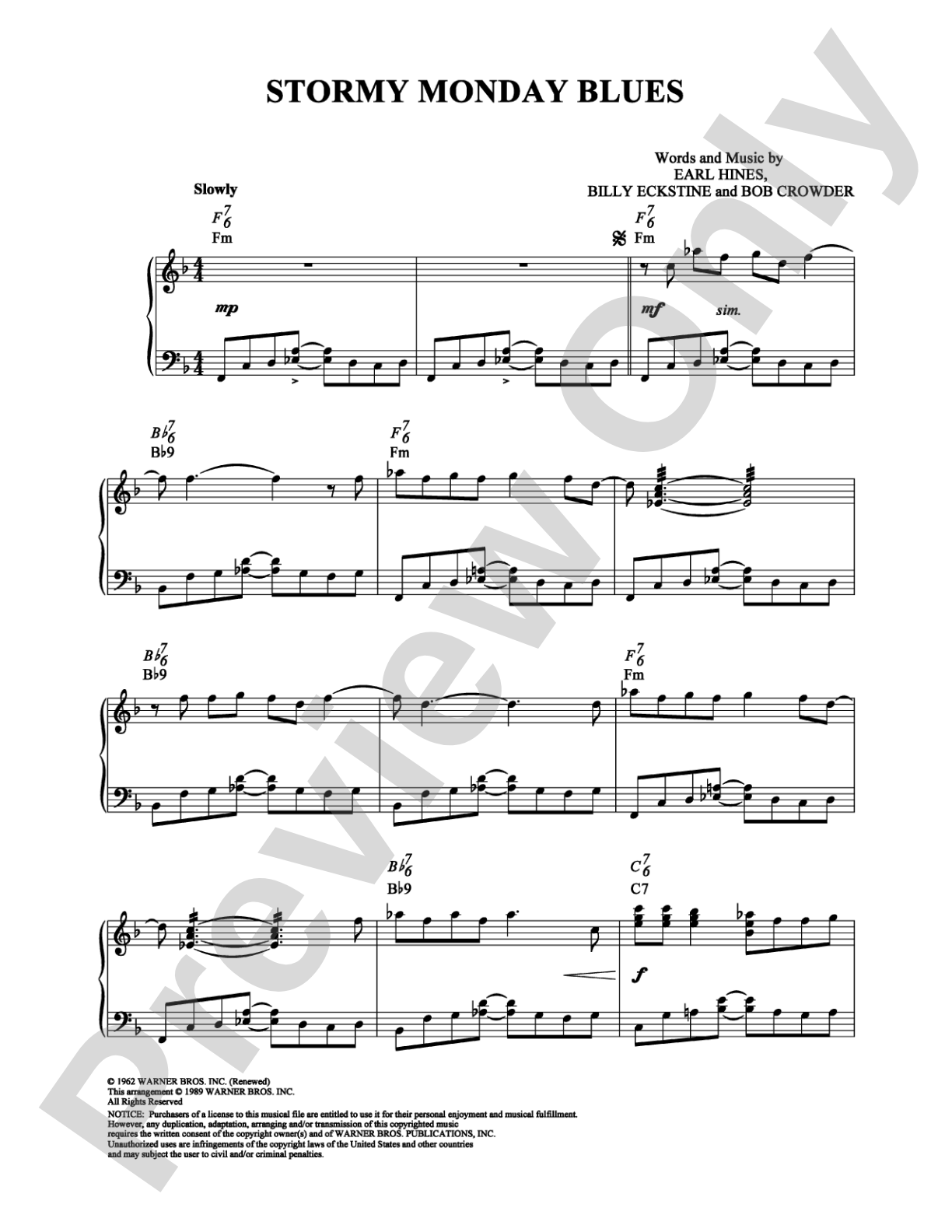
Stormy Monday Blues: Piano Digital Sheet Music

Stormy Monday Blues: Piano Digital Sheet Music

Earl Hines, Billy Eckstine, Bob Crowder

Item: 00-PS-0008737

Digital Download
$3.99
Description

Stormy Monday Blues: Piano Digital Sheet Music isn't in MakeMusic Cloud just yet...but it could be. Let us know you'd like to see it, and you'll help shape what comes next. In the meantime, start a free trial and dive into thousands of interactive titles your students can play along with today.

Sample Audio
No sample audio found.
Sample Video
Additional Details
SKU: 00-PS-0008737

More about this title

Why we love this

Stormy Monday sits at the intersection of jazz standard repertoire and blues idiom, making it ideal for pianists who want to deepen their understanding of swing feel and jazz harmony without stepping outside a deeply familiar form. The piece rewards both straight-ahead interpretation and creative reharmonization, giving you room to grow as you return to it across multiple semesters.

What to expect

The piece carries the mournful elegance of urban blues, with minor-key melancholy offset by the forward motion of a strong jazz groove. It balances introspection with the subtle swagger of a well-placed reharmonization or rhythmic displacement.

Who it's for

Jazz pianists working to build fluency with standard forms and blues changes. Advanced intermediate through adult pianists will find enough harmonic depth and swing vocabulary to sustain meaningful practice and performance.

How to get the most out of it

  • Lock into the triplet feel early in your practice. The swing eighth notes that define the groove need to be internalized before you layer in any improvisation or reharmonization.
  • Let the left hand groove sit slightly behind the beat. This pocket playing is what gives the blues its forward momentum and distinguishes it from classical stride technique.
  • Approach the chord changes as dialogue between melody and harmony. Rather than treating substitutions as decoration, use them to deepen the emotional arc of the phrase.
  • Record yourself playing the head straight so you have a reference for how the melody sits over the harmony before you begin interpreting.

How to use it

Include this on a jazz recital alongside other standards to demonstrate your student's command of the form, or sequence it with simpler 12-bar blues pieces to show progression in harmonic sophistication and rhythmic nuance. It also works well as a centerpiece for a program exploring American songbook material.

Skills your students will build

  • Swing eighth-note feel and triplet subdivision
  • Walking bass lines and left-hand groove playing
  • Reading and interpreting chord changes in jazz notation
  • Blues form navigation (12-bar structure)
  • Improvisation over a fixed harmonic structure
  • Dynamic control and phrasing in a groove context

You May Also Like