Stormchasing: Bassoon Sheet Music Preview

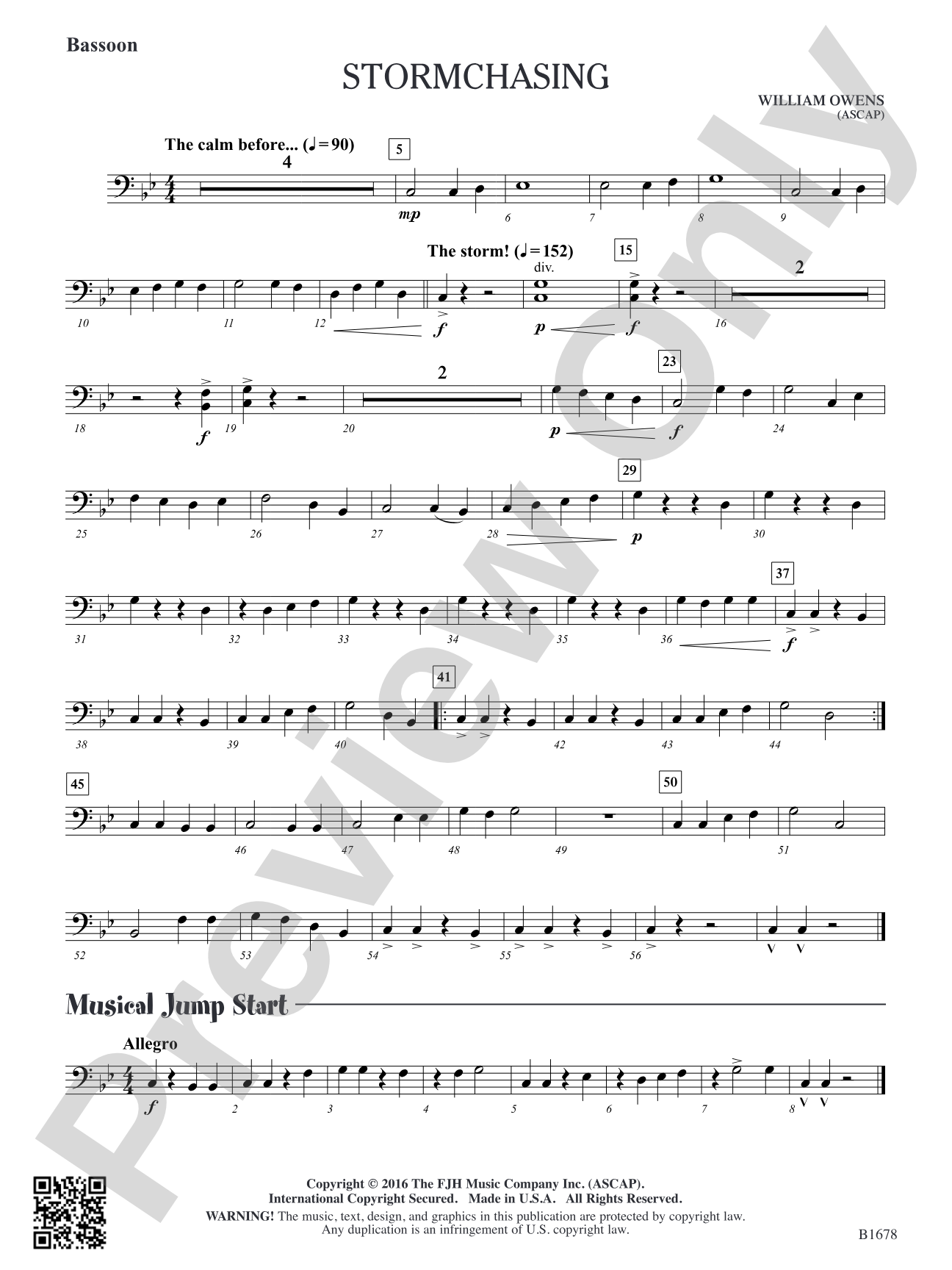
Stormchasing: Bassoon

By William Owens

Level:.5

Item: 98-PC-DB1678_B1

Digital Download
$7.00
Description
Take your audience by storm with this riveting work for beginning bands! With the mysterious and slow introduction and powerful allegro section, Stormchasing offers vast musical opportunities with the quarter note as the shortest rhythm. Special sound effects are strategically scored, and the Advanced Percussion 1 part will certainly add to the excitement. Lots of energy and great music with only six notes---a guaranteed winner! (2:00)

Don't just read it, hear it, play along with it, and watch your students grow with it. In MakeMusic Cloud, Stormchasing: Bassoon comes alive with professional accompaniment, adjustable tempo, and built-in practice tools that turn solo practice into real progress.

Sample Audio
0:00
0:00
Sample Video
Additional Details
Series: FJH Starter Series
Publisher: The FJH Music Company, Inc.
SKU: 98-PC-DB1678_B1

More about this title

About the Composer: William Owens

William Owens

William Owens brings three decades of band directing experience to his compositional work, having spent 30 years leading programs in Texas before his 2014 retirement. A 1985 graduate of VanderCook College of Music in Chicago, he has established himself as a prolific voice in young band literature, with over 300 published titles since 1993. His works appear on festival and contest lists across North America and have been featured in music education texts as repertoire standards.

Owens' approach to writing for developing ensembles balances musical substance with practical accessibility. His commissions include projects from the American Bandmasters Association, Phi Beta Mu International, and South Plains College, and he maintains active memberships in ASCAP and the Texas Music Educators Association. He resides in Fort Worth with his wife Georgia.

Why we love this

Beginning bands need music that sounds impressive without overwhelming players technically, and Stormchasing delivers exactly that. The contrast between a mysterious opening and a powerful allegro section keeps both performers and audiences engaged, while the strategic percussion effects add theatrical interest that makes students feel like they're creating something genuinely exciting. A piece this musical at this level, with a tight two-minute running time and only six pitches to manage, is a rare find for early-season programming.

What to expect

Stormchasing opens with mystery and unease, as if watching storm clouds gather on the horizon. The slow, atmospheric introduction draws listeners in before the piece suddenly shifts into kinetic energy and forward motion, mirroring the rush of a storm's arrival. It's dramatic without being bombastic, exciting without demanding virtuosity.

Who it's for

Beginning band directors searching for repertoire that challenges students musically without requiring extended ranges or complex rhythms. This work suits groups in their first year of study or those rebuilding programs where technical fundamentals are still developing. It's equally valuable for contest and festival preparation, where a short, high-energy selection can anchor a competitive set.

How to get the most out of it

  • Shape the mysterious introduction with dynamic control and careful attention to balance; let the silence and slower tempo create anticipation before the allegro erupts.
  • Coordinate the special sound effects with your percussion section in advance so they feel intentional and enhance the musical narrative rather than distract from it.
  • Keep the allegro section energized and driving; the rhythmic momentum carries the piece forward and makes the six-note limitation feel like a strength, not a constraint.
  • Use the conductor score to watch ensemble entries closely during transitions from the slow section to the fast section, ensuring the tempo shift lands with impact.

How to use it

Program this early in a concert when you want to establish momentum and showcase your ensemble's growing musicianship without technical demands that might expose limitations. Its two-minute length makes it ideal for festival schedules or as a warm-up piece that demonstrates polish and control. The theatrical quality also works well as an opener that signals to the audience that this will be a dynamic, engaging performance.

Skills your students will build

  • Sustaining consistent intonation across a slow section with sparse texture
  • Executing dynamic contrast between mysterious and energetic musical passages
  • Responding to percussion cues and special effects in ensemble coordination
  • Maintaining rhythmic precision with quarter-note movement at a brisk tempo
  • Balancing clarity on a limited melodic range while maintaining musical expression

You May Also Like