
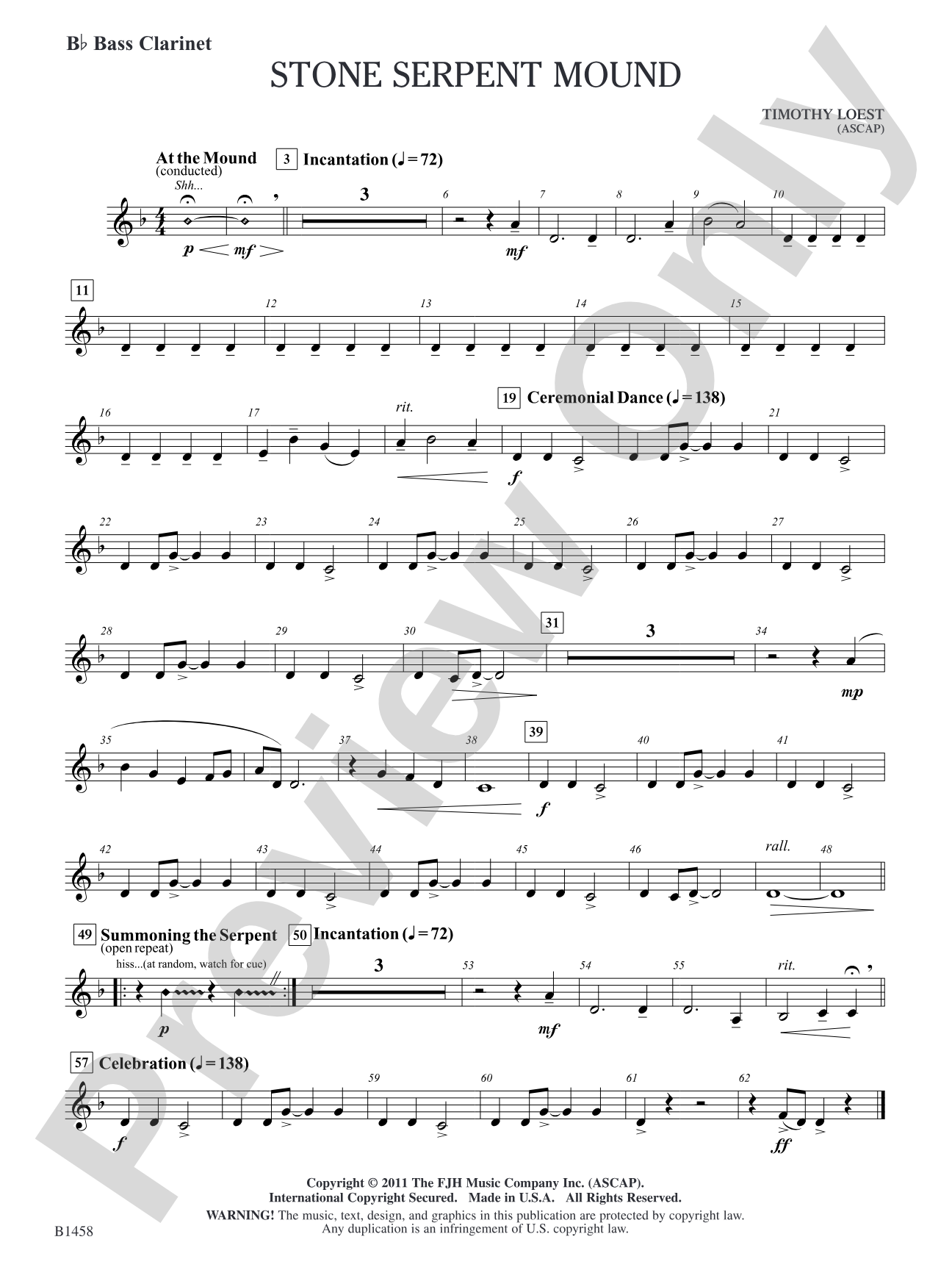

Stone Serpent Mound: B-flat Bass Clarinet
By Timothy Loest
Grade: 1.5
Item: 98-PC-DB1458_BC
$7.00
Pickup currently not available
Description
Embark on a mystical journey to a prehistoric stone serpent mound. This captivating programmatic work pays homage to Native American music and uses a wealth of intriguing sounds and innovative harmonies. A stunning opening sets the stage for the creative use of texture and harmony, as the main melody for the entire work surfaces just before the fast, dance-like section. A dark aleatoric passage features an eerie combination of trombone glissandi, shaking rattles and hissing snakes. Truly unique and stunning!


Stone Serpent Mound: B-flat Bass Clarinet isn't in MakeMusic Cloud just yet...but it could be. Let us know you'd like to see it, and you'll help shape what comes next. In the meantime, start a free trial and dive into thousands of interactive titles your students can play along with today.
Request This Title
Tell us you want it.
Start Your Free Trial
Explore everything that's ready to play right now.
Sample Audio
1
Audio File
--:--
0:00
0:00
Sample Video
No sample videos found.
Additional Details
Series:
FJH Developing Band
Publisher:
The FJH Music Company, Inc.
SKU:
98-PC-DB1458_BC
More about this title
About the Composer: Timothy Loest

Timothy Loest has built a career on writing music that meets young musicians where they are while refusing to compromise on artistic substance. His works have been performed by thousands of students across the country and have appeared on network television, from The Tonight Show Starring Jimmy Fallon to Good Morning America. In 2017, his composition Cloud Gate (Reflections of a City) reached over 5,000 spectators at Chicago's Millennium Park, and that same year he received the Illinois Grade School Music Association's Cloyd Myers Memorial Award for Excellence in Music Education.
With more than three decades spent teaching at F.E. Peacock Middle School in Illinois, Loest has shaped instrumental pedagogy through his work on bestselling band methods including Measures of Success: A Comprehensive Musicianship Band Method and Rhythms and Beyond. He founded Fanfare Music Press in 2022 to publish compositions and arrangements that prioritize both musicality and accessibility. His catalog spans publications from C.L. Barnhouse Company, FJH Music Company, and MakeMusic Publications, and he regularly accepts commissions. Loest holds degrees from Illinois State University and Northwestern University, maintains ASCAP membership, and continues to compose and arrange for bands of all levels.
Why we love this
Stone Serpent Mound succeeds because it tells a vivid story without overwhelming younger musicians. The grade 1.5 difficulty means your developing ensemble can handle real programmatic writing, complete with aleatoric sections and genuine harmonic color, rather than a simplified approximation. Directors appreciate how Loest balances accessibility with artistry, giving students something genuinely exciting to perform.
What to expect
Stone Serpent Mound evokes something primal and ceremonial. It opens with mystery and reverence, then shifts into an energetic, rhythmic dance that feels urgent and alive. The dark aleatoric section in the middle pulls you underground, into something ancient and unknowable, before the piece resolves with the same sense of discovery it began with.
Who it's for
Young concert bands in grades 5-7 ready to engage with programmatic music and contemporary compositional techniques. Students at this level benefit from having a concrete story to guide their interpretation, and this piece delivers that while building comfort with extended techniques and unconventional notation.
How to get the most out of it
- Shape the opening so it feels genuinely mysterious rather than simply soft; transparency matters more than volume in setting the ceremonial mood.
- The transition into the fast, dance-like section should feel purposeful and inevitable, not abrupt. Rehearse the tempo shift separately if needed.
- In the aleatoric passage, establish clear conducting patterns so players understand when to enter and exit despite the textural freedom; this builds confidence in an unfamiliar texture.
- Balance the trombone glissandi, rattles, and hissing sounds so each color registers distinctly without any one element drowning out the others.
How to use it
This works beautifully as an opener for a concert focused on American music or cultural themes. Pair it with other programmatic works to give audiences a thematic throughline, or program it mid-concert when student energy and focus are highest, since the demanding aleatoric section requires full ensemble attention.
Skills your students will build
- Interpreting programmatic music and connecting narrative to compositional choices
- Reading and performing aleatoric notation and unconventional textures
- Executing controlled glissandi and extended percussion techniques (rattles, hissing effects)
- Managing rapid tempo changes and maintaining ensemble cohesion through structural transitions
- Balancing independent melodic lines within a complex harmonic palette