
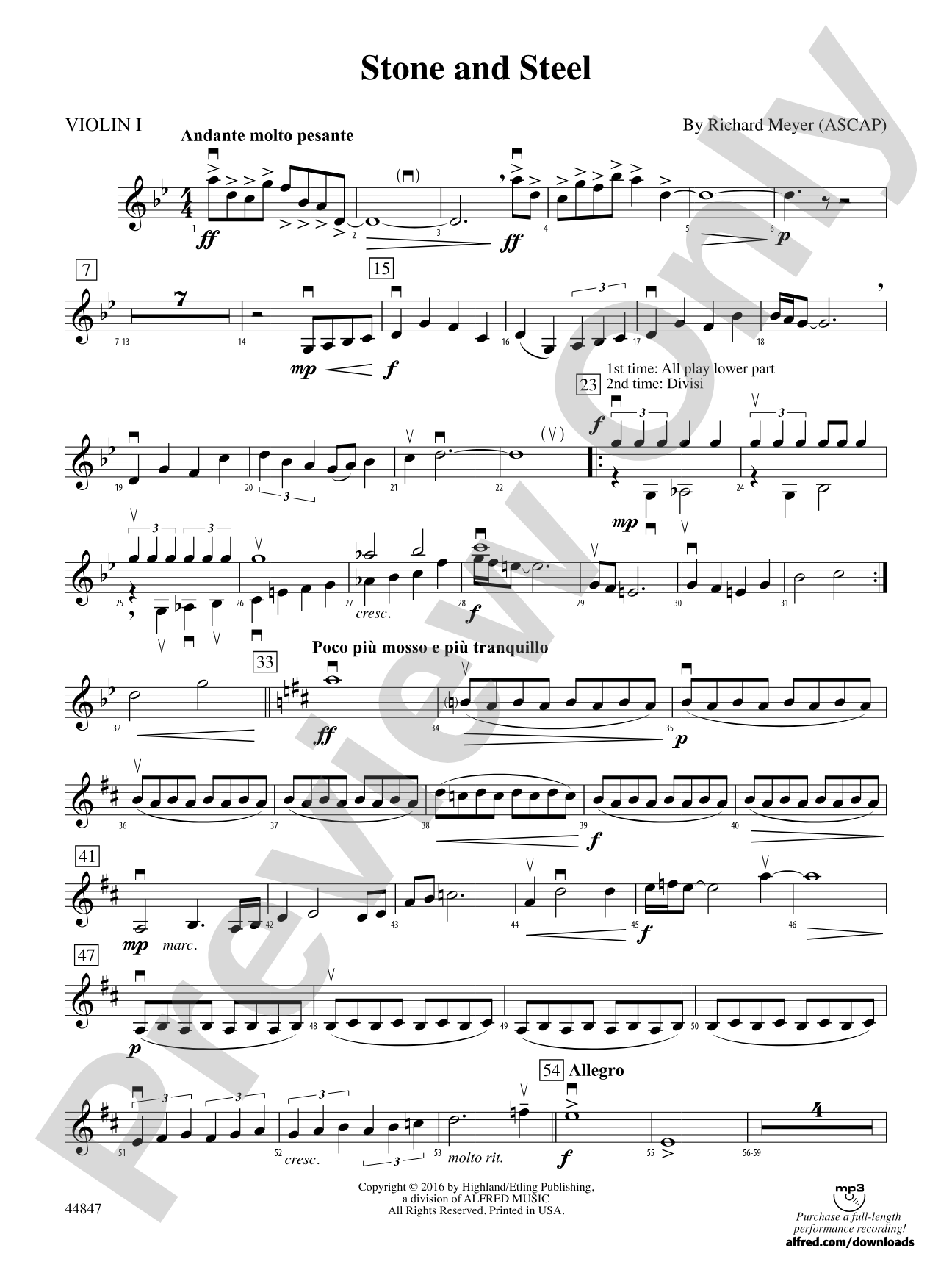

Stone and Steel: 1st Violin
By Richard Meyer
Grade: 3
Item: 00-PC-0017364_VN1
$5.99
Pickup currently not available
Description
Written to celebrate the 110th Anniversary of the Joliet Township High School Orchestras of Illinois, "Stone and Steel" is a modern concert overture by Richard Meyer that treats the listener and performer to a myriad of styles and moods.
The piece begins with a heavy, ponderous theme marked "Molto pesante," which depicts the limestone quarries that first earned Joliet the nickname "City of Stone" in the early 1800s. The mood soon changes and we can visualize huge barges laden down with stone, making their way through the city's large lift bridges and into the famous Illinois and Michigan Canal on their way to regional customers.
With the construction of a steel mill in 1869, Joliet became known as the "City of Steel." Stone and steel were now shipped by both canal and railroad, and this exciting new age is represented by a modern, fast-moving theme in a bright major key.
The two themes, "stone" and "steel," are then further developed, and the piece culminates in a majestic, celebratory final statement of the "steel" theme. (6:00)


The piece begins with a heavy, ponderous theme marked "Molto pesante," which depicts the limestone quarries that first earned Joliet the nickname "City of Stone" in the early 1800s. The mood soon changes and we can visualize huge barges laden down with stone, making their way through the city's large lift bridges and into the famous Illinois and Michigan Canal on their way to regional customers.
With the construction of a steel mill in 1869, Joliet became known as the "City of Steel." Stone and steel were now shipped by both canal and railroad, and this exciting new age is represented by a modern, fast-moving theme in a bright major key.
The two themes, "stone" and "steel," are then further developed, and the piece culminates in a majestic, celebratory final statement of the "steel" theme. (6:00)
Don't just read it, hear it, play along with it, and watch your students grow with it. In MakeMusic Cloud, Stone and Steel: 1st Violin comes alive with professional accompaniment, adjustable tempo, and built-in practice tools that turn solo practice into real progress.
Open in the Player
Jump straight in and assign it today.
Start Your Free Trial
Open this title and explore the full library in minutes.
Sample Audio
1
Audio File
--:--
0:00
0:00
Sample Video
Additional Details
Series:
Highland/Etling String Orchestra
Publisher:
Alfred Music
Page Count:
124
SKU:
00-PC-0017364_VN1
More about this title
About the Composer: Richard Meyer

Richard Meyer brings three decades of string education experience to his work as both conductor and composer. He spent 22 years directing orchestras at Oak Avenue Intermediate School in Temple City, California, expanding the program from 29 students to 200, while simultaneously overseeing the city's elementary string initiative. His "Giving Bach" program, launched in 2009, has earned national recognition for using interactive concerts to serve special needs and underserved students across Southern California.
Beyond the classroom, Meyer has guest-conducted All-State orchestras in multiple states and served as music director of the Pasadena Youth Symphony Orchestra for 16 years, leading them on international tours to Vienna, Australia, and Canada. As a composer, he has published over 190 works and arrangements; he also spent 16 years as string editor for Alfred Publishing Company and co-authored the widely adopted String Explorer Series and Sight-read It for Strings. He has been a featured clinician at the A.S.T.A. National Conference, Texas Orchestra Directors' Association Conference, and string workshops at Ohio State University.
Why we love this
Meyer understands exactly what Grade 3 orchestras can achieve musically and what will excite them to work hard. The piece swings between two distinct, memorable themes that give students something concrete to perform, build toward, and celebrate, while the historical context of Joliet's industrial transformation makes rehearsals feel purposeful beyond the notes on the page. It's the kind of concert piece that reminds students why they play.
What to expect
The opening settles into your chest with its heavy, quarry-like weight, then gradually shifts into bright momentum as you imagine barges moving through lift bridges and onto the canal. By the final section, the energy becomes genuinely triumphant, with both themes woven together in a way that feels earned and celebratory rather than bombastic.
Who it's for
String orchestras at the intermediate and early high school level looking for a piece that combines engaging storytelling, musical substance, and appropriate technical demands. Directors who want to program music that feels contemporary and historically rooted without requiring virtuosic technique.
How to get the most out of it
- Establish the weight of the "Molto pesante" opening by having the ensemble commit fully to the lower register; undersell the loudness and emphasize the thickness instead.
- Use the contrast between the two themes to create separate rehearsal focuses: treat the stone theme as foundational and grounded, the steel theme as rhythmically propulsive and bright.
- Balance the inner voices during theme development; many Grade 3 orchestras spotlight the melody and lose the harmonic color that Meyer's writing provides.
- Build the final celebratory statement by bringing all sections into the major-key steel theme together, then let the natural forward momentum carry the conclusion.
How to use it
Program this as the centerpiece of a concert exploring American industrial history or regional identity; it pairs naturally with other American works or local composers. It also works well as a contest or festival selection where the historical narrative and musical arc impress adjudicators, and the six-minute length fits standard competition time slots.
Skills your students will build
- Sustaining weight and tone in lower registers
- Contrast between pesante and bright articulations
- Clarity within harmonic textures during thematic development
- Balance and blend across multiple simultaneous musical lines
- Building momentum through rhythmic unison passages