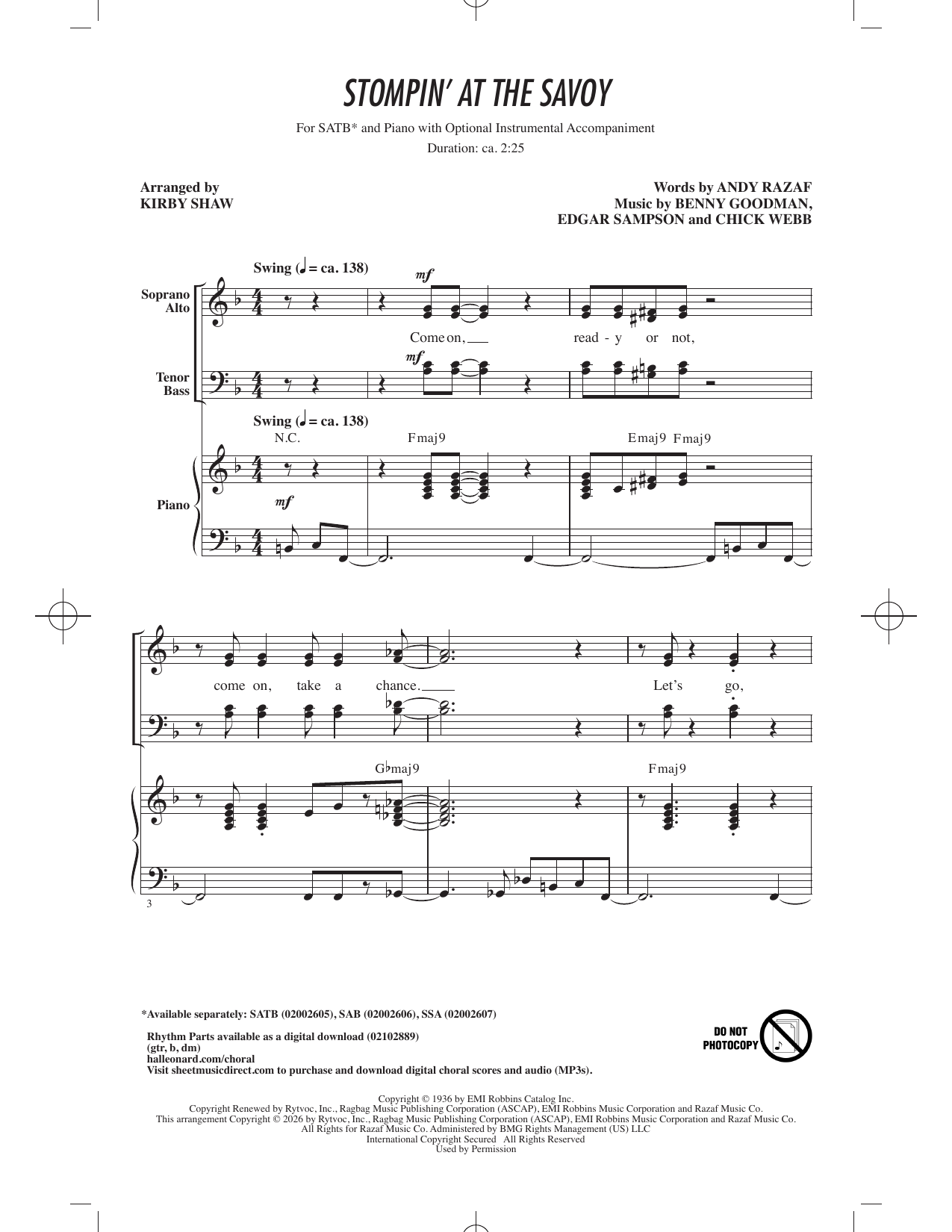
Stompin' At The Savoy (arr. Kirby Shaw): SATB Choral Octavo
Arranged by Kirby Shaw
Item: 35-DS01988248
Digital Download
$2.50
Minimum order quantity: 10 copies
Please note: Under U.S. copyright law, you must purchase the exact number of copies needed for your ensemble. Printing, duplicating or sharing additional copies is strictly prohibited.
Pickup currently not available
Description
Discover MakeMusic Cloud: thousands of interactive titles your students can play along with today.
Kirby Shaw's influence stretches across music education in North America and Europe, backed by advanced degrees in Music Education, Choral Composition, and Choral Conducting from San Jose State University and the University of Washington. His career spans decades of ensemble direction, from founding the celebrated COS Vocal Jazz Ensemble in California to building vocal jazz programs at Colorado State University and the University of Missouri at Kansas City. Currently directing the Jefferson State Choral Coalition at Southern Oregon University, Shaw brings both scholarly rigor and infectious energy to everything he teaches.
With over 2500 arrangements and compositions in print and nearly 20 million copies sold worldwide, Shaw has established himself as a leading voice in choral music. His collaborative scatting sessions with icons like Bobby McFerrin, Al Jarreau, and Jon Hendricks inform his arrangements with authentic jazz sensibilities. As a member of the a cappella ensemble Just 4 Kicks and a recent commission recipient from the Mormon Tabernacle Choir, Shaw continues to prove that prolific output and artistic integrity go hand in hand.
Why we love this
Shaw's work on this standard carries the fingerprints of someone who has spent a lifetime inside the vocal jazz idiom, not observing it from the outside. The arrangement sits in a sweet spot for mixed choirs: accessible enough for developing singers, yet sophisticated enough that experienced ensembles will find authentic swing vocabulary and voice leading that feels earned rather than simplified.
What to expect
Sophisticated and buoyant. The arrangement carries the energy of the Savoy Ballroom itself, that intersection of precision and loose groove where formality melts into pure joy. Singing this draws your choir into the language of swing, where every note lands with intention and lightness at once.
Who it's for
Choirs with a foundation in jazz vocabulary and rhythmic independence. Experienced high school vocal jazz ensembles, college mixed choirs, and community choruses looking to program a swinging standard will all find this arrangement rewarding.
How to get the most out of it
Focus on articulation within the jazz phrasing. The rhythm section groove only locks when singers commit to the syllable placement and rhythmic precision that swing style demands.
Record a section run-through and listen to balance. In a 10-page piece, it's easy for parts to drift toward melody dominance; this arrangement rewards equal presence across all voices.
Shape phrases around the lyrical content, not the bar lines. Jazz standards live and breathe when singers treat phrasing as speech-like conversation rather than metronomic exactness.
Let the accompaniment track guide tempo confidence. If your singers haven't internalized the swing feel, the recorded track becomes an anchor that keeps everyone in pocket.
How to use it
Pair this with other jazz standards to create a themed concert set, or tuck it into a longer program as a moment of stylistic brightness. The 10-page length and straightforward chord changes make it ideal for spring concerts or jazz-focused events when your ensemble has built some confidence with swing idiom.
Skills your students will build
Swing articulation and jazz phrasing vocabulary
Rhythmic independence and precision within ensemble groove
Voice leading and balance across a jazz harmony setting
Expressive interpretation within the constraints of a standard arrangement
Listening skills for harmonic movement in jazz context
You May Also Like
Scan to Complete Your Purchase
Use your phone's camera to scan the code below
You'll log in on your phone and the order will be added to your account