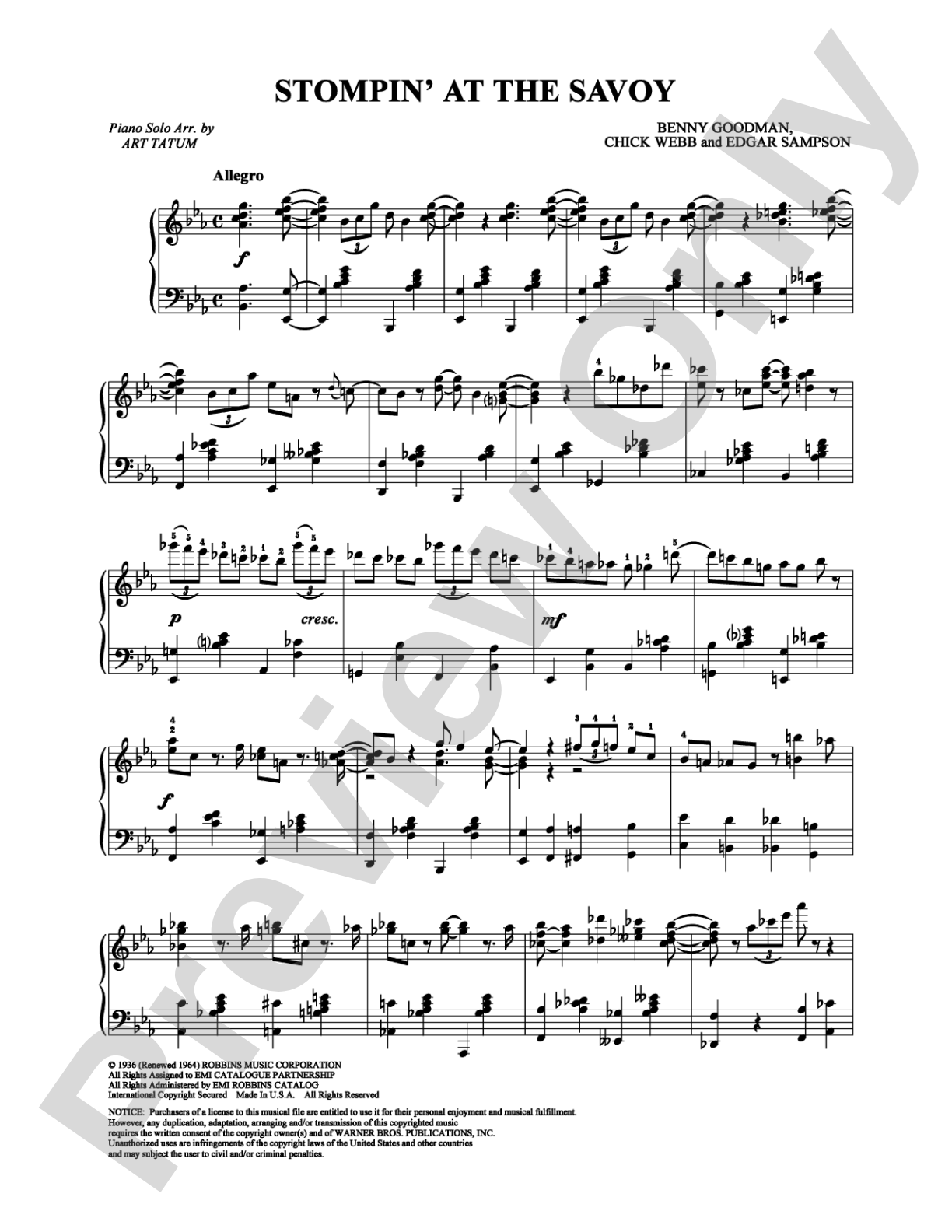
Stompin' At The Savoy: Piano Digital Sheet Music

Stompin' At The Savoy: Piano Digital Sheet Music

Chick Webb, Benny Goodman, Edgar Sampson, Art Tatum

Item: 00-PS-0007339

Digital Download
$3.99
Description

Stompin' At The Savoy: Piano Digital Sheet Music isn't in MakeMusic Cloud just yet...but it could be. Let us know you'd like to see it, and you'll help shape what comes next. In the meantime, start a free trial and dive into thousands of interactive titles your students can play along with today.

Sample Audio
No sample audio found.
Sample Video
Additional Details
SKU: 00-PS-0007339

More about this title

About the Artist: Art Tatum

Art Tatum (1909-1956) stands as one of the most technically accomplished and harmonically inventive pianists in jazz history. His virtuosic command of the keyboard, lightning-fast runs, and sophisticated reharmonization of standards fundamentally changed what pianists thought possible at the instrument, influencing generations of jazz and classical musicians alike.

Why we love this

Tatum's solo piano arrangement of this Savoy-era swing standard showcases the kind of improvisational sophistication that makes jazz piano endlessly rewarding to study. His reharmonizations and rhythmic flexibility offer pianists a masterclass in transforming a melody through harmonic invention while maintaining its essential character.

What to expect

Propulsive yet sophisticated, with the casual swagger of a master improviser at work. Tatum threads intricate right-hand figures over a driving stride bass, creating an exhilarating sense of forward momentum tempered by surprising harmonic turns and moments of reflective phrasing.

Who it's for

Advanced jazz pianists and serious students pursuing transcription study and solo repertoire in the swing tradition. This arrangement rewards pianists with strong harmonic knowledge and technical fluency who want to deepen their understanding of Tatum's approach to standard interpretation.

How to get the most out of it

  • Listen closely to how Tatum voices chords across octaves; the spacing creates clarity even at rapid tempos and builds the swinging groove.
  • Work through the piece at slow tempo first, isolating the left hand's stride patterns and comping rhythms before attempting full tempo.
  • Allow rubato in the introductory passages and wherever Tatum cadences; the written notes don't capture his sophisticated sense of timing and phrasing.
  • Focus on the bass line's rhythmic propulsion as your anchor; the right hand's elaborate passagework sits more comfortably when the foundation is locked.

How to use it

Feature this as a solo jazz piano number on a jazz showcase or concert featuring standards. It also functions beautifully as a teaching performance, play it for students studying jazz history or improvisation to demonstrate how a master musician approaches a familiar melody. Consider pairing it with other Tatum recordings to build a mini-unit on jazz piano evolution.

Skills your students will build

  • Stride bass technique and left-hand independence
  • Harmonic reharmonization and upper-structure voicing
  • Swing rhythm and triplet-based phrasing
  • Fast scalar and arpeggio passages in jazz context
  • Transcription skills through learning by ear and from notation

You May Also Like