
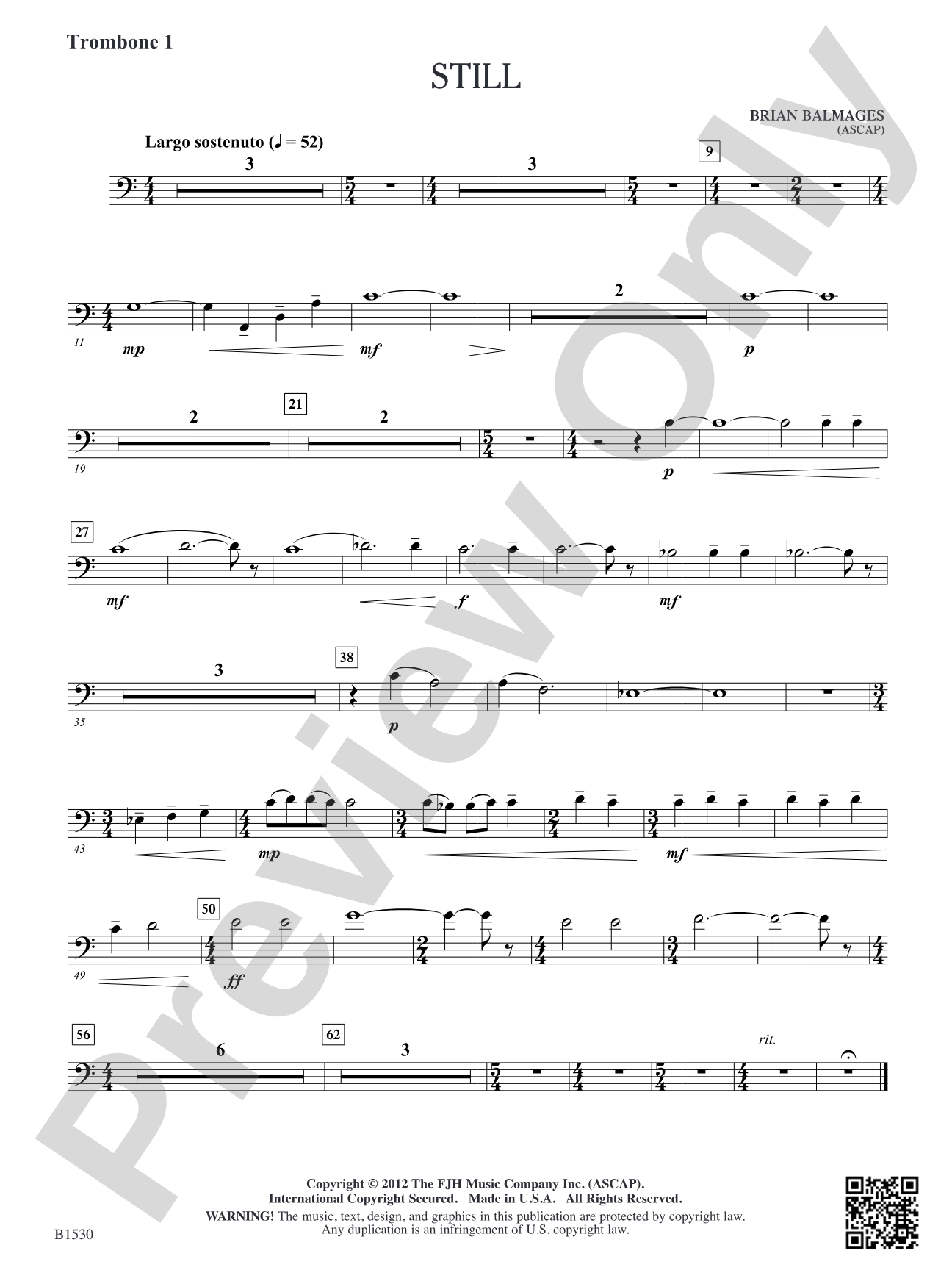

Still: Trombone 1
By Brian Balmages
Grade: 4
Item: 98-PC-DB1530_TN1
$7.00
Pickup currently not available
Description
This emotional escape ushers the listener into a world of slow motion and tranquility, where one can take a moment to stop and catch his breath. Complex harmonies seamlessly overlap with rising and falling expressions of longing. A breathtaking climax stuns the listener before an aura of calm takes over, reminding everyone to stop and take a moment. This piece is certain to find a special place in your heart.


Still: Trombone 1 isn't in MakeMusic Cloud just yet...but it could be. Let us know you'd like to see it, and you'll help shape what comes next. In the meantime, start a free trial and dive into thousands of interactive titles your students can play along with today.
Request This Title
Tell us you want it.
Start Your Free Trial
Explore everything that's ready to play right now.
Sample Audio
1
Audio File
--:--
0:00
0:00
Sample Video
No sample videos found.
Additional Details
Series:
FJH Symphonic Band
Publisher:
The FJH Music Company, Inc.
SKU:
98-PC-DB1530_TN1
More about this title
About the Composer: Brian Balmages

Brian Balmages has established himself as a prolific composer and conductor working across orchestral, band, and chamber repertoire. His works have been heard in some of the world's most prestigious venues, from Carnegie Hall to the Sydney Opera House, performed by ensembles ranging from professional orchestras to school groups. He was awarded the A. Austin Harding Award from the American School Band Directors Association and won the 2020 NBA William D. Revelli Composition Contest for Love and Light. An elected member of the American Bandmasters Association, Balmages also received the inaugural James Madison University Distinguished Alumni Award from the School of Visual and Performing Arts.
As a conductor, Balmages maintains active relationships with all-state and regional ensembles worldwide, and his guest conducting appearances span major conferences including the Midwest Clinic and Western International Band Clinic. His music was performed at the 2013 Presidential Inaugural Prayer Service, and he was commissioned by the University of Miami to compose for the inauguration of the institution's president. Currently serving as Director of MakeMusic Publications and Digital Education for Alfred and MakeMusic, Balmages continues to shape the landscape of contemporary wind band music.
Why we love this
Still demonstrates Balmages's gift for emotional architecture in large ensemble writing. The piece balances expressive vulnerability with sophisticated harmonic language, creating a moment of genuine reflection that resonates deeply with audiences while remaining accessible to Grade 4 ensembles. Its carefully structured arc from introspection through climax and back to stillness gives conductors a powerful programming tool for concerts that need musical and emotional weight.
What to expect
Still invites listeners into a suspended moment where time seems to slow and expand. Complex harmonies drift and overlap, creating gentle tensions that resolve into moments of longing, building toward a stunning emotional peak before settling into profound calm and restoration.
Who it's for
Grade 4 concert bands seeking repertoire with genuine emotional depth and musical substance. This work suits ensembles that have developed solid fundamentals in blend, intonation, and phrase control and are ready to explore more nuanced expressive concepts.
How to get the most out of it
- Balance the overlapping harmonies by identifying the primary melodic line in each section and allowing other voices to support rather than compete; use sectional rehearsals to clarify voicing relationships before combining full band
- Shape the phrase contours deliberately, resisting the urge to rush into the emotional climax; let the rising expressions of longing build gradually and organically
- Cultivate a warm, focused sound during the slower passages by emphasizing resonant vowels in sustained sections and maintaining consistent air support across phrase boundaries
How to use it
Program Still as a centerpiece concert moment, particularly for spring or year-end concerts where you want to shift audience energy and create space for reflection. It pairs naturally with more robust or energetic works, providing crucial programming contrast and demonstrating your ensemble's interpretive range.
Skills your students will build
- Phrasing and shape in slow, lyrical writing
- Balance and blend in complex harmonic textures
- Sustained tone quality and dynamic control
- Responding to subtle conductor cueing for emotional expression
- Intonation precision in sustained harmonies