
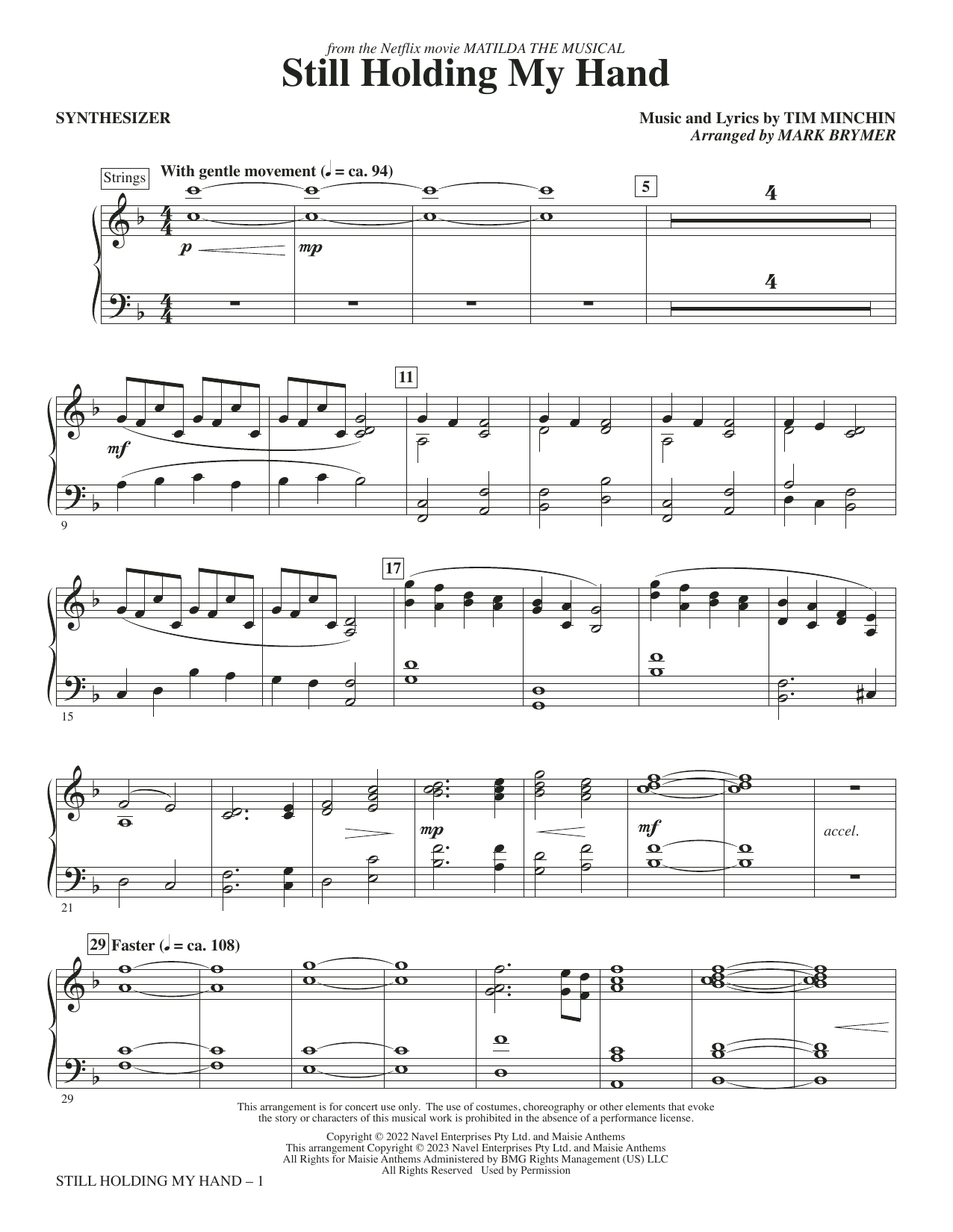

Still Holding My Hand (from Matilda The Musical) (arr. Mark Brymer): Choral Instrumental Pak
By Tim Minchin / Arranged by Mark Brymer
Item: 35-PK01318721
$28.00
Pickup currently not available
Buy Extra Parts (Digital PDF Download)
Parts Added to Cart!
Description
The character Matilda, after debuting with humble beginnings in Roald Dahl's 1988 children's novel, has seen an audio adaptation, a feature film, a radio program, a West End/Broadway musical, and finally a film adaptation of the aforementioned musical. The movie dropped on Netflix in 2022 and featured a brand new song from the original composer Tim Minchin. This fantastic new closing song starts small and builds into an enormous and positively extraordinarily cathartic explosion of choral voices!


Still Holding My Hand (from Matilda The Musical) (arr. Mark Brymer): Choral Instrumental Pak isn't in MakeMusic Cloud just yet...but it could be. Let us know you'd like to see it, and you'll help shape what comes next. In the meantime, start a free trial and dive into thousands of interactive titles your students can play along with today.
Request This Title
Tell us you want it.
Start Your Free Trial
Explore everything that's ready to play right now.
Sample Audio
No sample audio found.
Sample Video
No sample videos found.
Additional Details
Publisher:
Hal Leonard
SKU:
35-PK01318721
More about this title
About the Composer: Tim Minchin
Tim Minchin is a singer-songwriter and composer who has become known for blending comedy, storytelling, and genuine musical sophistication across theatrical and musical projects. His work on the Matilda musical, which debuted in the West End before transferring to Broadway, established him as a major voice in contemporary musical theater, earning widespread critical acclaim for his ability to write music that speaks authentically to both children and adults.
Why we love this
This arrangement captures the emotional architecture of a closing song perfectly: it honors the intimate simplicity of the melody while giving your choir the space to build toward something genuinely moving. Mark Brymer's orchestration respects the original while making it accessible for educational ensembles, and the payoff in the final chorus justifies every moment of restraint that comes before it.
What to expect
There's tenderness in the opening that captures Matilda's quiet resilience, then a gradual unfurling of hope as more voices join. By the final section, you're swept up in something joyful and defiant, a full-throated celebration of her journey. It's the kind of piece that leaves audiences moved without ever feeling manipulative.
Who it's for
Choirs looking for a contemporary closing number that lands emotionally without requiring a massive pit or complicated staging. This works equally well for high school groups, church choirs, or community ensembles seeking music that connects with audiences familiar with the Matilda film but appeals broadly to listeners who've never seen it.
How to get the most out of it
- Resist the urge to rush the opening sections. The power of this arrangement lives in the contrast between the vulnerable beginning and the full-voiced climax, so establish a clear tempo early and hold it steady through the buildup.
- Shape the dynamic arc with intention across the entire piece. Mark specific points where individual voice parts enter or the texture thickens, and rehearse those transitions so they feel organic rather than mechanical.
- Pay close attention to any divisi writing in the ensemble sections. Clean voice part independence during the explosive moments will create clarity rather than muddy volume.
How to use it
Save this for your spring concert finale or graduation ceremony, where it can serve as a powerful emotional anchor for the evening. The familiarity of the source material will draw listeners in immediately, while the arrangement's sophistication keeps it from feeling like a novelty or novelty cover.
Skills your students will build
- Sustaining tone quality through dynamic transitions from soft to full voice
- Balancing individual voice part independence within larger harmonic structures
- Phrasing across longer melodic lines that build cumulative emotional weight
- Responding to textural changes when new voice parts or accompaniment layers enter