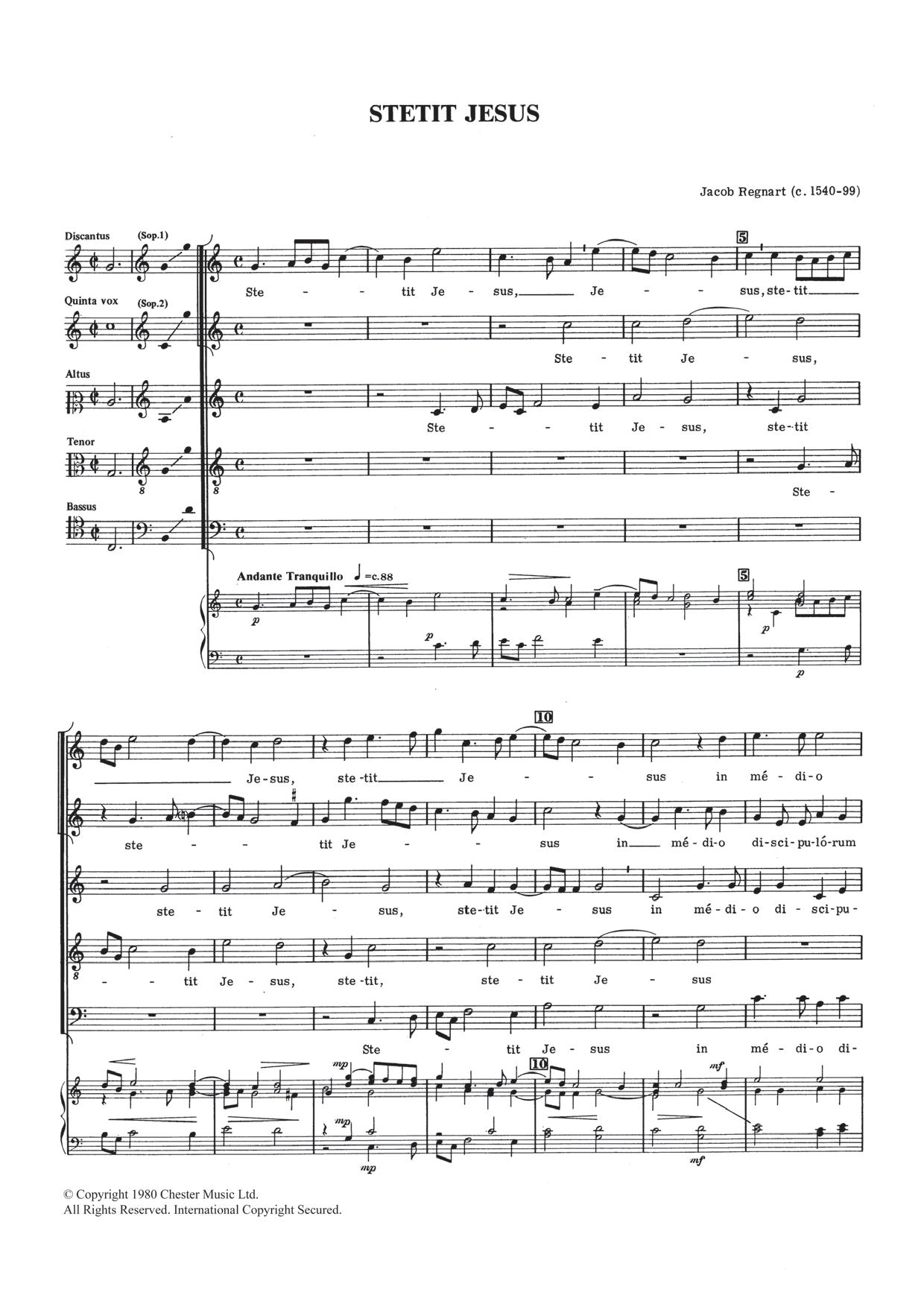
Stetit Jesus Sheet Music Preview

Stetit Jesus: SATB Choral Octavo

As performed by Jacob Regnart

Item: 35-DS00366736

Digital Download
$2.99
Description

Stetit Jesus: SATB Choral Octavo isn't in MakeMusic Cloud just yet...but it could be. Let us know you'd like to see it, and you'll help shape what comes next. In the meantime, start a free trial and dive into thousands of interactive titles your students can play along with today.

Sample Audio
No sample audio found.
Sample Video
Additional Details
Publisher: Hal Leonard
Page Count: 5
SKU: 35-DS00366736

More about this title

About the Artist: Jacob Regnart

Jacob Regnart (c. 1540-1599) was a Flemish composer active during the Renaissance whose motets and sacred works circulated widely across northern Europe. He served as a court musician in Vienna and was known for his mastery of polyphonic writing and his ability to set texts with clarity and expressive depth. His choral works remain valuable for ensemble singers seeking substantial yet manageable Renaissance repertoire.

Why we love this

Regnart's setting achieves remarkable textural clarity despite its polyphonic density, making it an ideal bridge between simple sacred works and more complex Renaissance counterpoint. The piece sits comfortably for mixed voices and rewards careful attention to phrase shaping without requiring virtuosic demands. Programming this alongside works by Palestrina or Victoria fills a meaningful space in the Renaissance choral canon.

What to expect

The music carries the weight of the text with understated dignity, moving through carefully voiced harmonic progressions that feel both inevitable and gently surprising. Moments of textural transparency emerge naturally from the polyphonic weave, creating pockets of luminosity that make the work feel both intricate and emotionally direct.

Who it's for

This octavo works well for SATB choirs with secure music reading skills and familiarity with Renaissance style. It suits both advanced high school ensembles and college/community choirs seeking repertoire that balances accessibility with substantive musical content.

How to get the most out of it

  • Shape phrases by recognizing that text underlay often indicates natural breathing points; resist the urge to rush through melismatic sections even when passages feel dense.
  • Balance the inner voices clearly so that the harmonic progression supports rather than obscures the soprano line, especially during points of imitation.
  • Consider the character as reflective rather than dramatic; a restrained dynamic approach (allowing pp to mf rather than full forte) honors the contemplative text.

How to use it

Place this as part of a thematic sacred program centered on Palm Sunday or Holy Week observance, or feature it alongside other Renaissance settings of the same text for an evening exploring varied compositional approaches to liturgical material. Its moderate length and accessibility make it an excellent concert opener that establishes musical sophistication without overextending rehearsal resources.

Skills your students will build

  • Renaissance polyphonic texture and part independence
  • Text-driven phrase shaping and breathing in through-composed works
  • Harmonic analysis of functional harmony in modal contexts
  • Balancing ensemble blend while maintaining individual line clarity

You May Also Like