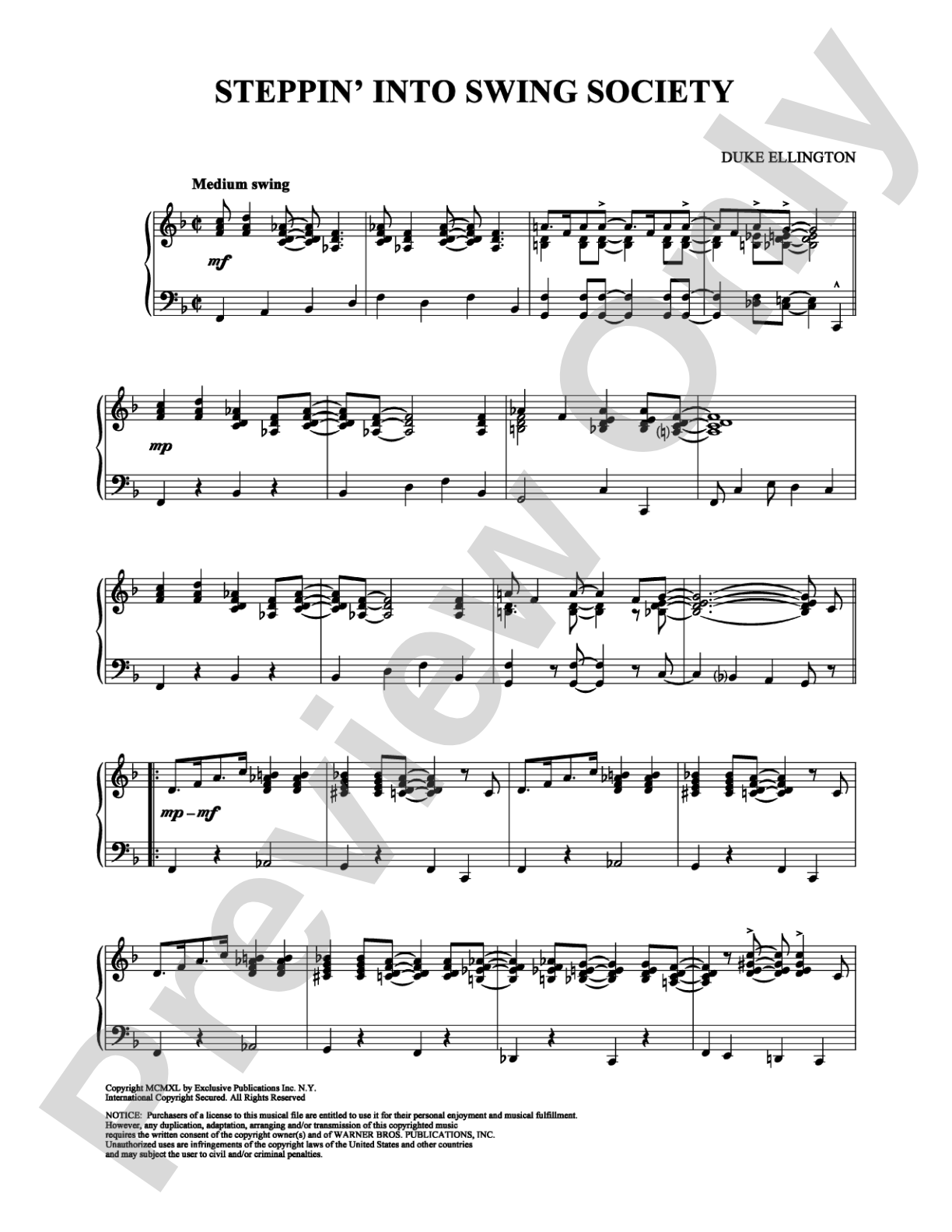
Steppin' Into Swing Society: Piano Digital Sheet Music

Steppin' Into Swing Society: Piano Digital Sheet Music

Duke Ellington

Item: 00-PS-0008213

Digital Download
$3.99
Description

Steppin' Into Swing Society: Piano Digital Sheet Music isn't in MakeMusic Cloud just yet...but it could be. Let us know you'd like to see it, and you'll help shape what comes next. In the meantime, start a free trial and dive into thousands of interactive titles your students can play along with today.

Sample Audio
No sample audio found.
Sample Video
Additional Details
SKU: 00-PS-0008213

More about this title

About the Artist: Duke Ellington

Duke Ellington (1899-1974) stands as one of the most prolific and influential composers in American music history. His output spanned five decades and included hundreds of compositions that moved fluidly between jazz standards, extended concert works, and film scores, each bearing his unmistakable harmonic sophistication and orchestral imagination.

Ellington's approach to composition fundamentally shaped how musicians understood the piano's role in jazz. His use of block chords, chromatic voice leading, and unexpected harmonic substitutions became models for generations of jazz pianists. Educators value his music not only for its artistic merit but for the way it demonstrates that serious compositional craft and popular accessibility are not mutually exclusive.

Why we love this

Ellington's compositions teach jazz piano through listening and imitation in a way no method book can match. The harmonic language here rewards close attention to voice leading and substitution, making it an excellent vehicle for pianists ready to understand jazz as a written art form rather than purely by ear.

What to expect

Sophisticated and urbane, with the kind of easy elegance that masks considerable harmonic complexity. The piece swings naturally when the rhythmic feel is right, and the voicings sit comfortably under the hands once learned.

Who it's for

Jazz pianists working to build repertoire beyond lead sheets and fake books will find substantial material here. This is equally valuable for classical pianists exploring jazz vocabulary and music theory students examining how Ellington constructs harmony.

How to get the most out of it

  • Honor the written harmonies rather than defaulting to simplified voicings; Ellington's chord choices are deliberate and often contain the melody within them.
  • Shape the phrasing across measures rather than note-to-note; swing jazz prose requires breathing room and forward momentum.
  • Listen to multiple recorded versions to understand how tempo, touch, and dynamics can reshape the piece without altering the notation.
  • Practice left-hand patterns separately, paying attention to how the bass movement supports harmonic clarity.

How to use it

Feature this in a jazz recital or mixed-repertoire concert where Ellington's writing can anchor a set of standards from the same era. It also serves well as a teaching piece in studio lessons focused on jazz harmony and interpretation.

Skills your students will build

  • Reading and interpreting jazz chord voicings and harmonic substitutions
  • Executing swing articulation and rhythmic feel on the piano
  • Understanding voice leading within jazz harmonies
  • Developing left-hand independence and bass movement awareness
  • Interpreting written jazz notation and making stylistically informed choices

You May Also Like