
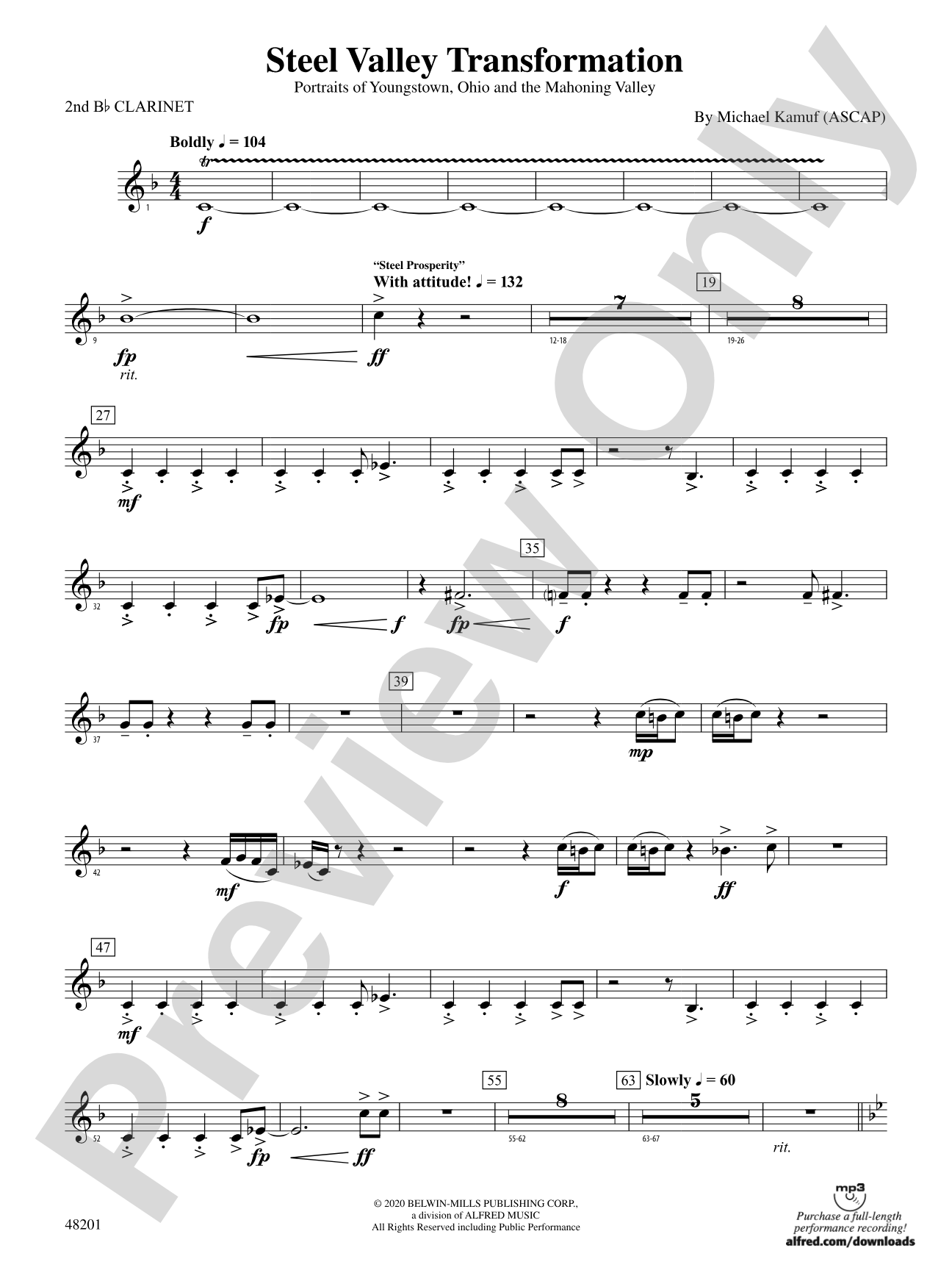

Steel Valley Transformation: 2nd B-flat Clarinet
Portraits of Youngstown, Ohio and the Mahoning Valley
By Michael Kamuf
Grade: 3.5 (Medium)
Item: 00-PC-0018558_C2
$3.00
Pickup currently not available
Description
With a driving energy, the punctuated percussion contribution is powerful. This original concert work celebrating the grit and resolve of Ohio's Mahoning Valley community over the past century is a perfect concert or festival choice to show off your ensemble's ability to play expressively while having fun! Majestic! (6:30) This title is available in MakeMusic Cloud.


Don't just read it, hear it, play along with it, and watch your students grow with it. In MakeMusic Cloud, Steel Valley Transformation: 2nd B-flat Clarinet comes alive with professional accompaniment, adjustable tempo, and built-in practice tools that turn solo practice into real progress.
Open in the Player
Jump straight in and assign it today.
Start Your Free Trial
Open this title and explore the full library in minutes.
Sample Audio
1
Audio File
--:--
0:00
0:00
Sample Video
Additional Details
Series:
Belwin Concert Band
Publisher:
Alfred Music
Page Count:
272
SKU:
00-PC-0018558_C2
More about this title
About the Composer: Michael Kamuf

Michael Kamuf earned degrees in Jazz Performance and Music Education from the Dana School of Music at Youngstown State University, followed by a Master of Arts in Instrumental Conducting from George Mason University. His compositions and arrangements have been performed by prestigious ensembles including the Woody Herman and Glenn Miller Orchestras, the USAF Airmen of Note, the US Navy Commodores, and soloists such as James Moody, Eddie Daniels, and Sean Jones. He is an exclusive writer for the Belwin Division of Alfred Music Publishing, with over 100 publications across jazz, orchestra, and concert band catalogs.
Kamuf taught instrumental music in Montgomery County Public Schools for thirty years, serving as Director of Bands and Orchestras and Music Department Chairperson at John T. Baker Middle School in Damascus, Maryland. Under his leadership, the Baker ensembles earned consistent high ratings at festivals and commissioned numerous works for young concert bands. He currently leads the Mike Kamuf Little Big Band, a jazz octet featuring musicians from the Baltimore and Washington, DC regions.
Why we love this
Kamuf writes concert band music that respects the skill level of developing ensembles while refusing to compromise on compositional substance. The percussion writing here is genuinely interesting (not decorative), the thematic material is strong enough to sustain six and a half minutes, and the piece has a clear narrative arc that gives your students something meaningful to shape rather than just play through.
What to expect
Driving and purposeful, with a grit that comes from the relentless rhythmic energy in the percussion section and the forward momentum of the melodic lines. The piece balances majesty with accessibility, building moments of genuine power without losing sight of clarity and expression.
Who it's for
Concert bands at the upper middle school and early high school level, as well as festival-bound ensembles looking for original repertoire with regional or community relevance. This work gives developing bands a chance to tackle substantive compositional writing while celebrating themes of resilience and collective identity.
How to get the most out of it
- Build the intensity gradually through the first two minutes rather than hitting full volume immediately; this allows the ensemble to settle into the driving rhythmic foundation and gives the percussion line room to cut through.
- Balance the melodic voices carefully when they sit above the rhythmic pulse; at grade 3.5, intonation tends to suffer when students are concentrating on blend, so rehearse those sections slowly and in isolated parts first.
- Let the percussion section feel confident and secure in their rhythmic role; they are carrying the heartbeat of this piece, so lock in with them during sectionals before bringing the full ensemble together.
- Shape the climactic moments by preparing dynamic transitions well in advance; mark and rehearse the breath points where energy shifts, so the band understands where the music is moving next.
How to use it
Program this as a centerpiece for a concert exploring American themes, particularly one highlighting local or regional history. At six and a half minutes, it can anchor a half or full concert program and works equally well in a festival setting where judges appreciate original works that showcase ensemble cohesion and rhythmic precision.
Skills your students will build
- Maintaining steady rhythmic pulse while balancing independent melodic lines
- Expressive dynamic control within a moderate range (avoiding extremes while still achieving impact)
- Precision in articulation, especially in punctuated rhythmic passages
- Listening to and locking in with percussion as a rhythmic anchor
- Sustaining focus and ensemble sound over an extended concert work