
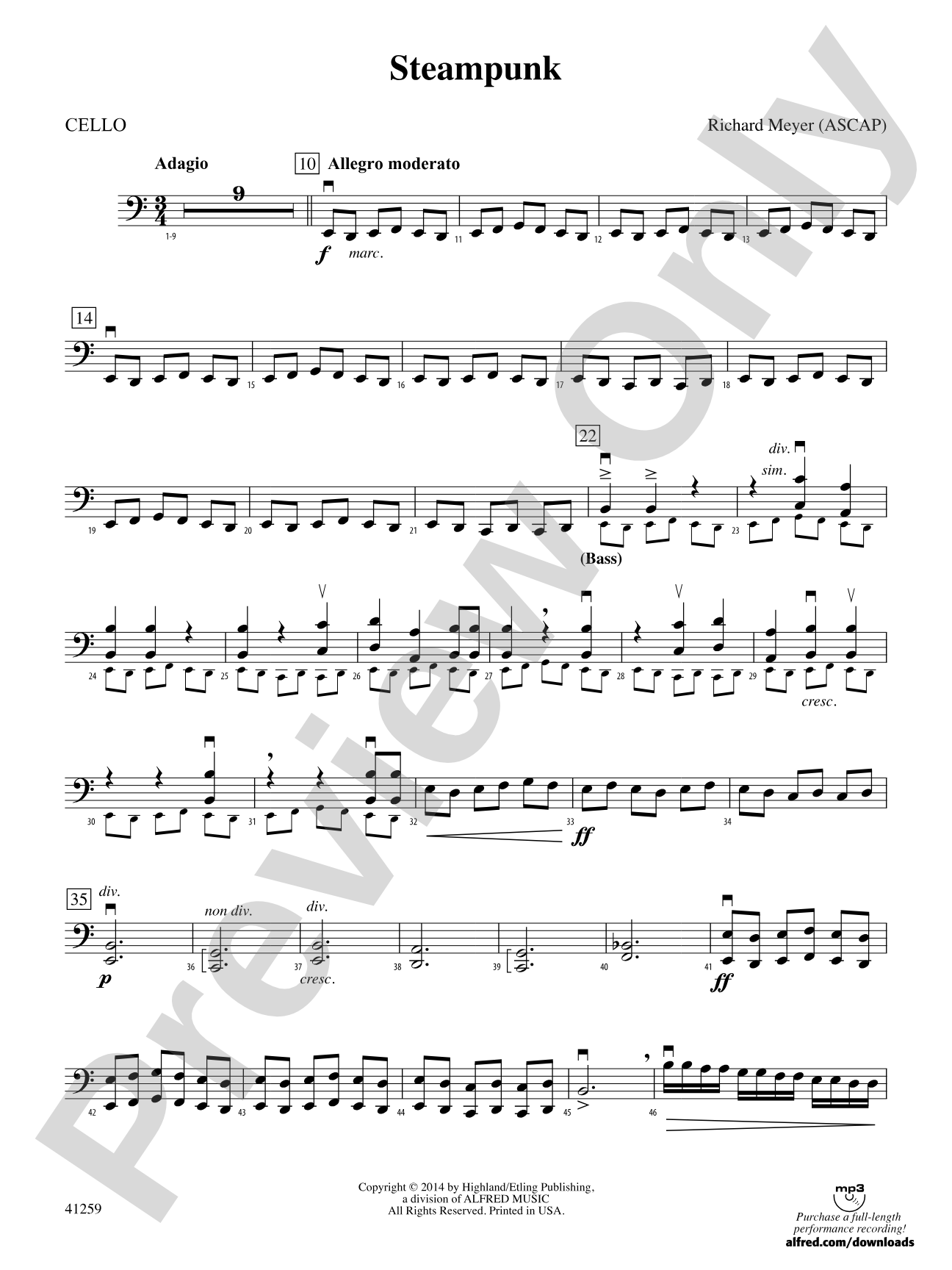

Steampunk: Cello
By Richard Meyer
Grade: 3.5
Item: 00-PC-0016376_VC1
$5.99
Pickup currently not available
Description
The word "steampunk" refers to a genre of science fiction that features steam-powered machinery. Works of fiction in this style are most often set in the 19th century British Victorian era or the American Wild West. Machines and technology found in the works of Jules Verne and H.G. Wells would be good examples of steampunk-style inventions. The piece itself follows no specific narrative, but rather is meant to capture the spirit and mood of this hearty, highly imaginative, industrial-based movement. (5:00) This title is available in MakeMusic Cloud.


Don't just read it, hear it, play along with it, and watch your students grow with it. In MakeMusic Cloud, Steampunk: Cello comes alive with professional accompaniment, adjustable tempo, and built-in practice tools that turn solo practice into real progress.
Open in the Player
Jump straight in and assign it today.
Start Your Free Trial
Open this title and explore the full library in minutes.
Sample Audio
1
Audio File
--:--
0:00
0:00
Sample Video
No sample videos found.
Additional Details
Series:
Highland/Etling String Orchestra
Publisher:
Alfred Music
Page Count:
132
SKU:
00-PC-0016376_VC1
More about this title
About the Composer: Richard Meyer

Richard Meyer spent 35 years teaching strings across elementary, middle, and high school levels in public schools. At Oak Avenue Intermediate School in Temple City, California, he built the orchestral program from 29 students to 200 and oversaw the city's elementary string curriculum for 22 of those years. He also directed the Pasadena Youth Symphony Orchestra for 16 years, taking them on performance tours to New York, Washington D.C., Vienna, Australia, and Canada.
Beyond the classroom, Meyer has become a nationally recognized composer with nearly 200 works and arrangements published. He served as string editor for Alfred Publishing Company and co-authored the widely used String Explorer Series and Sight-read It for Strings. In 2009, he launched the "Giving Bach" program at his school, an initiative that earned national recognition for using interactive concerts to reach special needs and underserved students throughout Southern California. He has clinicked at the A.S.T.A. National Conference, Texas Orchestra Directors' Association Conference, and regional workshops across the country.
Why we love this
Meyer captures the visual drama of steampunk without relying on programmatic storytelling or complex narrative scaffolding. The Grade 3.5 orchestration manages genuine industrial atmosphere through rhythmic drive and orchestral color rather than technical pyrotechnics, making it accessible for developing orchestras while remaining engaging for more experienced groups. It works equally well as a concert opener or festival selection, and the five-minute duration fits neatly into any program.
What to expect
Steampunk captures the clatter and energy of 19th-century invention without descending into cartoon parody. Rhythmic ostinatos and orchestral color evoke the visual splendor of Jules Verne's imagined machines, propelled by an industrial heartbeat that powers the entire work. The atmosphere is imaginative and brassy in spirit even when the instrumentation is purely strings.
Who it's for
Middle and high school string orchestras at the intermediate level, as well as advanced elementary orchestras ready for Grade 3.5 literature. Directors seeking a novelty title that has substance and works in both concert and festival settings will find this particularly useful. The piece engages students who connect with contemporary concepts while maintaining strong musical value.
How to get the most out of it
- Emphasize the mechanical, pulsing quality of the rhythmic figures; they should feel steady and relentless, like machinery in motion, rather than elastic or rubato
- Balance the various instrumental colors as they trade thematic material; younger orchestras often submerge inner parts, so highlight second violins and violas when they carry lines
- Use dynamics as a tool to build the "industrial" character; the piece gains impact through contrast between driving passages and momentary breathing space
- Lock the tempo and maintain it throughout; the novelty element depends on rhythmic consistency and the cumulative effect of repeated figures
How to use it
Program this as a concert opener to establish energy and personality from the opening notes, or as a festival selection that stands apart from traditional classical repertoire while demonstrating strong musicianship. It pairs well with classical core literature in a mixed program, offering students and audiences a refreshing change of pace without sacrificing musical integrity.
Skills your students will build
- Maintaining steady rhythmic pulse within repetitive ostinato patterns
- Balancing multiple melodic lines occurring simultaneously across the string section
- Creating orchestral color and character through coordinated dynamic shaping
- Articulation clarity in rapid passage work
- Listening for inner voice independence rather than doubling