
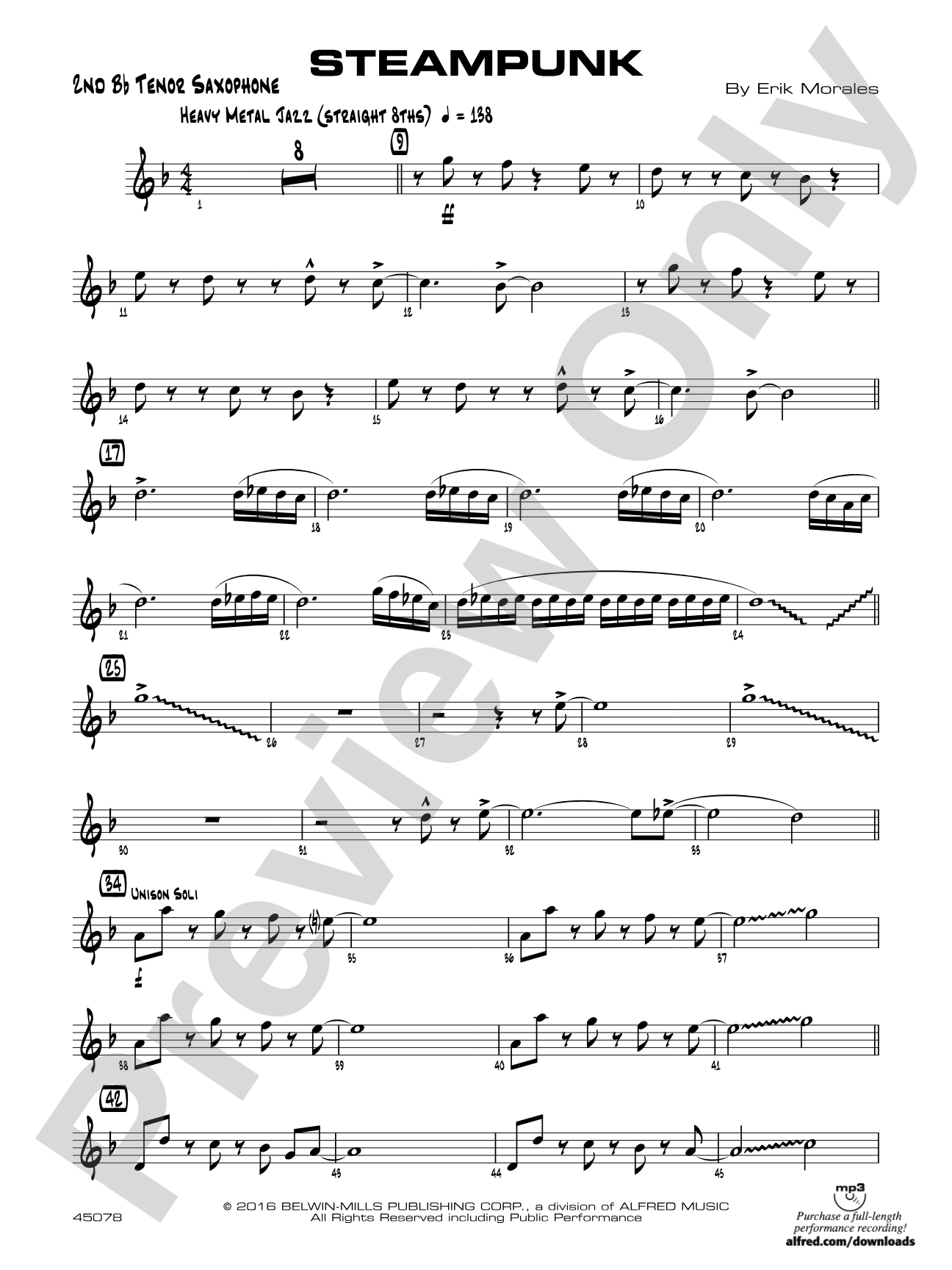

Steampunk: 2nd B-flat Tenor Saxophone
By Erik Morales
Grade: 3.5 (Medium)
Item: 00-PC-0017487_TX2
$3.00
Pickup currently not available
Description
Heavy metal big band! Guitar is the featured solo instrument in this very cool chart so if you, the band, and your drummer dig a rock vehicle to wake everyone up---"Steampunk" by Erik Morales is it. Lead trumpet range only to written G on top of the staff. A suggested written guitar solo is provided if needed. Totally exciting and a great tune for guitar and big band! (5:43)


Don't just read it, hear it, play along with it, and watch your students grow with it. In MakeMusic Cloud, Steampunk: 2nd B-flat Tenor Saxophone comes alive with professional accompaniment, adjustable tempo, and built-in practice tools that turn solo practice into real progress.
Open in the Player
Jump straight in and assign it today.
Start Your Free Trial
Open this title and explore the full library in minutes.
Sample Audio
1
Audio File
--:--
0:00
0:00
Sample Video
Additional Details
Series:
Jazz Band Series
Publisher:
Alfred Music
Page Count:
102
SKU:
00-PC-0017487_TX2
More about this title
About the Composer: Erik Morales

Erik Morales (born 1966 in New York City) brings a distinctive approach to melody and harmony across classical, jazz, and commercial idioms. His catalog exceeds 150 published works spanning wind, orchestral, jazz, and chamber ensembles, performed by musicians worldwide. Morales studied composition at Florida International University and earned his bachelor's degree from the University of Louisiana, Lafayette (1989), launching his professional career shortly after high school when a former band director commissioned arrangements for marching band in 1985.
As a trumpet player, Morales has made substantial contributions to trumpet literature. His trumpet ensembles earned first-place honors at the 2006 and 2008 National Trumpet Competitions, and his Concerto for Trumpet in C and Piano premiered at the 2009 International Trumpet Guild conference. A 2012 consortium commission resulted in the Concerto for Two Trumpets, premiered at the 2013 ITG conference. In 2016, he was inducted into the Louisiana Association for Jazz Education's Hall of Fame. His work consistently balances artistic integrity with accessibility for educational settings.
Why we love this
Steampunk proves that a Grade 3.5 big band chart can deliver genuine excitement without sacrificing musicianship. The writing puts your guitarist front and center with a suggested solo and engaging ensemble support, making this an ideal vehicle for a player who doesn't always get the spotlight in a traditional big band setting. At 5 minutes 43 seconds, it's long enough to be substantial but short enough to fit almost any concert, and it works equally well in a festival or concert hall context.
What to expect
Steampunk splits the difference between heavy metal attitude and big band tradition, driven by rock-solid groove and featuring your guitarist as the focal point. The writing channels the raw energy of rock without sacrificing jazz sophistication, delivering the kind of piece that makes audiences lean forward and band members remember why they love playing together.
Who it's for
Jazz ensemble directors who want to program a contemporary, high-energy chart that grabs audiences while remaining accessible for Grade 3.5 players. If you have a strong guitarist, this is their moment to lead the band. It's equally suited to ensembles looking for contest material or a standout concert feature.
How to get the most out of it
- Let your lead trumpet player know the range tops out at written G; this accessibility means the section can focus on blend and ensemble sound rather than struggling with extreme highs.
- If your guitarist needs the support, use the provided solo suggestion as a starting point, but encourage them to develop their own voice over the changes; a confident soloist will make this chart shine.
- Balance the rhythm section carefully so the groove locks in without overwhelming the band; the heavy rock feel depends on pocket, not volume.
- The recorded timing (5:43) gives you a reference, but don't feel bound to it; this tune can breathe differently depending on how your ensemble interprets the groove.
How to use it
Program this as a midsection or closer on a concert; its energy and relative brevity make it ideal for resetting audience attention between longer works. It also shines in a jazz festival setting where it can stand toe-to-toe with other contemporary charts. Consider pairing it with a blues or swing number to frame it within a cohesive set.
Skills your students will build
- Rock and heavy metal groove feel in a jazz ensemble context
- Comping and ensemble support for a featured soloist
- Articulation and rhythmic precision in syncopated big band writing
- Lead trumpet range management (written notes up to G)
- Ensemble blend and dynamic control in a high-energy setting