
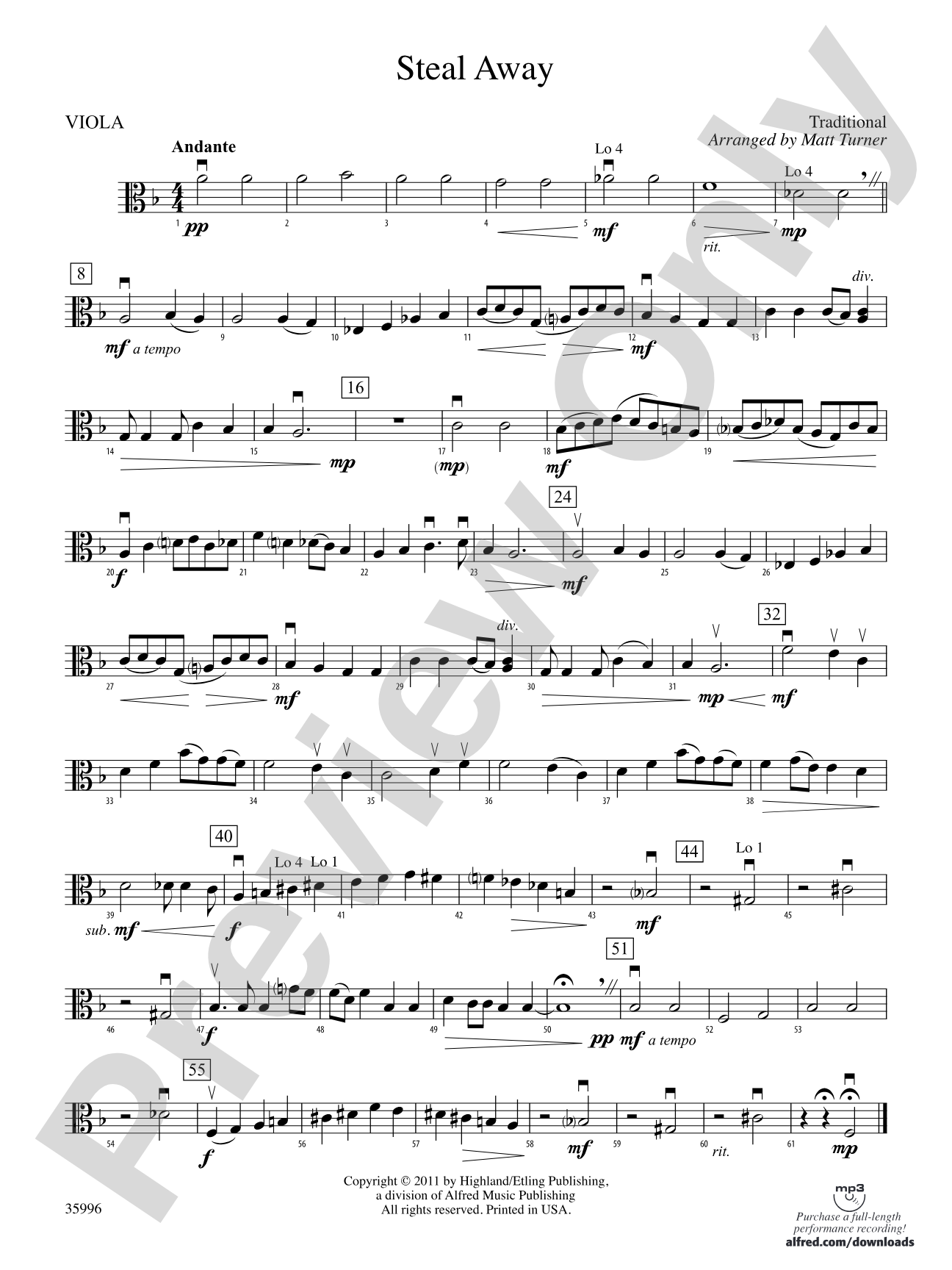

Steal Away: Viola
Traditional / arr. Matt Turner
Grade: 3
Item: 00-PC-0015071_VA1
$5.99
Pickup currently not available
Description
This arrangement of the beloved African-American spiritual offers students the opportunity to experience chromaticism within beautiful moving lines and harmonies. A simple hymn-like texture at the beginning gradually leads to an expedition in bi-tonality, giving this arrangement a contemporary but accessible sound.


Don't just read it, hear it, play along with it, and watch your students grow with it. In MakeMusic Cloud, Steal Away: Viola comes alive with professional accompaniment, adjustable tempo, and built-in practice tools that turn solo practice into real progress.
Open in the Player
Jump straight in and assign it today.
Start Your Free Trial
Open this title and explore the full library in minutes.
Sample Audio
1
Audio File
--:--
0:00
0:00
Sample Video
No sample videos found.
Additional Details
Series:
Highland/Etling String Alternatives
Publisher:
Alfred Music
Page Count:
62
SKU:
00-PC-0015071_VA1
Instrumentation:
strings
More about this title
About the Arranger: Matt Turner

Matt Turner has built a distinctive career as an improvising cellist and pianist, performing across jazz, contemporary classical, and world music contexts. He has recorded prolifically (over 100 releases) and collaborated with artists ranging from Cape Breton fiddler Natalie MacMaster to avant-garde pioneers like Marilyn Crispell and Peter Kowald, as well as vocalists Bobby McFerrin and Jo Gabriel. His work spans recordings on Sketch/Harmonia Mundi, Asian Improv, Illusions, and numerous independent labels.
Turner holds degrees from Lawrence University and the New England Conservatory of Music, where he studied contemporary improvisation with Dave Holland, Geri Allen, and Joe Maneri. He teaches improvisation at Lawrence University and the Renaissance School for the Arts, and remains an active performer with Bill Carrothers' Armistice 1918 ensemble and the Fantastic Merlins. As a Yamaha Performing Artist, his understanding of ensemble texture and harmonic depth deeply informs his arranging work.
Why we love this
Turner's arrangement honors the spiritual's emotional foundation while introducing your students to contemporary harmonic language in a way that feels organic rather than imposed. The progression from hymn-like simplicity into bitonality gives directors a pedagogically rich moment: students experience how the same melody can be reimagined without losing its soul. This is thoughtful arranging that respects tradition while refusing to be static.
What to expect
The arrangement begins in familiar, warm territory: a spiritual sung with dignity and clarity. Gradually, the harmonic ground shifts beneath the melody, introducing chromatic threads and then full bitonality that creates a sense of gentle unease and forward motion. It's contemplative rather than agitated, sophisticated but never cold.
Who it's for
String orchestras at Grade 3 seeking repertoire that marries meaningful cultural material with contemporary compositional thinking. This works well for ensembles ready to tackle harmonic complexity and expressive maturity beyond basic technical proficiency.
How to get the most out of it
- Balance the choir within the orchestration carefully in early sections; the string voices should support rather than overwhelm the contrapuntal movement that emerges as the arrangement develops.
- Use the shift into bitonality as an expressive turning point rather than a technical hurdle. Encourage singers and players to feel the harmonic tension rather than merely executing it correctly.
- Shape the chromaticism with intention; these moving lines deserve breath and phrasing that makes their journey audible to the listener.
- Consider the tempo relationship between the opening hymn-like section and the later explorations. A slight tempo flexibility can highlight the contrast without losing structural coherence.
How to use it
Program this alongside other spirituals or American folk material to create a thematic concert section that traces how these traditions evolve across different musical voices. The Grade 3 accessibility makes it suitable for a mid-season concert while its harmonic sophistication rewards an audience paying close attention.
Skills your students will build
- Voice independence within bitonality and harmonic ambiguity
- Chromatic line shaping and intonation in moving parts
- Ensemble balance across expanding harmonic textures
- Phrasing and expression within non-traditional harmonic contexts