
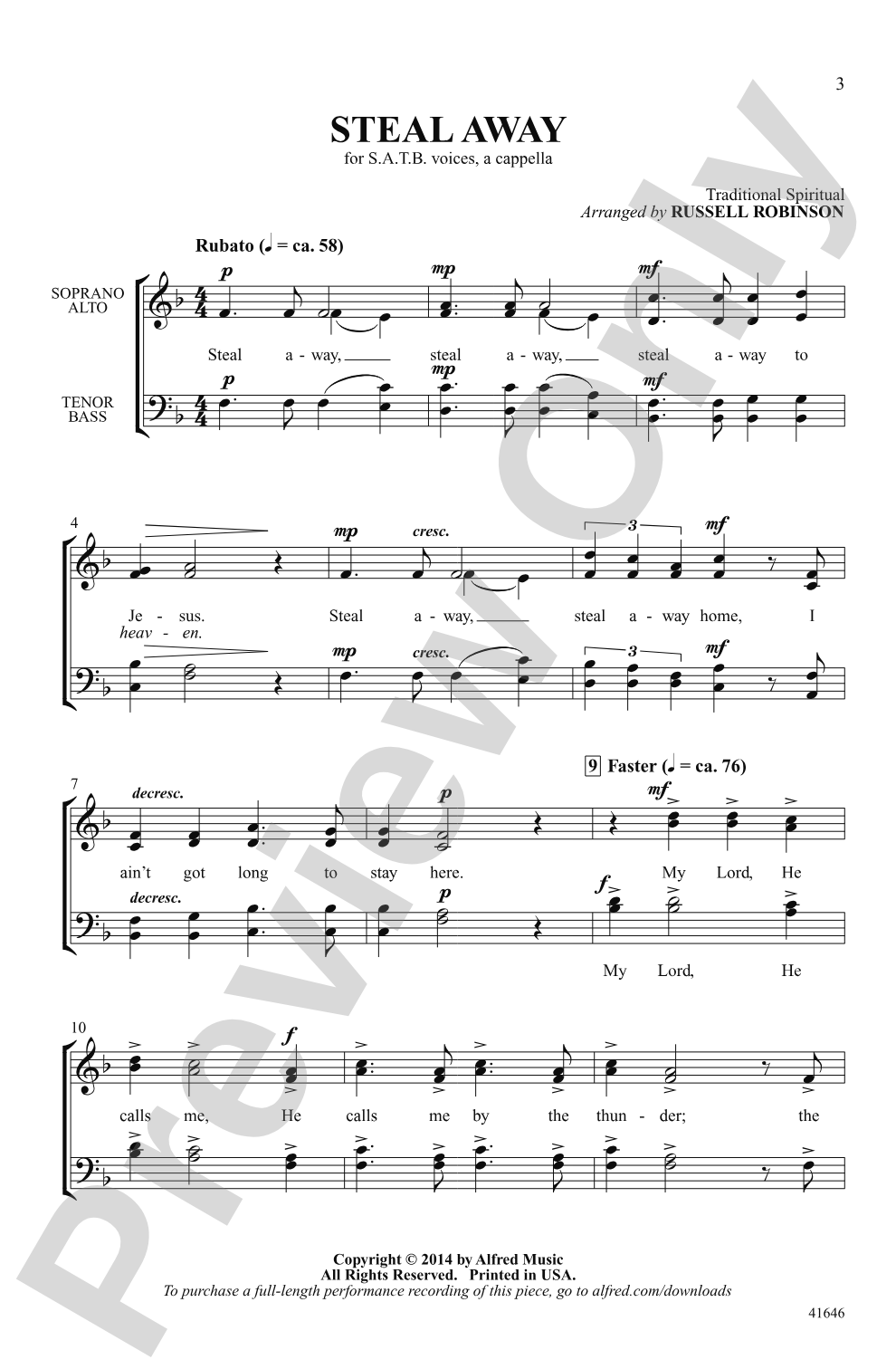
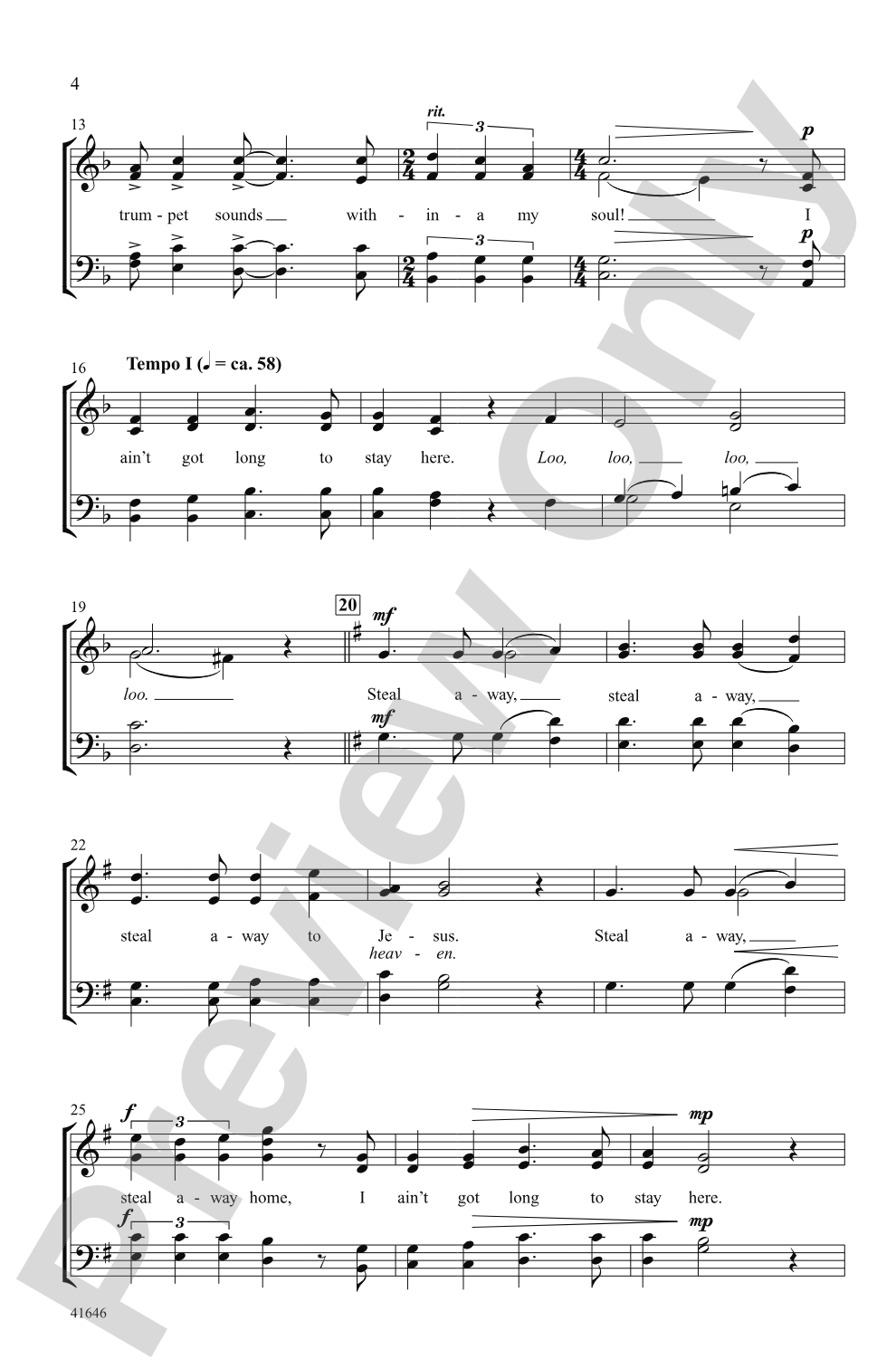

Steal Away: SATB, a cappella Choral Octavo
Traditional Spiritual / arr. Russell Robinson
Item: 00-PO-0001851
$1.85
Minimum order quantity: 20 copies
Pickup currently not available
Related Items
Steal Away: SATB, a cappella Choral Octavo |
$1.85
|
View |
Description
A fine interpretation of this expressive arrangement will be a source of considerable pride for conductors and singers alike. Dr. Robinson treats the moving spiritual with great reverence and employs classic hallmarks of the choral tradition. Take liberties with the marked rubato for a meaningful performance.


Steal Away: SATB, a cappella Choral Octavo isn't in MakeMusic Cloud just yet...but it could be. Let us know you'd like to see it, and you'll help shape what comes next. In the meantime, start a free trial and dive into thousands of interactive titles your students can play along with today.
Request This Title
Tell us you want it.
Start Your Free Trial
Explore everything that's ready to play right now.
Sample Audio
1
Audio File
--:--
0:00
0:00
Sample Video
No sample videos found.
Additional Details
Series:
Alfred Choral Designs
Publisher:
Alfred Music
Page Count:
8
SKU:
00-PO-0001851
More about this title
About the Arranger: Russell Robinson

Russell Robinson brings decades of experience in choral music education and conducting to his work as a composer and arranger. An Emeritus Professor of Music Education at the University of Florida, Robinson has conducted at major venues including Carnegie Hall, Lincoln Center, and the Kennedy Center, and has led honor choirs and all-state ensembles across six continents. He served as Associate Dean of the UF College of the Arts and held leadership roles in the National Association for Music Education.
Robinson's catalog exceeds 500 published works spanning choral compositions, arrangements, articles, and instructional materials. His 2016 induction into the Florida Music Educators Association Hall of Fame reflects his sustained influence on choral music in schools and universities. His arrangements honor the spiritual depth of traditional repertoire while remaining accessible to committed student choirs.
Why we love this
Robinson's treatment of this spiritual respects its emotional gravity without sacrificing singability. The arrangement sits naturally in the SATB voices while inviting the kind of interpretive freedom that lifts a performance from competent to compelling. Directors will appreciate how the marked rubato creates space for meaningful expression rather than prescribing every musical moment.
What to expect
The arrangement unfolds with quiet dignity, allowing the spiritual's melodic and harmonic beauty to emerge without embellishment. There is space here for contemplation and genuine emotional connection; the restraint of the writing becomes its strength. Singing this piece, a choir discovers that reverence and expressiveness are not in conflict but intertwined.
Who it's for
This octavo serves choirs with solid pitch and intonation skills who are ready to handle the interpretive demands of an unaccompanied spiritual arrangement. It fits advanced high school choirs, college ensembles, and community choirs preparing for festival or concert performance. Directors seeking to deepen their choirs' connection to the sacred choral tradition will find this a rewarding choice.
How to get the most out of it
- Honor the rubato markings as starting points rather than rigid boundaries. Allow singers to breathe where the text and phrasing suggest, giving the melody room to unfold with dignity.
- Balance the voicing so that inner parts support the spiritual's emotional contour rather than compete for prominence. The arrangement's power comes from unified forward motion.
- Shape the dynamics with intention; avoid rushing through soft passages. These moments often carry the deepest expression in spiritual traditions.
- Work sectional balance in rehearsal by having singers listen to parts other than their own. This builds the interdependence that makes an a cappella arrangement sing.
How to use it
Program this as the centerpiece of a concert segment devoted to spirituals and sacred music, where it can anchor a thematic exploration. Its eight pages and a cappella format make it equally at home in a festival setting where it showcases both your choir's musicianship and interpretive maturity. Consider pairing it with contrasting repertoire to highlight the arrangement's emotional depth.
Skills your students will build
- Intonation management without instrumental support
- Expressive use of rubato and tempo flexibility in ensemble context
- Stylistic sensitivity to spiritual traditions and sacred music idioms
- Balance and blend in four-part harmonic writing
- Interpretive restraint and the power of musical silence