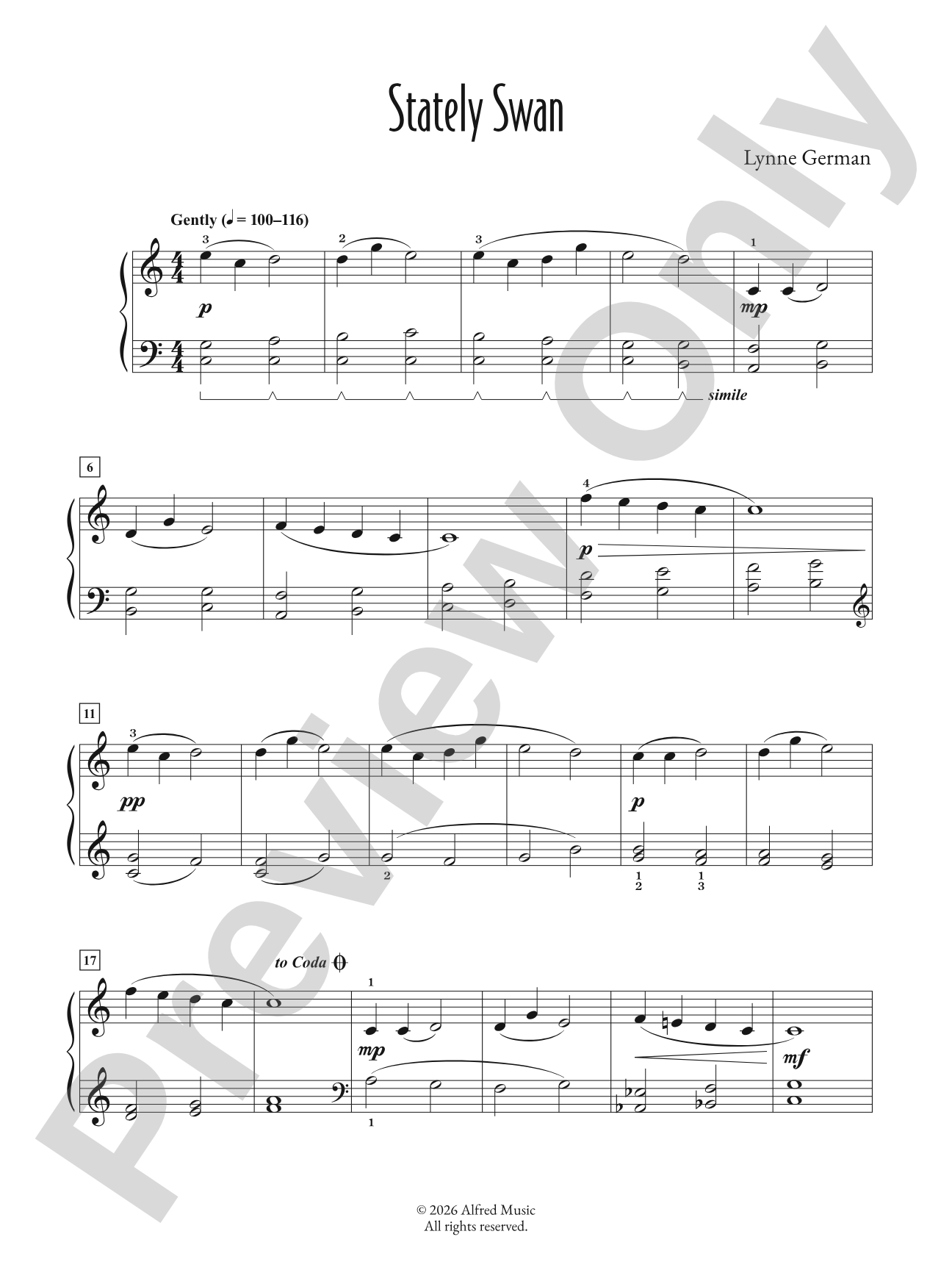
This elegant ABA piece opens with a stately, procession-like introduction before moving to a flowing middle section in the relative minor. Rippling patterns and steady momentum beautifully suggest the motion of a swan gliding across the water.
Discover MakeMusic Cloud: thousands of interactive titles your students can play along with today.
Lynne German brings together rigorous training and deep classroom experience in her work as a composer and educator. She holds degrees from Bob Jones University and Old Dominion University (Master of Music Education, summa cum laude) and completed Kodály certification at James Madison University. Her background teaching piano, flute, and voice, combined with her direction of award-winning school and church choirs, informs every piece she writes.
At Old Dominion University, where she serves on the music faculty, and as Training Choir Director for the Virginia Children's Chorus, German continues to champion music education and artistic growth. She founded the German Music Studio and established the Harrisonburg Piano Teachers Forum, where she served as founding president. Inducted into the National Piano Guild Hall of Fame, German is a published composer whose works are distributed through J.W. Pepper and performed internationally. Her mission centers on helping young musicians find joy in music and develop authentic artistic expression.
Why we love this
German's descriptive approach to composition gives students a concrete musical narrative to inhabit. The ABA structure provides early intermediate pianists with formal clarity while the rippling accompaniment patterns and relative minor section create genuine musical interest that doesn't rely on technical pyrotechnics.
What to expect
Stately Swan captures the quiet elegance of a bird in motion, beginning with ceremonial presence before releasing into flowing, water-like passages. The relative minor section carries a reflective quality, almost meditative, before the opening's dignified character returns transformed by what came before.
Who it's for
Early intermediate pianists ready to move beyond simple repertoire into music that combines structural clarity with evocative imagery. This piece suits students who respond well to programmatic titles and who have developed enough technical security to focus on phrasing and character rather than note-reading.
How to get the most out of it
Shape the opening procession section with a steady, unhurried pulse; resist the urge to rush, as the stately character depends on clear forward motion without urgency.
Let the flowing middle section breathe; the rippling patterns should feel effortless, achieved through relaxed wrist rotation rather than finger tension.
Balance the return to the opening by maintaining the same measured dignity while bringing fresh awareness to how the familiar material now contrasts with the relative minor section you've just traveled through.
How to use it
Place this as a solo recital piece to showcase a student's developing musicianship and interpretive maturity. Its moderate length and clear sectional structure make it an accessible encore, or program it alongside other character pieces to build a coherent thematic set focused on nature or movement.
Skills your students will build
Understanding ABA form and its emotional effect
Sustaining steady pulse in stately (moderate tempo) passages
Executing rippling accompaniment patterns with independence between hands
Shaping phrases in a flowing middle section while maintaining harmonic awareness of the relative minor
Creating contrast between formal/ceremonial character and reflective minor-key material
You May Also Like
Scan to Complete Your Purchase
Use your phone's camera to scan the code below
You'll log in on your phone and the order will be added to your account