Stately Dances: F Educational Pack Sheet Music Preview

Stately Dances: F Educational Pack

By Robert Sheldon

Grade: 1.5 (Easy)

Item: 00-PC-0017002_F_EDPAK

Digital Download
$3.00
Description
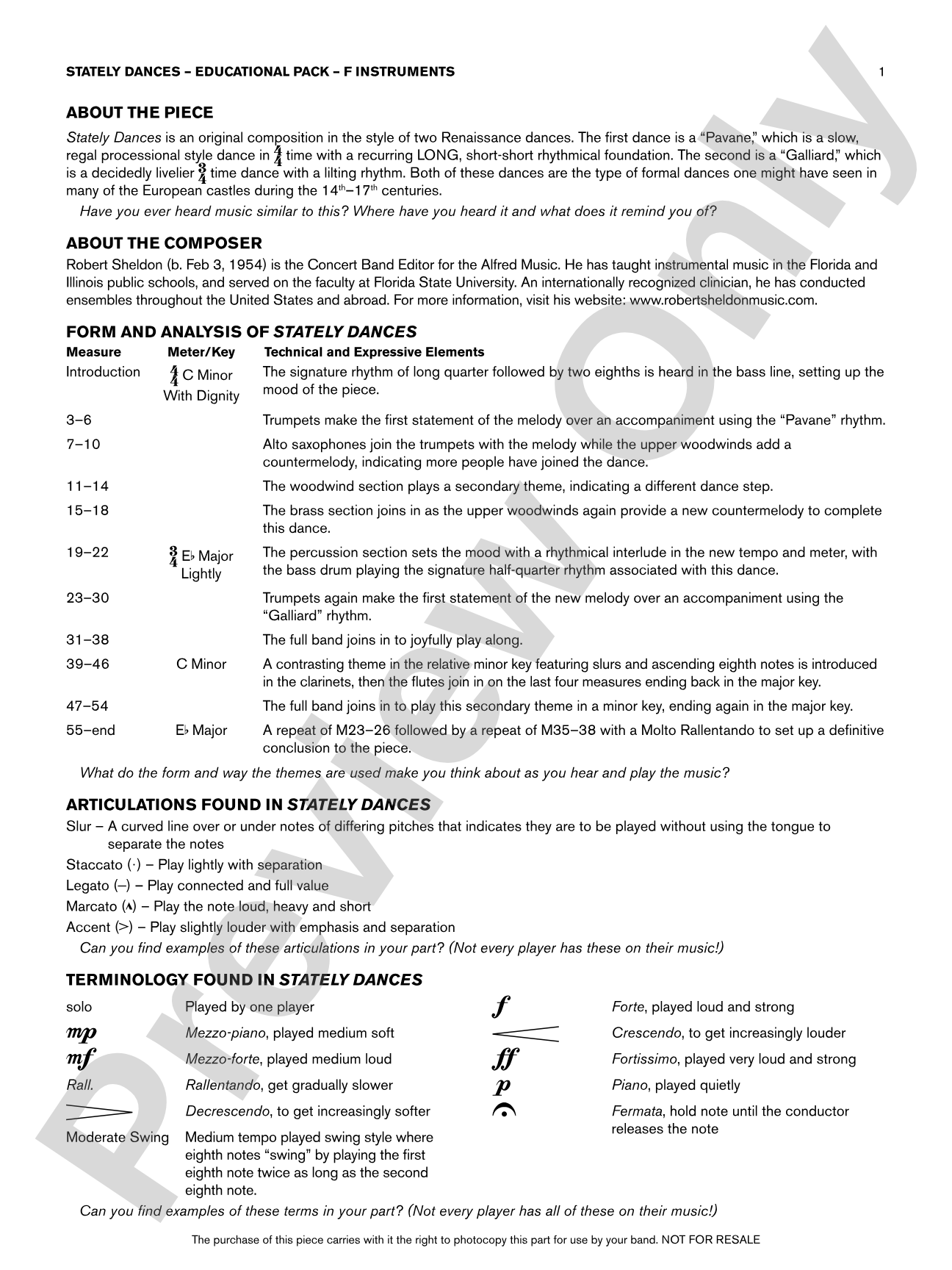
The dance music of the Renaissance inspired this two-movement work. An opening "Pavane" sets the stage with its dignified processional. A lively "Galliard" brings the piece to a conclusion showcasing brass and woodwind choirs in both major and minor keys. (2:20)

Don't just read it, hear it, play along with it, and watch your students grow with it. In MakeMusic Cloud, Stately Dances: F Educational Pack comes alive with professional accompaniment, adjustable tempo, and built-in practice tools that turn solo practice into real progress.

Sample Audio
0:00
0:00
Sample Video
Additional Details
Series: Sound Innovations for Concert Band
Publisher: Alfred Music
Page Count: 132
SKU: 00-PC-0017002_F_EDPAK

More about this title

About the Composer: Robert Sheldon

Robert Sheldon

Robert Sheldon stands among the most widely performed composers in wind band literature, with his works appearing on concert and festival programs internationally. He authored Sound Innovations for Concert Band and has received recognition from the American School Band Director's Association, Phi Beta Mu, and ASCAP for compositions that balance musical substance with accessibility across all ability levels.

Sheldon's conducting and clinician work spans the globe, from All-State and Regional Honor Bands to universities and state music education conferences. His works have been performed at Carnegie Hall, Orchestra Hall, Boston's Symphony Hall, the Sydney Opera House, and the Kennedy Center. VanderCook College of Music granted him an honorary doctorate in 2020.

Why we love this

Sheldon captures the essence of Renaissance court music without sacrificing the directness that Grade 1.5 ensembles need. The movement from stately to spirited gives your band a complete arc to conduct, and the scoring cleanly separates brass and woodwind choirs so that students hear themselves and understand the piece's architecture from rehearsal one.

What to expect

The Pavane unfolds with quiet grandeur, each phrase rising and settling like a formal procession. When the Galliard arrives, the energy shifts sharply; bright rhythmic figures bounce between sections, with brass and woodwinds trading the spotlight in a dialogue that feels both playful and precise.

Who it's for

This score and parts package serves conductors of beginning to early-intermediate concert bands who want authentic Baroque-inspired material without scaled-down sophistication. It works equally well for students in their second or third year of band and for directors seeking contest or concert repertoire that develops ensemble cohesion and listening skills at an approachable level.

How to get the most out of it

  • Shape the Pavane's sustained lines with gentle dynamic swells rather than holding them flat. This teaches singers' phrasing habits to your instrumentalists and honors the Renaissance roots.
  • In the Galliard, keep the tempo crisp and consistent between sections. Younger ensembles can drift when the texture gets busier; a clear pulse from the podium prevents rushing.
  • Balance the key changes (major to minor) by adjusting dynamic color slightly, not volume. This helps students hear harmonic movement as a compositional choice, not just a page turn.
  • Let the brass solos in the Galliard breathe. Many young conductors push the tempo here; give them space to articulate cleanly and project with confidence.

How to use it

Open a concert with the Pavane to set an elegant tone, then continue directly into the Galliard for a single unified statement. Alternatively, use just the Pavane as a lyrical opener before heavier repertoire, or program the complete work as your opener when you want to demonstrate ensemble control and musicality before moving to showier pieces.

Skills your students will build

  • Conducting two contrasting tempos and characters within a single work
  • Balancing sustained lines in the Pavane with proper phrase shaping
  • Executing crisp articulation and rhythmic precision in the Galliard
  • Hearing and responding to key changes (major to minor sections)
  • Listening to woodwind and brass choirs as independent musical voices

You May Also Like