
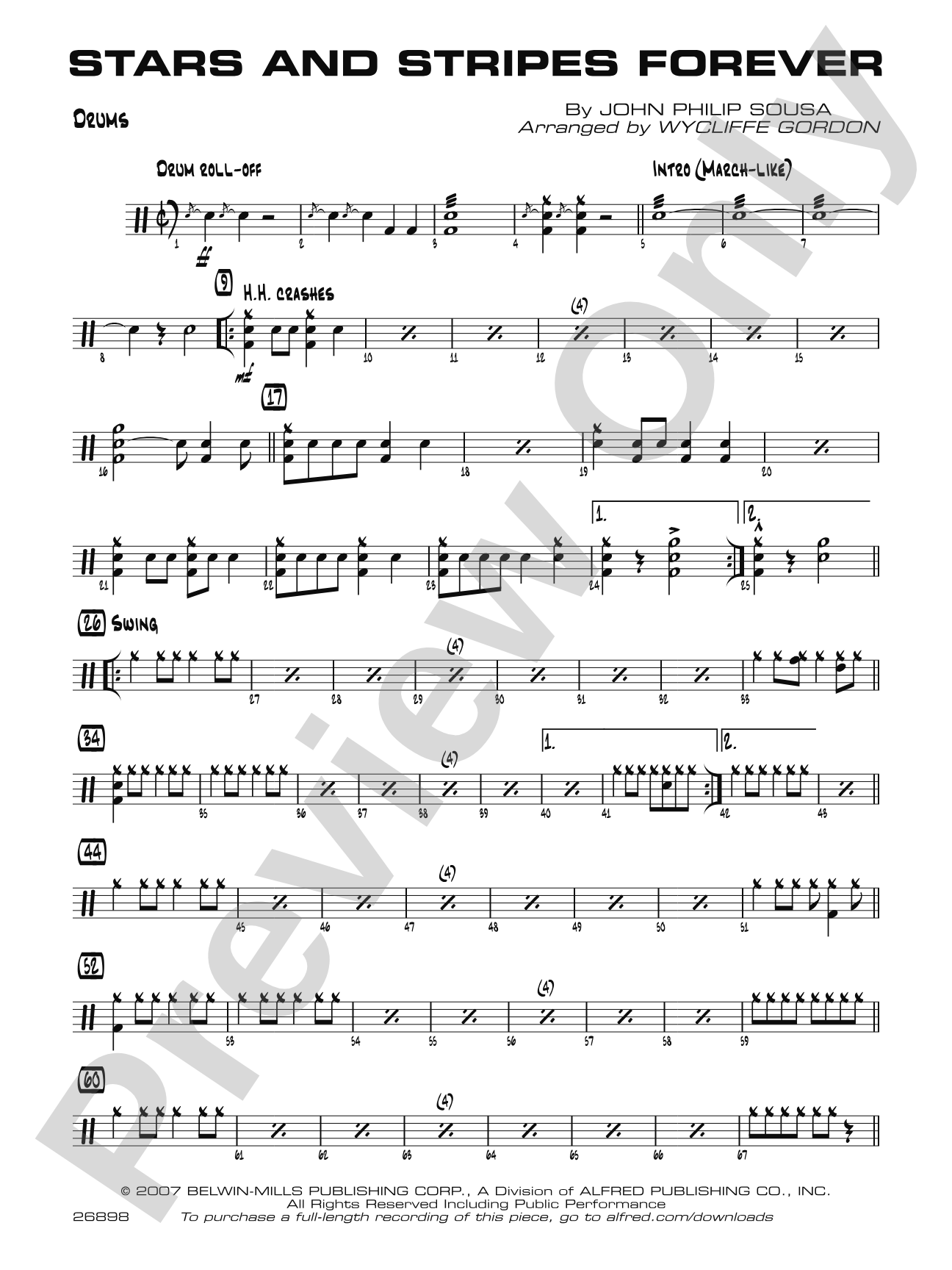

Stars and Stripes Forever: Drums
By John Philip Sousa / arr. Wycliffe Gordon
Item: 00-PC-0017125_D
$3.00
Pickup currently not available
Description
Sousa for jazz ensemble! Jazz trombonist, composer and arranger Wycliffe Gordon has created a tour de force on this traditional march. It has swing, Latin and New Orleans all rolled into one superb chart. Solos are (written) for trumpets 1 and 2. This chart will bring down the house! This title is available in MakeMusic Cloud.


Don't just read it, hear it, play along with it, and watch your students grow with it. In MakeMusic Cloud, Stars and Stripes Forever: Drums comes alive with professional accompaniment, adjustable tempo, and built-in practice tools that turn solo practice into real progress.
Open in the Player
Jump straight in and assign it today.
Start Your Free Trial
Open this title and explore the full library in minutes.
Sample Audio
1
Audio File
--:--
0:00
0:00
Sample Video
Additional Details
Series:
Jazz for Young People Series
Publisher:
Alfred Music
Page Count:
98
SKU:
00-PC-0017125_D
More about this title
About the Composer: John Philip Sousa
John Philip Sousa (1854-1932) stands as America's most celebrated march composer and bandmaster. His works defined the genre and remain cornerstones of wind and jazz ensemble repertoire, known for their infectious melodies, driving rhythms, and sophisticated harmonic structures that appeal equally to performers and audiences.
Sousa's influence extends far beyond his own era. Educators value his marches for their clarity of form, accessibility to developing musicians, and proven ability to inspire ensemble pride and precision. His compositional legacy continues to anchor concert programming and ceremonial music across the United States.
Why we love this
Wycliffe Gordon's arrangement reimagines this quintessential American march through a distinctly jazz lens, infusing it with swing rhythms, Latin grooves, and New Orleans flavor while preserving Sousa's iconic melodic architecture. The result plays to what jazz ensembles do best: rhythmic vitality and interactive soloing, making this chart both musically substantive and genuinely fun to perform. Directors will appreciate that this arrangement honors the original while giving young jazz players an arrangement that genuinely excites them.
What to expect
Patriotic vigor meets jazz swagger. The familiar march melody returns transformed: syncopated, swinging, layered with Latin percussion and New Orleans inflection. What emerges is both recognizable and fresh, infectious enough to move an audience and substantive enough to hold musicians' interest through repeated rehearsals and performances.
Who it's for
Jazz ensemble directors working with high school and advanced middle school groups seeking repertoire that honors American tradition while meeting young players' appetite for contemporary jazz arranging. This is ideal for programs with at least intermediate-level improvisation experience and a solid rhythm section foundation.
How to get the most out of it
- Balance the ensemble sound so the melody sings clearly even when layered with swing rhythms and accompanying figures; Sousa's themes deserve prominence in any style.
- Lock in the groove with your rhythm section early in rehearsals; the Latin and New Orleans sections demand tighter coordination than straight swing.
- Feature the trumpet soloists confidently; Gordon's written solos are central to the chart's appeal and deserve rehearsal time dedicated to their phrasing and tone.
- Shape the dynamic arc across the full form to maintain energy through key and stylistic shifts; this chart's power comes from building momentum through contrasting sections.
How to use it
Program this as a summer or patriotic concert centerpiece that bridges classical American music and contemporary jazz. It works especially well paired with other Sousa marches (in traditional settings) to show stylistic range, or alongside modern jazz compositions to illustrate how jazz arrangers recontextualize familiar material. The novelty and accessibility make it a strong closer that leaves audiences energized.
Skills your students will build
- Swing rhythm and groove feel in an ensemble setting
- Stylistic navigation (swing, Latin, and New Orleans idioms within a single chart)
- Trumpet solo construction and phrasing
- Rhythmic precision in syncopated ensemble figures
- Leading and responding within jazz section textures