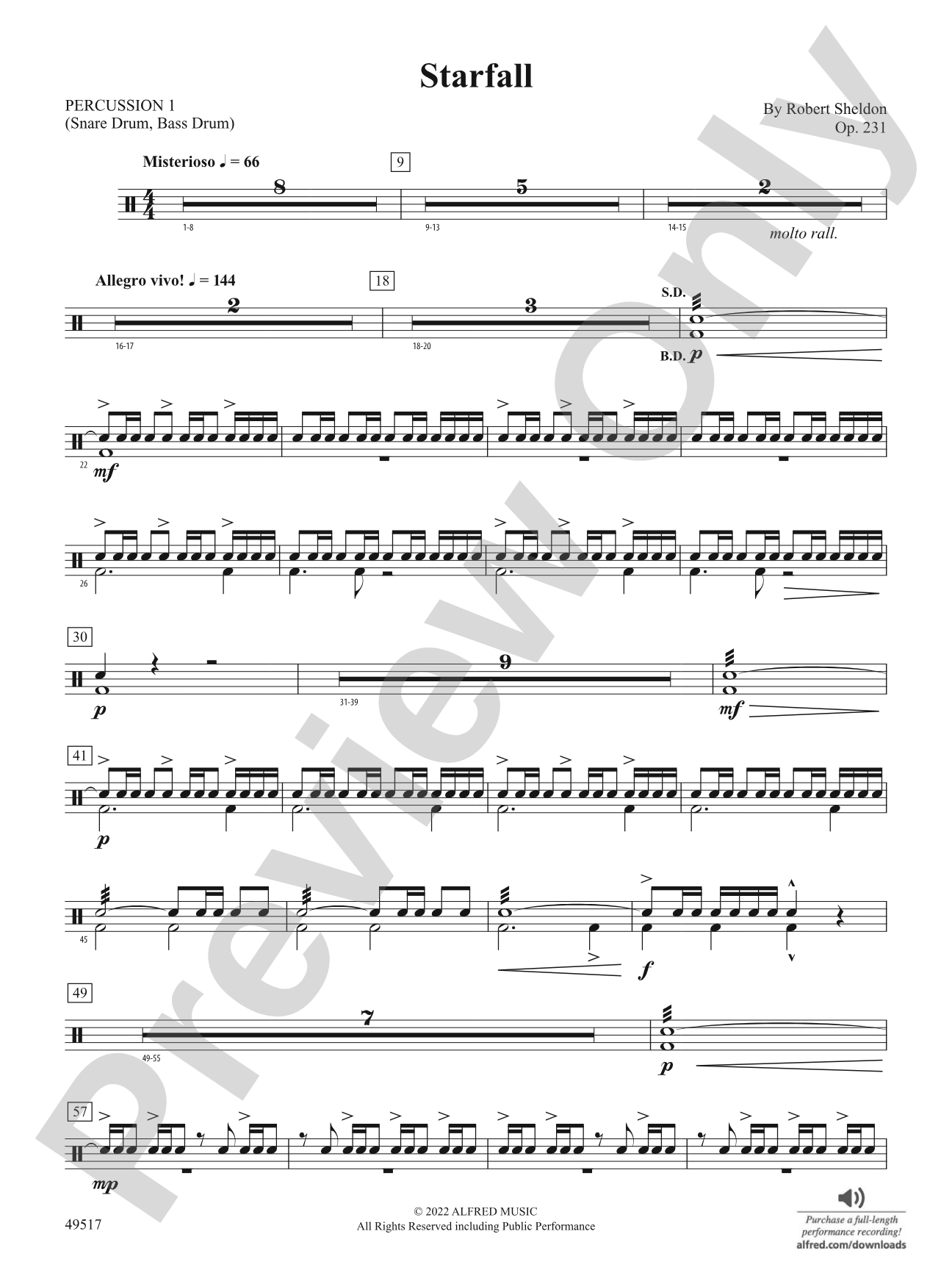
Starfall: 1st Percussion Sheet Music Preview

Starfall: 1st Percussion

By Robert Sheldon

Grade: 3

Item: 00-PC-0018810_PC1

Digital Download
$3.00
Description
Starfall by Robert Sheldon is a dynamic and exciting piece that was inspired by a viewing of the Lyrid meteor shower. This composition invokes interstellar drama with introspection into the vastness of our universe. (5:04)

Don't just read it, hear it, play along with it, and watch your students grow with it. In MakeMusic Cloud, Starfall: 1st Percussion comes alive with professional accompaniment, adjustable tempo, and built-in practice tools that turn solo practice into real progress.

Sample Audio
0:00
0:00
Sample Video
Additional Details
Series: Young Symphonic
Publisher: Alfred Music
SKU: 00-PC-0018810_PC1

More about this title

About the Composer: Robert Sheldon

Robert Sheldon

Robert Sheldon stands among the most frequently performed composers for wind ensembles internationally. His works appear consistently on state and national contest lists, in concert halls from Carnegie Hall to the Kennedy Center, and in rehearsal rooms across six continents. Beyond composition, he co-authored Sound Innovations for Concert Band and regularly mentors young conductors through guest appearances at All-State and Regional Honor Bands.

Sheldon's accolades include recognition from the American School Band Directors Association, Phi Beta Mu, and the American Society of Composers, Authors and Publishers. He maintains an active commissioning schedule and produces substantial new literature annually. His impact as a clinician and guest conductor has extended throughout the United States and internationally to Japan, Canada, Italy, Germany, Australia, and China. In 2020, VanderCook College of Music awarded him an honorary doctorate in recognition of his contributions to music education.

Why we love this

Sheldon crafts programmatic music that maintains genuine musical substance rather than relying on gimmick. Starfall delivers the drama and excitement bands crave at Grade 3 while remaining accessible to developing ensembles. The piece works equally well in contest settings or concert programming where you need an opener that energizes both players and audience.

What to expect

Starfall captures the wonder and unease of witnessing a meteor shower. The music shifts between moments of vast cosmic silence and bursts of kinetic excitement, inviting listeners into contemplation of something immense and unknowable.

Who it's for

This score and parts set serves Grade 3 concert bands ready to explore programmatic writing with real musical depth. It suits ensembles preparing for festival and contest settings as well as those building a concert program that reaches beyond purely abstract works.

How to get the most out of it

  • Balance the interstellar drama with moments of reflective quiet. The contrast between these sections gives the piece its emotional arc and keeps listeners engaged throughout.
  • Pay attention to dynamics in the upper woodwinds during the faster passages. Their brightness drives the sense of motion that evokes the meteor shower.
  • Shape the phrasing across the full five minutes so the piece feels like one cohesive journey rather than disconnected sections. This unifies the programmatic narrative.
  • Work the rhythm section as a unit to maintain steady momentum during the exciting passages while responding sensitively to tempo adjustments that underscore the introspective moments.

How to use it

Open a concert with Starfall to set a contemplative yet energetic tone, or position it as a centerpiece where you want to showcase your ensemble's ability to balance technical facility with musical storytelling. The five-minute duration makes it ideal for festival competitions where you need impact without excessive runtime.

Skills your students will build

  • Shaping phrases across contrasting dynamic landscapes
  • Executing rapid passages with clarity and precision
  • Responding to programmatic intent through expressive playing
  • Maintaining ensemble cohesion during tempo and textural shifts
  • Balancing solo lines against ensemble support

You May Also Like