Star Wars: The Rise of Skywalker (arr. Matt Conaway) Sheet Music Preview

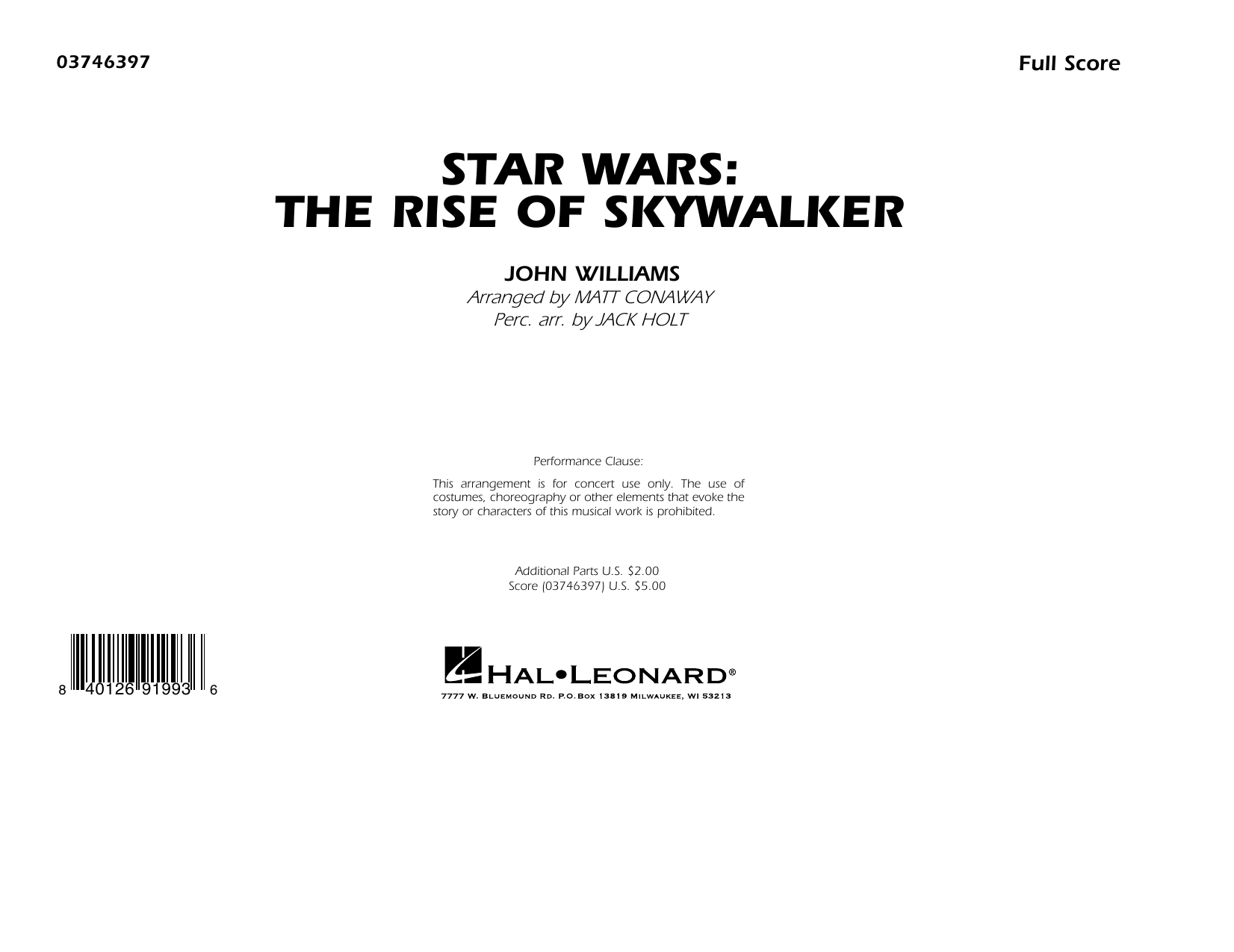
Star Wars: The Rise of Skywalker (arr. Matt Conaway): Marching Band Conductor Score & Parts

By John Williams / Arranged by Matt Conaway / Arranged by Jack Holt

Grade: 4

Item: 35-PK00461303

Digital Download
$75.00

One moment…

Description
The "Star Wars" saga wraps up with this blockbuster movie, and features more fabulous music from John Williams. This arrangement starts slow with a majestic new theme, then builds steadily to the familiar and exciting main theme.

Star Wars: The Rise of Skywalker (arr. Matt Conaway): Marching Band Conductor Score & Parts isn't in MakeMusic Cloud just yet...but it could be. Let us know you'd like to see it, and you'll help shape what comes next. In the meantime, start a free trial and dive into thousands of interactive titles your students can play along with today.

Sample Audio
No sample audio found.
Sample Video
Additional Details
Publisher: Hal Leonard
SKU: 35-PK00461303

More about this title

About the Composer: John Williams

John Williams stands as one of the most prolific and celebrated film composers in history, with a catalog spanning over five decades. His mastery of orchestral writing, combined with his gift for creating instantly recognizable themes, has made him the voice of modern blockbuster cinema. For music educators, Williams represents the gold standard of melodic composition and orchestration; his scores reward careful listening and serve as models for how thematic material can drive large-scale narratives.

Beyond the concert hall, Williams' work has introduced millions of students to classical forms and sophisticated harmonic language. His ability to write music that engages both casual listeners and musicians with serious training makes his arrangements ideal teaching tools.

Why we love this

Matt Conaway and Jack Holt have crafted an arrangement that honors Williams' signature orchestral sweep while respecting the practical demands of marching ensemble performance. The structural arc—beginning with the new theme's measured majesty before accelerating into the familiar main theme—gives your band a genuine narrative to execute, not just a collection of hits. At Grade 4, the orchestration sits in that sweet spot where competent sections can produce real impact.

What to expect

The opening unfolds with ceremony and grandeur, strings and woodwinds woven into something almost spiritual before the energy shifts. Once the main theme emerges, the pulse quickens and the music catches fire; what began as introspective becomes triumphant and driving. It's the feeling of a story reaching its climax, all themes converging into a final, undeniable statement.

Who it's for

Programs looking to add contemporary blockbuster music to their marching season will find this arrangement accessible without sacrificing musical substance. Grade 4 groups with solid fundamentals can execute the writing convincingly, and audiences recognize the material immediately. This works equally well for competitive circuits and community concert settings.

How to get the most out of it

  • Balance the opening theme's sustained character by resisting any urge to rush. The majestic quality depends on confident long tones from your woodwind choir; drill them as a section first before integrating with brass.
  • Mark the transition into the main theme with intentional precision. This shift is your moment to show stylistic range, and a clean rhythmic attack signals to the audience that something significant is happening.
  • Pay close attention to dynamics during the buildup. Incremental increases in volume matter far more than sudden jumps; they create forward momentum that carries through to the final theme statement.
  • Consider your horn line as essential architecture. Williams relies on horns to anchor harmonic transitions, so ensure they're heard clearly without overwhelming the melodic voices.

How to use it

This arrangement fits naturally as a season closer or featured selection on a pop music themed concert. The contrast between the contemplative opening and energetic finale makes it compelling as a solo feature, but it also pairs well alongside other contemporary or film music selections to create a cohesive program block. Consider programming it midseason once your ensemble has built their fundamentals; the arrangement rewards clean execution.

Skills your students will build

  • Sustaining long tones across phrase lengths without losing tone quality
  • Executing smooth dynamic transitions and gradual crescendos
  • Balancing melody and harmony within a complex orchestration
  • Responding to thematic transitions with stylistic clarity
  • Maintaining rhythmic precision during tempo and intensity shifts

You May Also Like