
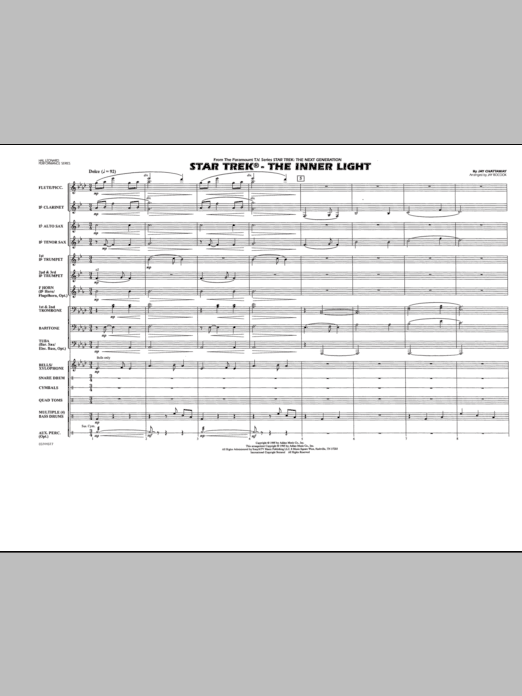

Star Trek - The Inner Light: Marching Band Conductor Score & Parts
By Jay Chattaway / Arranged by Jay Bocook
Grade: 4
Item: 35-PK00123312
$65.00
Pickup currently not available
Buy Extra Parts (Digital PDF Download)
Parts Added to Cart!
Description
From "Star Trek: The Next Generation," this is the well-known (to trekkies) "pennywhistle" song played by Captain Picard (Patrick Stewart). A simple and sweet melody that Jay transforms into an effective production.


Star Trek - The Inner Light: Marching Band Conductor Score & Parts isn't in MakeMusic Cloud just yet...but it could be. Let us know you'd like to see it, and you'll help shape what comes next. In the meantime, start a free trial and dive into thousands of interactive titles your students can play along with today.
Request This Title
Tell us you want it.
Start Your Free Trial
Explore everything that's ready to play right now.
Sample Audio
No sample audio found.
Sample Video
No sample videos found.
Additional Details
Publisher:
Hal Leonard
SKU:
35-PK00123312
More about this title
About the Composer: Jay Chattaway
Jay Chattaway is a prolific composer and orchestrator whose work spans television, film, and concert music. He served as the principal composer for Star Trek: The Next Generation, creating iconic themes and underscore that defined the show's sonic identity across seven seasons. His ability to craft both sweeping orchestral moments and intimate melodic passages has made him a valued voice in science fiction scoring.
Why we love this
Bocook's arrangement captures the emotional core of this beloved TNG moment while being entirely playable by a marching ensemble. The Grade 4 setting respects the tune's lyrical simplicity without dumbing it down, giving your students a chance to perform something recognizable and meaningful from popular culture.
What to expect
Serene and introspective, with the quiet dignity of a captain reflecting on time, loss, and connection. The melody carries a timeless quality that feels both intimate and profound, inviting performers to move with purpose rather than flash.
Who it's for
Any marching program looking to program a moment of genuine emotional substance alongside competitive selections. It works especially well for bands seeking repertoire that connects with audiences beyond traditional concert fare and appeals to younger performers who grew up with this show.
How to get the most out of it
- Shape the melody with deliberate long-line phrasing rather than mechanical articulation; this tune asks for warmth and reflection, not precision marching.
- Balance the harmonic foundation carefully so the lead voice sits clearly without overwhelming; the arrangement likely features supporting voices that need definition without competing.
- Consider tempo stability as essential here. The beauty of the piece lives in unhurried, consistent forward motion rather than interpretive rubato.
How to use it
Position this as a set opener or closer that establishes a reflective mood; it pairs beautifully with other character-driven selections and provides genuine contrast to higher-energy marching fare. It's ideal for fall or spring shows where emotional storytelling matters as much as technical display.
Skills your students will build
- Legato articulation and sustained phrasing on marching instruments
- Balance and blend within ensemble voice parts
- Tempo stability and awareness without conducting intervention
- Connecting popular music to concert performance values