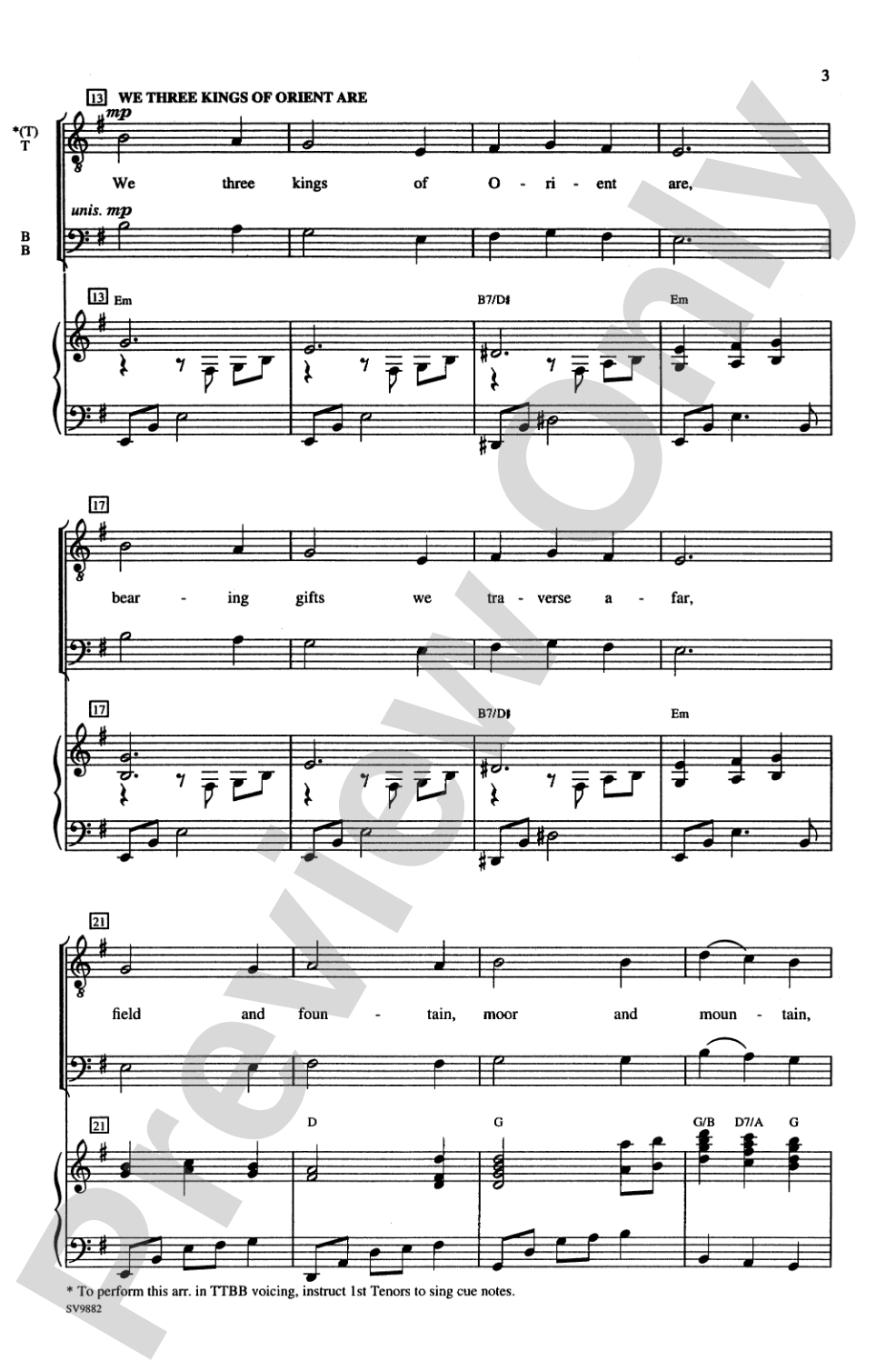
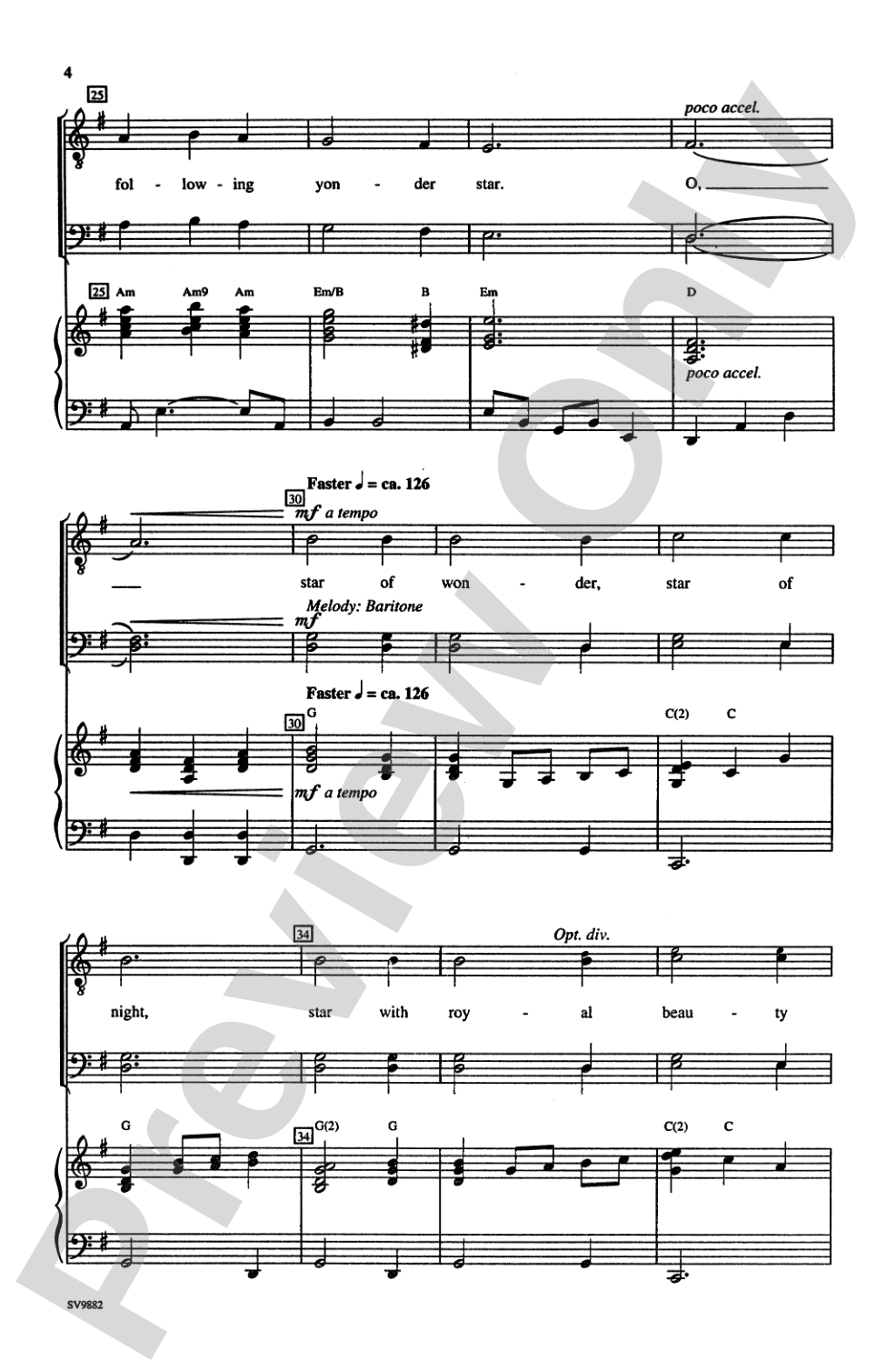
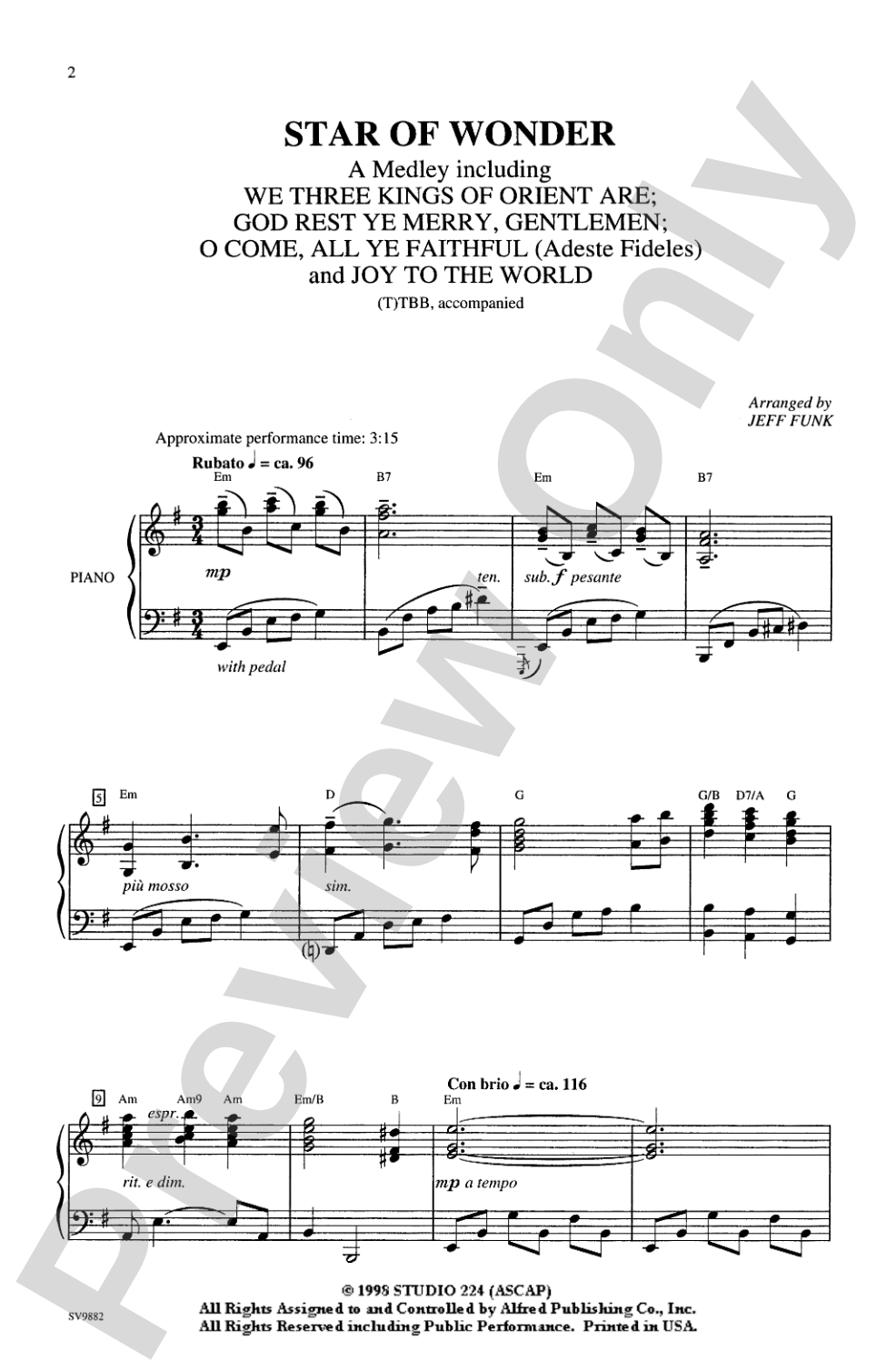
Star of Wonder (A Medley) Sheet Music Preview

Star of Wonder (A Medley): (T)TBB Choral Octavo

Featuring: We Three Kings of Orient Are / God Rest Ye Merry, Gentlemen / O Come, All Ye Faithful (Adeste Fidelis) / Joy to the World

Arr. Jeff Funk

Item: 00-PO-0005292

Digital Download
$2.25

Minimum order quantity: 20 copies

Description
What a wonderful way to feature your men on your holiday concerts! This medley of carols is carefully written to be performed with three or four parts. If you have plenty of tenors, the optional fourth part adds a nice touch. Lovely vocal writing and a wonderful accompaniment part make this Jeff Funk arrangement a real choral showcase. Featuring "We Three Kings of Orient Are," "God Rest Ye Merry, Gentlemen," "O Come, All Ye Faithful (Adeste Fidelis)," and "Joy to the World")Take a serious look at this one!

Star of Wonder (A Medley): (T)TBB Choral Octavo isn't in MakeMusic Cloud just yet...but it could be. Let us know you'd like to see it, and you'll help shape what comes next. In the meantime, start a free trial and dive into thousands of interactive titles your students can play along with today.

Sample Audio
No sample audio found.
Sample Video
Additional Details
Series: Alfred Archive Edition: Studio PR Catalog
Publisher: Alfred Music
Page Count: 12
SKU: 00-PO-0005292

More about this title

About the Arranger: Jeff Funk

Jeff Funk

Jeff Funk launched his publishing work at eighteen with the song Fly to the Sky Tonight, and his compositional output has grown substantially since then. His catalog now spans hundreds of choral arrangements with over 1.7 million copies distributed; he holds a summa cum laude degree from Millikin University (1993) and composed the opening number for NBC's 2000 Macy's Thanksgiving Day Parade broadcast.

Beyond music, Funk has worked as an assistant editor for Necro Publications and appeared as a featured extra in the independent horror film Return in Red, which screened at the Leeds Festival in the United Kingdom. He resides in Auburn, Indiana.

Why we love this

Funk's approach to medley writing avoids the patchwork feeling that can undermine multi-carol arrangements. The flexible voicing structure means you're not locked into one configuration; whether your tenor section is strong or you need the extra part for balance, the writing adapts. The accompaniment alone justifies programming this one, it's crafted to enhance rather than carry the singers.

What to expect

Warm and reverent without being overwrought. The familiar melodies ground listeners in the comfort of tradition, while Funk's arrangement refreshes them through thoughtful part-writing and rich harmonic support. You get the gravitational pull of these beloved carols alongside a sense of polish and care.

Who it's for

Men's choirs seeking substantive holiday repertoire that respects their voices and gives them genuine showcase moments. This works equally well for mixed ensembles looking to feature their male singers on a winter concert without gimmicky or overly simplified writing.

How to get the most out of it

  • Balance the four carols by bringing out their distinct character rather than treating each section identically. The shift between minor-key "We Three Kings" and the brighter major-key carols should feel intentional.
  • If you're using the optional fourth part, have tenors and baritones rehearse their divisi sections well before putting the full choir together, since that's where the ensemble weight will shift.
  • Let the accompaniment do its job during transitions between hymns. The parts are written to complement vocal phrasing, not fight it.

How to use it

Position this as your anchor number for the men's section of a holiday concert, or program it as the finale to your holiday set if your ensemble is entirely male. Twelve pages of music with four iconic texts means it can stand alone as a substantial musical statement and still give your audience the carol repertoire they expect.

Skills your students will build

  • Singing with independence in divided voicing while maintaining blend with the ensemble
  • Adapting articulation and phrasing across multiple melodic lines within a single piece
  • Recognizing and performing characteristic minor and major key harmonic language
  • Following accompaniment cues through modulations and transitions between medley sections

You May Also Like