
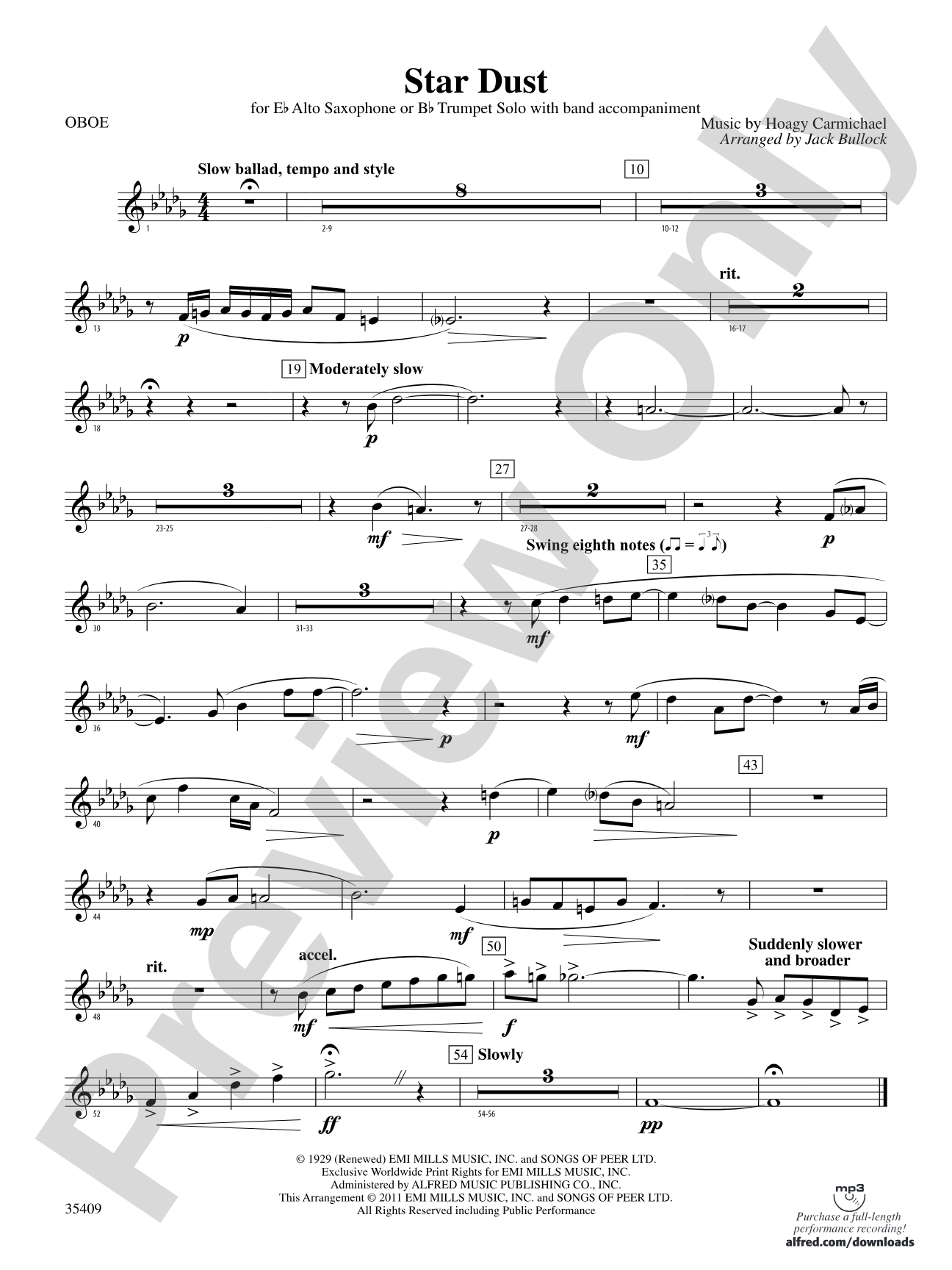

Star Dust: Oboe
For E-flat Alto Saxophone or B-flat Trumpet Solo with Band Accompaniment
By Hoagy Carmichael / arr. Jack Bullock
Grade: 3 (Medium Easy)
Item: 00-PC-0014947_O1
$5.99
Pickup currently not available
Description
The popular ballad Star Dust was written and recorded by Hoagy Carmichael and has been recorded by many popular music stars since it was published in 1929. Scored for alto saxophone or trumpet solo with concert band accompaniment, Jack Bullock's arrangement is appropriate for soloists from your band, or an advanced pro allowing a few more liberties and embellishments. A beautiful ballad, among the most popular songs ever published, this is a tremendous way to showcase your soloist. A charming concert addition!


Don't just read it, hear it, play along with it, and watch your students grow with it. In MakeMusic Cloud, Star Dust: Oboe comes alive with professional accompaniment, adjustable tempo, and built-in practice tools that turn solo practice into real progress.
Open in the Player
Jump straight in and assign it today.
Start Your Free Trial
Open this title and explore the full library in minutes.
Sample Audio
1
Audio File
--:--
0:00
0:00
Sample Video
No sample videos found.
Additional Details
Series:
Pop Concert Band
Publisher:
Alfred Music
Page Count:
124
SKU:
00-PC-0014947_O1
More about this title
About the Composer: Hoagy Carmichael
Hoagy Carmichael (1899-1981) was an American composer, pianist, and singer who became one of the most prolific songwriters of the Great American Songbook. Trained as a lawyer, he pursued music full-time and composed hundreds of popular songs, many becoming standards recorded by generations of jazz and popular artists. His melodies were crafted to be both singable and musically sophisticated, making them enduring fixtures in concert halls, jazz clubs, and recording studios worldwide.
Beyond songwriting, Carmichael was a skilled jazz pianist and entertainer who understood ensemble writing and arrangement. His ability to create accessible yet musically substantial material made his compositions natural vehicles for both student and professional performers, and many of his songs have been arranged for concert band, string orchestra, and other educational ensembles.
Why we love this
Star Dust offers your band a chance to present a masterwork of American song in an idiomatically appropriate concert setting. Bullock's arrangement respects Carmichael's original melody while giving your soloist room to breathe and shape the line with genuine musicality. At Grade 3, the band parts remain accessible while the featured part rewards a mature player with interpretive freedom.
What to expect
Warm, nostalgic, and introspective. Star Dust carries the hushed intimacy of a jazz standard performed in a small room, even when played by a full concert band. There is an underlying melancholy in the harmony that draws listeners in, combined with the sense of witnessing a musician sharing something personal and deeply felt.
Who it's for
Any concert band with a capable alto saxophone or trumpet soloist looking for a substantial solo vehicle that appeals to both musicians and audiences. The Grade 3 scoring works well for high school bands, community ensembles, and even college groups seeking a balanced program. It is equally suitable for student soloists with serious artistic intent and for advanced performers willing to add tasteful interpretation.
How to get the most out of it
- Balance the soloist above the band texture without requiring excessive dynamic restraint from the ensemble. The accompanying parts should support without overwhelming the lyrical line.
- Coach your soloist to sing the melody rather than merely play the notes. This ballad thrives on expressive phrasing, subtle rubato, and attention to breath-like punctuation in the phrase structure.
- Shape the harmonic progression with gentle dynamic waves. Many bar lines suggest local peaks and valleys in the supporting voices; these gentle swells anchor the soloist's interpretation.
- Keep the accompaniment relaxed and unhurried. The temptation to push the pulse is strong in familiar material, but this ballad needs space and an almost conversational quality.
How to use it
Program this as the centerpiece of a ballads or jazz standards concert, pairing it with other classic American songs arranged for band. It also works beautifully as a second-half opener or finale, offering audiences a moment of reflection before or after higher-energy material. Consider featuring different soloists across multiple performances or rehearsals to showcase both your alto saxophone and trumpet sections.
Skills your students will build
- Lyrical phrasing and expressive control on a solo line
- Balance and blend between a featured soloist and ensemble accompaniment
- Interpretation of jazz and popular song idioms in a concert band context
- Rhythmic flexibility and rubato within a supporting harmonic framework
- Ensemble listening and accompaniment technique