
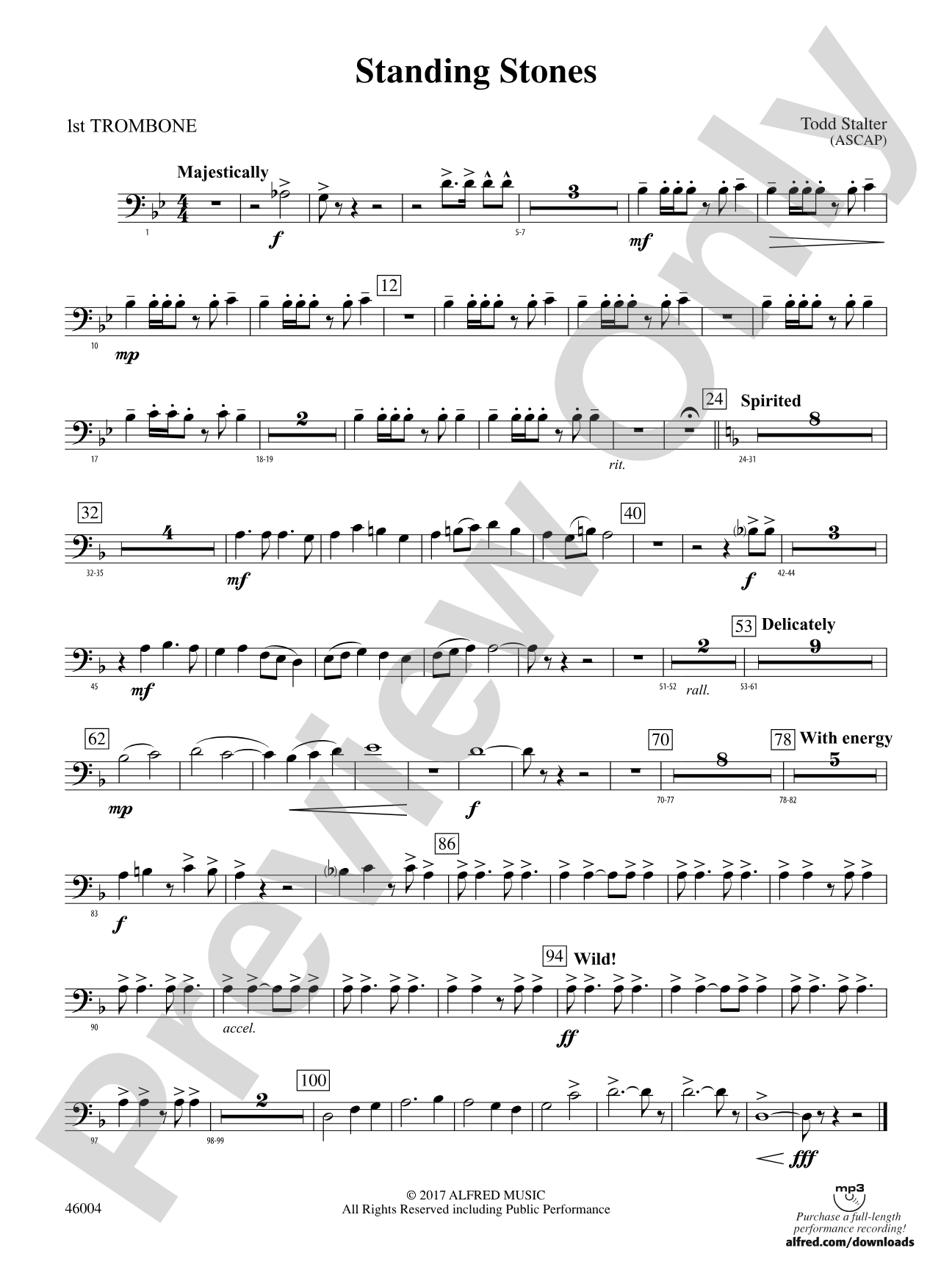

Standing Stones: 1st Trombone
By Todd Stalter
Grade: 3.5 (Medium)
Item: 00-PC-0017730_TN1
$5.99
Pickup currently not available
Description
Ancient legend says that as the Oneida were being chased on foot through a forest by an enemy tribe, they came to a clearing and suddenly disappeared from sight, confounding their enemies by shape-shifting into the stones that stood in the clearing. This piece is meant to commemorate that event. (4:30)


Don't just read it, hear it, play along with it, and watch your students grow with it. In MakeMusic Cloud, Standing Stones: 1st Trombone comes alive with professional accompaniment, adjustable tempo, and built-in practice tools that turn solo practice into real progress.
Open in the Player
Jump straight in and assign it today.
Start Your Free Trial
Open this title and explore the full library in minutes.
Sample Audio
1
Audio File
--:--
0:00
0:00
Sample Video
Additional Details
Series:
Alfred Concert Band
Publisher:
Alfred Music
Page Count:
208
SKU:
00-PC-0017730_TN1
More about this title
About the Composer: Todd Stalter

Todd Stalter built his reputation over 34 years as Director of Bands at Eureka High School in Illinois, where his ensembles achieved sustained excellence across multiple disciplines. The marching band earned 16 Class 1A state championships, the concert band consistently received Superior ratings at IHSA contests, and his groups performed at Orchestra Hall in Chicago, Walt Disney World, and bowl game festivals. He was inducted into the Illinois State Marching Band Championships Hall of Fame and has since maintained an active schedule as a guest conductor for all-state and honor bands in multiple states.
Stalter's compositional output has established a strong foothold in music education curricula nationwide. His works for band and string orchestra appear regularly on state contest and festival lists, and several pieces are featured in the acclaimed "Teaching Music Through Performance in Band" series published by GIA. He holds degrees from Illinois State University in music education and trumpet performance, where he studied with standout performers and conductors including a principal from the President's Own United States Marine Band.
Why we love this
Stalter grounds this piece in a genuine historical narrative about the Oneida, transforming cultural legend into compelling concert music that invites students to engage with Native American history and tradition. The Grade 3.5 scoring makes the Oneida origin story accessible to developing bands while maintaining the kind of musical sophistication that holds attention in both rehearsal and performance contexts. Few educational works at this level weave cultural meaning so seamlessly into the musical fabric.
What to expect
The music traces a journey from urgency and pursuit through landscape and shadow, culminating in a moment of stillness and transformation. Sonorities shift from fragmented, restless textures into sustained, almost stone-like harmonic blocks that linger in the listener's ear long after the final note.
Who it's for
Concert bands at the intermediate level seeking repertoire with historical depth and cultural relevance. Directors building contests and festival programs will find a work that engages students musically while grounding them in meaningful subject matter, whether or not the piece is competition-bound.
How to get the most out of it
- Shape the opening phrases to suggest movement through the forest; tempo flexibility here creates unease before the transformation moment.
- Balance the band's full sound during the climactic section by careful part doubling review; Mark your dynamic targets in rehearsal so all sections land them together.
- Allow space for the sustained tones that represent the "standing stones" to ring clearly; resist the urge to cut them short.
- Prepare transitions between sections in isolated passages before full run-throughs; this piece's narrative arc depends on seamless momentum shifts.
How to use it
This piece fits naturally into a concert program exploring themes of history, transformation, or cultural traditions. Its four-and-a-half minute length makes it an ideal companion to shorter concert openers or a centerpiece for a thematic set; many directors pair it with other works inspired by indigenous narratives or legends.
Skills your students will build
- Shaping longer phrases with purposeful dynamic arcs
- Transitioning between contrasting tempos and textures
- Sustaining ensemble balance across a full band sound
- Responding to narrative and programmatic content through musical expression
- Executing rhythmic precision in moderately complex mixed meters