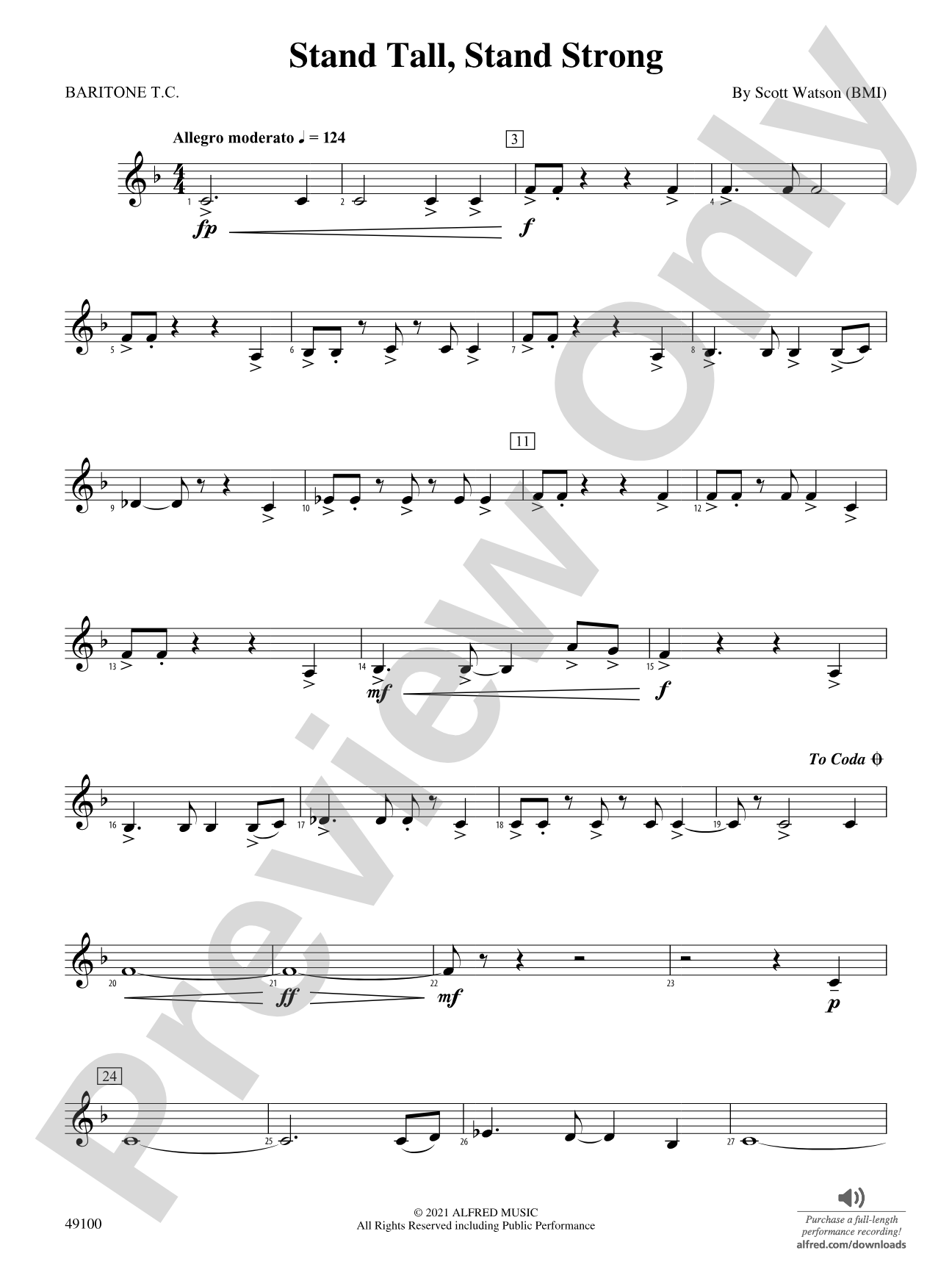
Stand Tall, Stand Strong: Baritone T.C. Sheet Music Preview

Stand Tall, Stand Strong: Baritone T.C.

By Scott Watson

Grade: 1.5 (Very Easy)

Item: 00-PC-0018674_BTC1

Digital Download
$3.00
Description
Stand Tall, Stand Strong by Scott Watson instills a musically resolute, optimistic statement appropriate for our time. No matter how soundly we are thrown down or how big the obstacles before us, we can rise again, press on, rebuild, and overcome. With grit and tenacity, we will emerge even stronger from the trials that beset us. (2:45)

Don't just read it, hear it, play along with it, and watch your students grow with it. In MakeMusic Cloud, Stand Tall, Stand Strong: Baritone T.C. comes alive with professional accompaniment, adjustable tempo, and built-in practice tools that turn solo practice into real progress.

Sample Audio
0:00
0:00
Sample Video
Additional Details
Series: Challenger Band Series
Publisher: Alfred Music
Page Count: 101
SKU: 00-PC-0018674_BTC1

More about this title

About the Composer: Scott Watson

Scott Watson

Scott Watson brings three and a half decades of public school teaching experience to his work as a composer and clinician. His dual background—first as a high school band director and later as coordinator of elementary band and strings across his district—grounds his compositional voice in the realities of ensemble rehearsal rooms at every level. Since joining Cairn University as Associate Professor of Music, he has continued to shape music education through workshops, guest conducting, and his textbook on technology and musical creativity.

With more than 120 published works for concert band, string orchestra, and chamber ensembles, Watson has established himself as a composer whose voice resonates across contemporary concert art music and traditional band literature. His pieces have been heard at the Academy of Music in Philadelphia, the Midwest Clinic in Chicago, and the White House. As an exclusive composer and clinician for Alfred Publications and a contributor to the Sound Innovations series, Watson remains deeply invested in creating accessible, meaningful music for student musicians.

Why we love this

Watson captures something essential here: the emotional truth of resilience without ever feeling preachy or heavy-handed. At Grade 1.5, the writing remains straightforward and playable, yet the musical statement lands with genuine conviction. Directors often struggle to find pieces at this level that inspire both the ensemble and the audience; this one does both.

What to expect

Anchored and forward-moving. The piece conveys steady determination rather than bombast, with harmonic language that feels warm and accessible while maintaining musical integrity. There is genuine optimism here, the kind that acknowledges difficulty but refuses to dwell in it.

Who it's for

Young concert bands (middle school through early high school) ready for literature that speaks to them musically and emotionally, without overwhelming technical demands. This works equally well for ensembles seeking meaningful programming or for contest and festival repertoire that carries substance.

How to get the most out of it

  • Shape the melodic contour deliberately; even at an easy level, clear phrase direction and dynamic shape create the sense of rising and pressing forward that the title promises.
  • Balance the harmony so sustained chords feel supportive rather than static. This reinforces the message of collective strength.
  • Let the tempo breathe naturally. Resist the urge to rush; the optimism comes through pacing, not speed.

How to use it

Program this as a concert opener that sets an uplifting, purposeful tone for your season. It also functions powerfully as contest or festival literature; the combination of accessible technical demands and meaningful content gives judges and audiences both solid musicianship and authentic expression. Consider pairing it with a contrasting work to build a well-rounded set.

Skills your students will build

  • Sustaining balanced tone in harmonic texture
  • Shaping longer phrases with direction and purpose
  • Reading and responding to dynamic and expressive markings
  • Coordinating ensemble sound across different instrumental sections

You May Also Like