
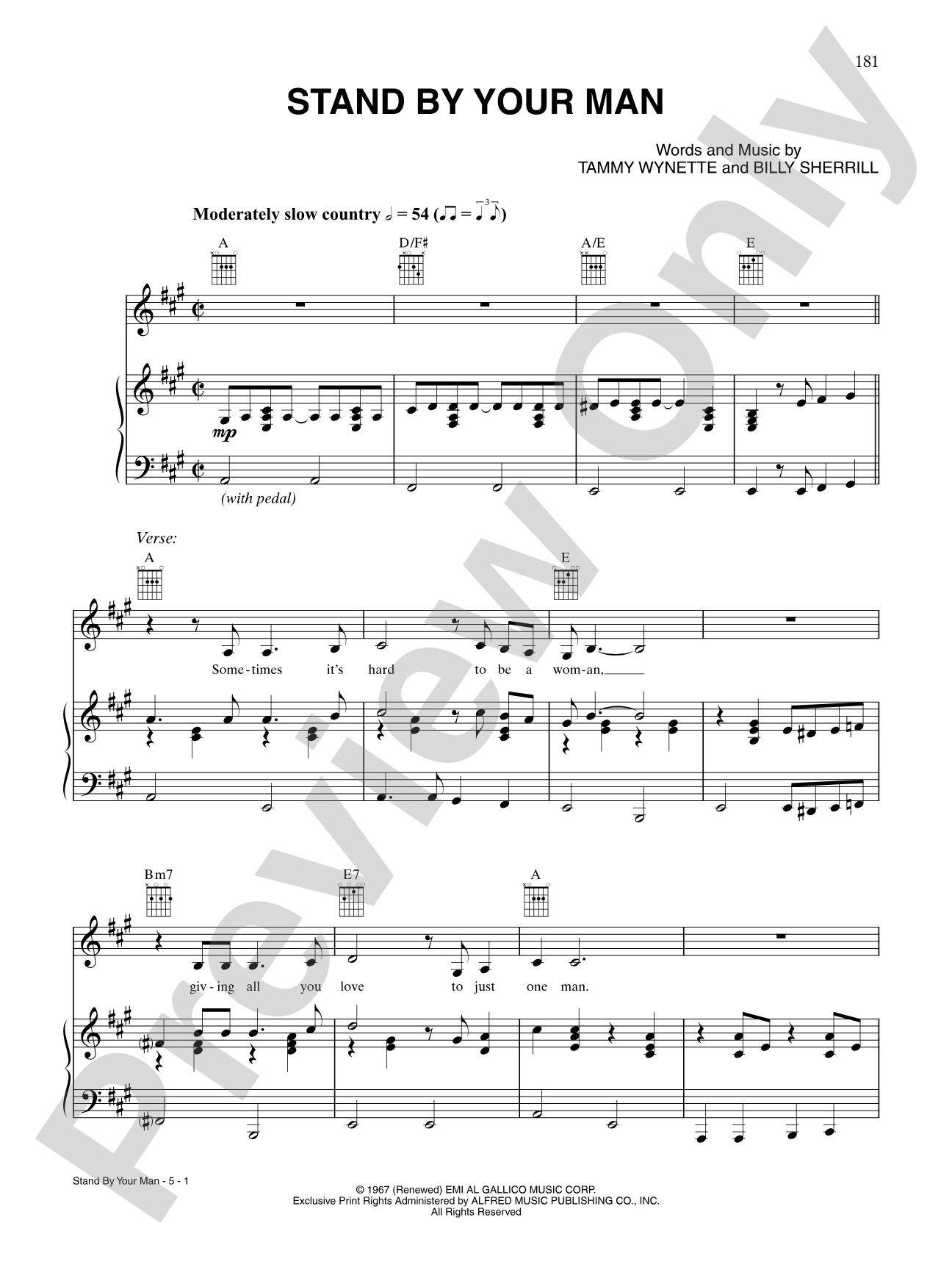

Stand By Your Man: Piano/Vocal/Chords
Item: 00-PS-0015651
$4.99
One moment…
Related Items
Take Me Home, Country Roads: Piano/Vocal/Chords |
$4.99
|
View | |
Almost Persuaded: Piano/Vocal/Chords |
$4.99
|
View | |
Amazed: Piano/Vocal/Chords |
$5.99
|
View | |
There You'll Be: Piano/Vocal/Chords |
$4.99
|
View | |
I Told You So: Piano/Vocal/Chords |
$4.99
|
View | |
I Swear: Piano/Vocal/Chords |
$4.99
|
View | |
Jesus, Take the Wheel: Piano/Vocal/Chords |
$5.99
|
View | |
Whiskey Lullaby: Piano/Vocal/Chords |
$5.99
|
View | |
White Horse: Piano/Vocal/Chords |
$5.99
|
View | |
The Giant Book of Country Sheet Music: Piano/Vocal/Chords Book |
$22.99
|
View |
Description
Country music fans who play or sing will love this giant songbook, which contains sheet music for more than 40 all-time favorites. Titles: All-American Girl (Carrie Underwood) * Almost Persuaded (David Houston) * Amazed (Lonestar) * American Honey (Lady Antebellum) * Anyway (Martina McBride) * Before He Cheats (Carrie Underwood) * Blown Away (Carrie Underwood) * Crazy Girl (Eli Young Band) * The Dance (Garth Brooks) * Do You Believe Me Now (Jimmy Wayne) * For You (Keith Urban) * Go Rest High on That Mountain (Vince Gill) * Good in Goodbye (Carrie Underwood) * How Do I Live (LeAnn Rimes) * I Could Not Ask for More (Sara Evans) * I Swear (John Michael Montgomery) * I Told You So (Carrie Underwood) * If I Die Young (The Band Perry) * I'll Stand by You (Carrie Underwood) * In My Daughter's Eyes (Martina McBride) * Jesus, Take the Wheel (Carrie Underwood) * Let Me Down Easy (Billy Currington) * Live Like You Were Dying (Tim McGraw) * Love Can Build a Bridge (The Judds) * Mama's Song (Carrie Underwood) * Margaritaville (Jimmy Buffett) * My Heart Can't Tell You No (Sara Evans) * Red Solo Cup (Toby Keith) * Smile (Uncle Kracker) * Some Hearts (Carrie Underwood) * Stand By Your Man (Tammy Wynette) * Take Me Home, Country Roads (John Denver) * Teardrops on My Guitar (Taylor Swift) * Temporary Home (Carrie Underwood) * There You'll Be (Faith Hill) * Undo It (Carrie Underwood) * Walk Me Down the Middle (The Band Perry) * When I Said I Do (Clint Black) * When You Come Back Down (Nickel Creek) * Whenever You Remember (Carrie Underwood) * Whiskey Lullaby (Brad Paisley and Carrie Underwood) * White Horse (Taylor Swift) * Why Wait (Rascal Flatts) * You Light Up My Life (LeAnn Rimes).


Stand By Your Man: Piano/Vocal/Chords isn't in MakeMusic Cloud just yet...but it could be. Let us know you'd like to see it, and you'll help shape what comes next. In the meantime, start a free trial and dive into thousands of interactive titles your students can play along with today.
Request This Title
Tell us you want it.
Start Your Free Trial
Explore everything that's ready to play right now.
Sample Audio
No sample audio found.
Sample Video
No sample videos found.
Additional Details
Series:
The Giant Book of Sheet Music
Publisher:
Alfred Music
Page Count:
256
SKU:
00-PS-0015651
More about this title
About the Composer: Tammy Wynette
Tammy Wynette (1942-1998) was a foundational figure in country music whose influence extends far beyond her era. Her composition "Stand By Your Man" became an anthem that defined Nashville songwriting in the 1960s and remains one of the most recorded country songs of all time. Wynette's work bridged traditional country and pop sensibilities, making her catalog essential listening for anyone studying how country music achieved mainstream reach.
As a composer and performer, Wynette demonstrated how deeply personal storytelling could resonate across genres and generations. Her songs explore themes of loyalty, heartbreak, and resilience with directness and emotional clarity that continue to inspire both interpreters and new songwriters. For music educators, her catalog represents a crucial chapter in understanding how country music evolved as both a regional tradition and a global commercial force.
Why we love this
This collection gathers over 40 country standards spanning decades of recording history, from Tammy Wynette classics to contemporary hits by Carrie Underwood, Tim McGraw, and Taylor Swift. The breadth makes it invaluable for singers and pianists who need accessible arrangements of recognizable repertoire that audiences actually want to hear. Programming a recital around these songs transforms what could feel like "covers" into a cohesive exploration of how country songwriting approaches melody, harmony, and narrative.
What to expect
These songs capture country music's gift for emotional directness without sentimentality. Whether you're playing a ballad about heartbreak or a lighter number like "Margaritaville," the arrangements honor the original recordings' essence while remaining accessible to play and sing. There's a warmth and intimacy in performing from this book, a sense of connecting to both deeply personal moments and widely shared cultural touchstones.
Who it's for
This book serves singers and pianists who perform in recitals, weddings, casual performances, or coffeehouse settings and want reliable, professional arrangements of country repertoire that audiences recognize. It's equally valuable for piano students exploring contemporary songwriting and singers developing a country-focused recital program. Choir directors can also mine it for contemporary soloists or featured singers within a larger concert context.
How to get the most out of it
- Balance the vocal line with harmonic interest in the piano part. These arrangements often use the chord symbols to suggest fuller voicings than the printed staff notation shows; lean into the richness without burying the singer.
- Pay attention to rhythmic pocket and groove rather than metronomic precision. Country phrasing often sits slightly behind or ahead of the beat in ways that feel natural in a band context but require deliberate choice at the piano.
- Let the lyrics inform your dynamic shape. Many of these songs build their power through emotional restraint in early verses before opening up; follow the story rather than pushing volume too early.
- Use the chord symbols to explore different voicing options in rehearsal. The printed piano part provides one interpretation, but these songs often sound fresh when you adapt the accompaniment to match the singer's interpretation or the emotional arc of a particular performance.
How to use it
Feature individual songs as solo pieces within a larger mixed recital, or build an entire program around a thematic arc that the variety here allows (working through time periods, emotional territories, or artists). This collection also serves student pianists learning to accompany singers, offering familiar material where focus can shift to collaboration rather than learning new melodies. For classroom or coffeehouse performances, it's a ready resource for students who want to perform meaningful repertoire outside the classical canon.
Skills your students will build
- Reading and interpreting chord symbols in the context of full piano arrangements
- Supporting a vocal line while maintaining rhythmic independence in the accompaniment
- Understanding contemporary songwriting structures and how they differ from classical forms
- Sight-reading piano-vocal arrangements with mixed notation (staff and chord symbols)
- Communicating musicality and phrasing with a singer in rehearsal and performance
- Adapting printed arrangements to serve different interpretive choices and performance contexts