
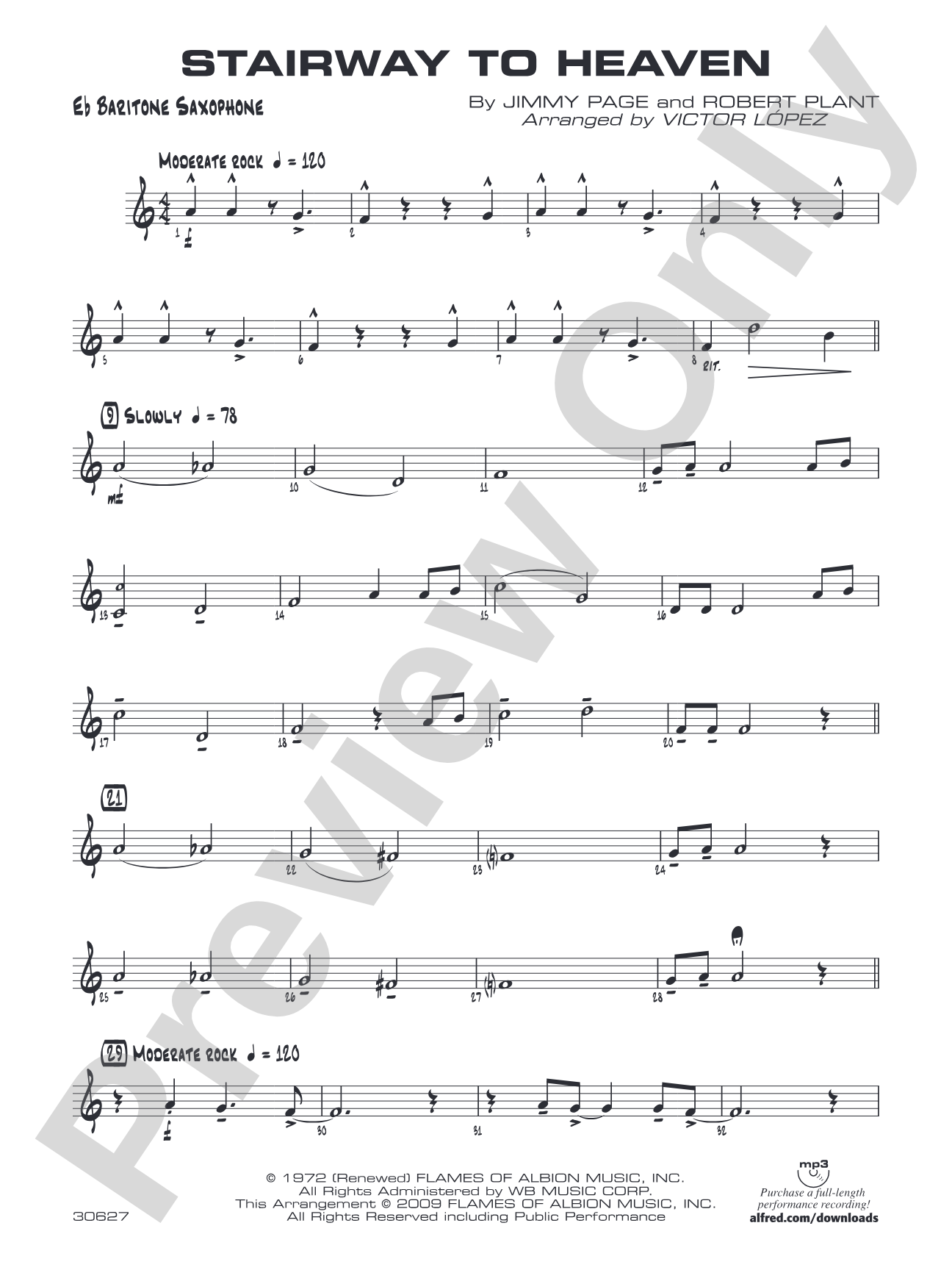

Stairway to Heaven: E-flat Baritone Saxophone
Words and music by Jimmy Page and Robert Plant / arr. Victor López
Grade: 2 (Medium Easy)
Item: 00-PC-0017513_BTX
$3.00
Pickup currently not available
Description
This is the classic Led Zeppelin hit adapted and arranged for jazz ensemble. There are a few easy tempo changes in this chart to allow it to conform to the original recording, but the essence is intact. A moderate rock groove opens the chart with plenty of cascading ensemble lines and a brief alto sax melody line, but no improvised solos. This could be a highlight of any concert so check it out! (3:20) This title is available in MakeMusic Cloud.


Don't just read it, hear it, play along with it, and watch your students grow with it. In MakeMusic Cloud, Stairway to Heaven: E-flat Baritone Saxophone comes alive with professional accompaniment, adjustable tempo, and built-in practice tools that turn solo practice into real progress.
Open in the Player
Jump straight in and assign it today.
Start Your Free Trial
Open this title and explore the full library in minutes.
Sample Audio
1
Audio File
--:--
0:00
0:00
Sample Video
No sample videos found.
Additional Details
Series:
Young Jazz Ensemble
Publisher:
Alfred Music
Page Count:
90
SKU:
00-PC-0017513_BTX
More about this title
About the Composer: Jimmy Page
Jimmy Page emerged as one of rock music's most innovative guitarists and composers, pioneering the heavy rock and hard rock sound that defined the 1970s. As the guitarist and primary songwriter for Led Zeppelin, Page crafted arrangements that blended blues, folk, and Eastern musical influences into compositions of remarkable sophistication and emotional range. His work as a composer extended far beyond typical rock songwriting; Page approached each piece as a complete musical statement, layering instrumentation and dynamics in ways that influenced generations of musicians across all genres.
Why we love this
Victor Lopez's arrangement captures the architectural elegance of the original without asking for soloists to improvise, making this accessible for ensembles still building their improvisational confidence. The tempo changes that frame the composition honor the original recording's journey while remaining manageable in rehearsal and performance. Programming this arrangement alongside more traditional jazz standards creates a refreshing contrast that keeps audiences engaged and reminds students why they fell in love with jazz in the first place.
What to expect
The opening unfolds with the meditative, building tension of the original before settling into a moderate rock groove that energizes the ensemble. Cascading lines weave through the texture like the famous guitar arpeggios reimagined for multiple voices, creating momentum and sophistication despite the medium-easy grade level. The piece feels both familiar and fresh, bridging rock and jazz in a way that feels natural rather than forced.
Who it's for
This arrangement serves Grade 2 jazz ensembles that want to perform recognizable, engaging repertoire without tackling advanced improvisation or complex harmony. Directors looking for a concert highlight that resonates with audiences of all ages will find a piece that balances approachability with genuine musicality. Students gain experience reading a full jazz score while performing a composition they and their listeners already know and love.
How to get the most out of it
- Balance the cascading ensemble lines carefully so that each instrumental section can be heard; these layered passages define the chart's character and need clarity more than volume.
- Use the tempo markings as compositional signposts rather than obstacles. Allow adequate rehearsal time for the transitions so they feel inevitable rather than abrupt.
- Shape the alto sax melody with presence but restraint; it's brief and deserves careful attention to phrasing and tone quality to anchor the listener's ear.
- Lock the rhythm section into the rock groove at the opening so that the ensemble's cascading lines sit comfortably on top of a solid foundation.
How to use it
Position this arrangement as a concert-closing number or as the finale of a jazz-focused set where it can serve as an audience favorite that sends people home humming. The 3-minute-20-second duration makes it a substantial feature without dominating a program, and its accessibility means rehearsal time can focus on refinement and performance quality rather than fundamental technique. Consider programming it alongside other rock-influenced jazz standards to create a thematic arc that shows how jazz ensembles approach contemporary music.
Skills your students will build
- Reading multiple tempo markings and executing smooth transitions between them
- Balancing individual instrumental lines within dense ensemble textures
- Playing rock-inflected rhythms and grooves in a jazz ensemble context
- Interpreting articulation and phrasing choices that bridge rock and jazz aesthetics