
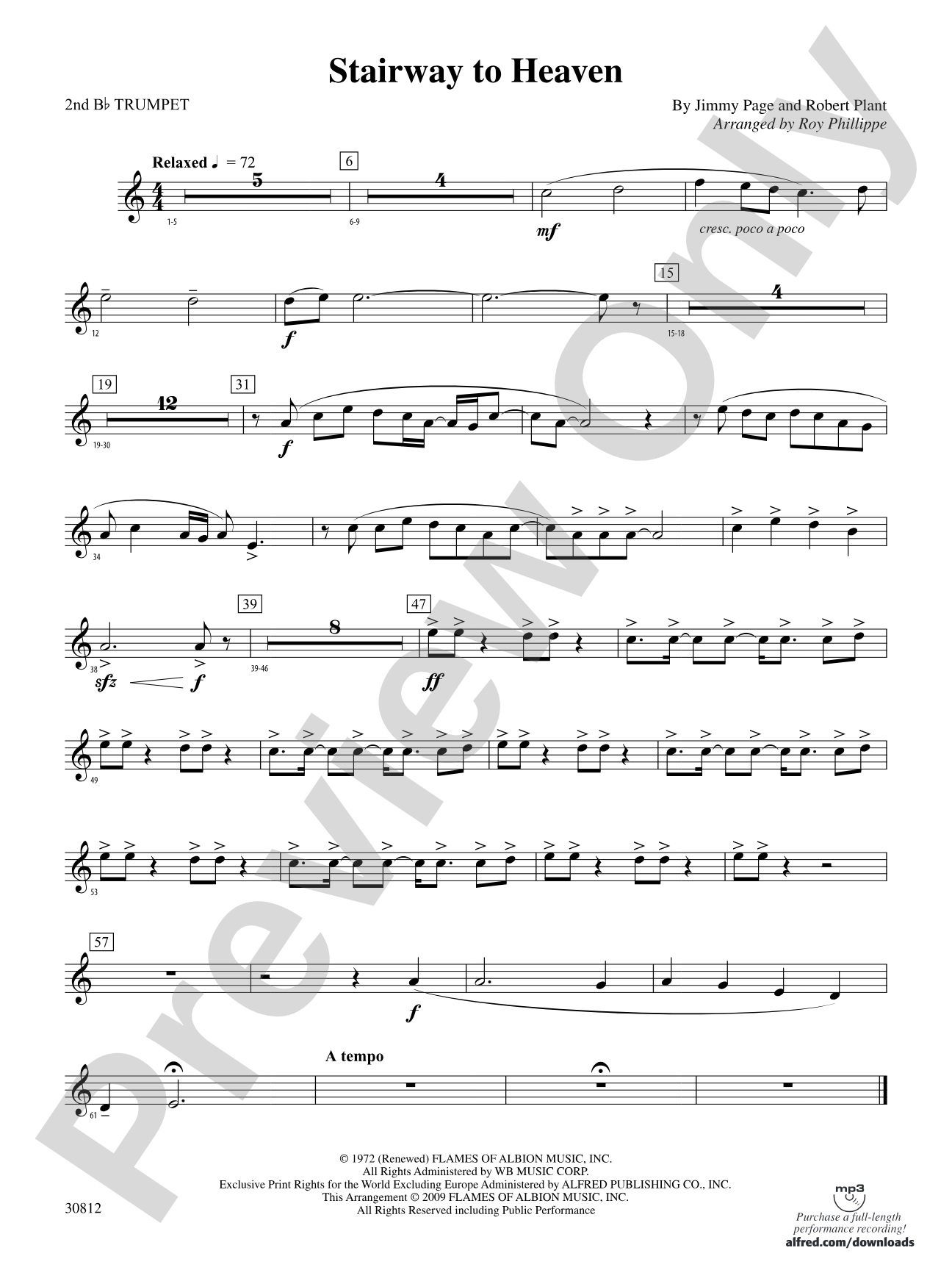

Stairway to Heaven: 2nd B-flat Trumpet
As performed by Led Zeppelin
By Jimmy Page and Robert Plant / arr. Roy Phillippe
Grade: 3 (Medium Easy)
Item: 00-PC-0001687_T2
$5.99
Pickup currently not available
Description
Stairway to Heaven is a song by the English rock band Led Zeppelin. It was composed by guitarist Jimmy Page and vocalist Robert Plant for the band's fourth studio album, Led Zeppelin IV. It was voted #3 in 2000 by VH1 on their list of the 100 Greatest Rock Songs. It is the most requested and most played song on FM radio stations in the United States, despite never having been released as a single there. Classic rock just never goes bad! This solidly scored arrangement has a driving rock beat that will have your concert band at the top of the charts as well.


Don't just read it, hear it, play along with it, and watch your students grow with it. In MakeMusic Cloud, Stairway to Heaven: 2nd B-flat Trumpet comes alive with professional accompaniment, adjustable tempo, and built-in practice tools that turn solo practice into real progress.
Open in the Player
Jump straight in and assign it today.
Start Your Free Trial
Open this title and explore the full library in minutes.
Sample Audio
1
Audio File
--:--
0:00
0:00
Sample Video
No sample videos found.
Additional Details
Series:
Pop Concert Band
Publisher:
Alfred Music
Page Count:
120
SKU:
00-PC-0001687_T2
More about this title
About the Artist: Jimmy Page
Jimmy Page stands as one of rock music's most innovative guitarists and producers. His work with Led Zeppelin across four decades defined hard rock and heavy metal, setting standards for guitar technique, studio experimentation, and songwriting that musicians still study today. Page's arrangements and production choices transformed how rock music was recorded and performed, making him a crucial figure in understanding modern ensemble music beyond classical traditions.
Why we love this
Roy Phillippe's arrangement captures the iconic architecture of the original without losing the driving energy that makes this song instantly recognizable to your students and audiences alike. The Grade 3 scoring distributes the melodic and rhythmic material across the full band, giving every section meaningful contributions rather than relegating some players to accompaniment. Concert bands rarely get to tackle genuine classic rock that resonates across generations, and this arrangement proves that crossover repertoire can be both musically rewarding and genuinely engaging for performers.
What to expect
From the opening notes, you feel the weight and swagger of classic rock, but filtered through the fullness and color of a concert band. The arrangement builds and ebbs with the architecture of the original song, creating moments of intense unison power alongside sections where individual voices emerge. It captures the song's hypnotic quality, that sense of building intensity and inevitable forward motion that has made it one of the most enduring recordings in rock history.
Who it's for
Concert band directors looking to program music that genuinely excites student musicians and audiences without compromising musical substance. This arrangement works for bands at the upper end of Grade 2 through solid Grade 3 ensembles; it offers enough textural interest and part independence to challenge developing players while remaining accessible in terms of range and technical demands.
How to get the most out of it
- Balance the bass line and low woodwind foundation carefully during the heavier sections; these voices anchor the driving rock feel and need clarity even when the upper voices are fully voiced.
- Treat the dynamics as essential to the arrangement's forward momentum. Rock phrasing lives in the subtle pushes and pulls around the beat, not in metronomic uniformity.
- Pay attention to how the melody passes between sections. The original's power comes from the continuity of the main theme, so coordinate handoffs between instruments to maintain its shape and impact.
- Use the rhythmic precision of your section leaders to lock in the rock beat. Percussion and lower brass need to establish the groove confidently so that the full band's energy feels propulsive rather than tentative.
How to use it
Program this as a concert highlight or season closer when you want to demonstrate the range of musical styles your band can command. The 120-page score suggests a piece substantial enough to anchor a program, and it pairs well with traditional concert band fare on a mixed repertoire concert. Many bands find this especially effective for spring concerts, pep assemblies, or community engagement events where reaching a broad audience matters as much as artistic presentation.
Skills your students will build
- Playing driving rock rhythms with precision and swing feel
- Balancing melody across multiple instruments within a section-based texture
- Dynamic contrast and phrasing in a non-classical idiom
- Sustaining ensemble groove and forward momentum over longer harmonic cycles
- Reading and interpreting notation specific to rock and pop arrangements