
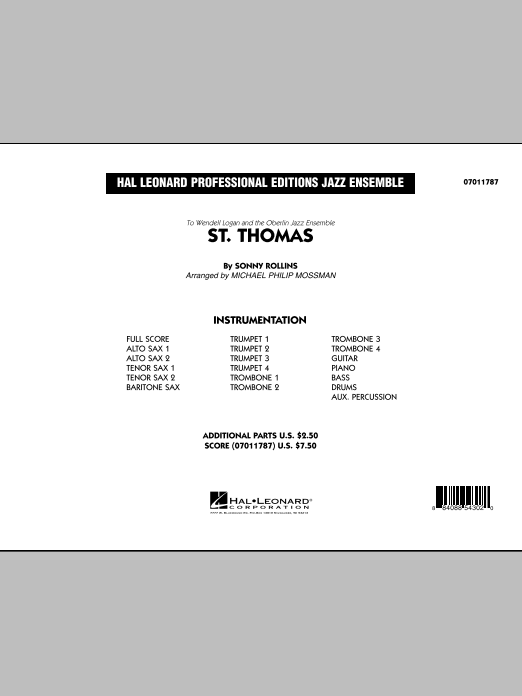

St. Thomas: Jazz Ensemble Conductor Score & Parts
By Sonny Rollins / Arranged by Michael Philip Mossman
Grade: 5
Item: 35-PK00175303
$60.00
Pickup currently not available
Buy Extra Parts (Digital PDF Download)
| Product | Price | Quantity |
|---|---|---|
| St. Thomas - Conductor Score (Full Score) | $7.50 | |
| St. Thomas - Alto Sax 1 | $6.00 | |
| St. Thomas - Alto Sax 2 | $6.00 | |
| St. Thomas - Tenor Sax 1 | $6.00 | |
| St. Thomas - Tenor Sax 2 | $6.00 | |
| St. Thomas - Baritone Sax | $6.00 | |
| St. Thomas - Trumpet 1 | $6.00 | |
| St. Thomas - Trumpet 2 | $6.00 | |
| St. Thomas - Trumpet 3 | $6.00 | |
| St. Thomas - Trumpet 4 | $6.00 | |
| St. Thomas - Trombone 1 | $6.00 | |
| St. Thomas - Trombone 2 | $6.00 | |
| St. Thomas - Trombone 3 | $6.00 | |
| St. Thomas - Trombone 4 | $6.00 | |
| St. Thomas - Guitar | $6.00 | |
| St. Thomas - Piano | $6.00 | |
| St. Thomas - Bass | $6.00 | |
| St. Thomas - Drums | $6.00 | |
| St. Thomas - Aux Percussion | $6.00 |
Parts Added to Cart!
Description
One of the most familiar Latin standards is given a complete facelift by Michael Mossman in this creative and impressive sounding arrangement. You'll find harmonic wrinkles and rhythmic twists and turns amidst some really hot ensemble writing. A variety of solo opportunities are also provided.


St. Thomas: Jazz Ensemble Conductor Score & Parts isn't in MakeMusic Cloud just yet...but it could be. Let us know you'd like to see it, and you'll help shape what comes next. In the meantime, start a free trial and dive into thousands of interactive titles your students can play along with today.
Request This Title
Tell us you want it.
Start Your Free Trial
Explore everything that's ready to play right now.
Sample Audio
No sample audio found.
Sample Video
No sample videos found.
Additional Details
Publisher:
Hal Leonard
SKU:
35-PK00175303
More about this title
About the Composer: Sonny Rollins
Sonny Rollins stands as one of the most influential tenor saxophonists in jazz history, known for his fearless improvisation and harmonic sophistication. His composition 'St. Thomas' has become a jazz standard precisely because of its infectious melody and structural clarity, making it an ideal vehicle for student ensemble arrangements.
Rollins' legacy in music education extends beyond his own performances. His approach to melody and rhythm provides an essential study in how a simple, memorable tune can accommodate endless reharmonization and creative interpretation, a principle that makes this Mossman arrangement so pedagogically valuable.
Why we love this
Mossman respects the tune's infectious core while introducing harmonic sophistication and rhythmic playfulness that keeps ensemble players engaged and attentive throughout. The solo opportunities scattered across the arrangement mean different sections get moments in the spotlight, and the variety of textures prevents the piece from becoming predictable. For a Grade 5 ensemble, this hits the sweet spot between accessibility and genuine artistry.
What to expect
Energetic and inventive. The familiar melody grounds listeners immediately, but Mossman's harmonic reimagining and rhythmic detours keep things fresh and unpredictable. The ensemble writing feels orchestral in scope while maintaining the conversational character essential to jazz.
Who it's for
Grade 5 jazz ensembles ready to tackle a recognizable standard with real harmonic teeth and ensemble sophistication. Directors seeking a piece that connects students to jazz tradition while offering fresh arranging ideas will find plenty to work with here.
How to get the most out of it
- Lock the ensemble into the clave rhythm early in rehearsal. This arrangement's Latin feel depends on rhythmic precision from rhythm section and horns together, not as separate layers.
- Encourage soloists to listen to recordings of Rollins' original to understand the tune's character before they personalize it. The melodic contour should remain recognizable even with creative liberty.
- Balance the harmonic complexity in ensemble passages by having players mark chord tones versus passing motion. Mossman's wrinkles reveal themselves when inner voices stay clear.
- Give the ensemble permission to phrase the Latin grooves with a slight swing feel in certain sections. The arrangement's rhythmic twists benefit from flexible, conversational articulation rather than mechanical precision.
How to use it
This works beautifully as a second-set opener or closer where its vitality can anchor a concert. Pair it with other standards at similar difficulty levels to build a cohesive jazz program, or use it to demonstrate how one tune can support multiple arranging philosophies when you program it alongside other 'St. Thomas' versions.
Skills your students will build
- Reading and performing Latin rhythmic patterns (clave, montuno figures)
- Navigating reharmonized changes while keeping the original melody recognizable
- Balancing solo improvisation within ensemble textures
- Responding to dynamic harmonic complexity in real time
- Interpreting articulation and phrasing cues specific to jazz style