
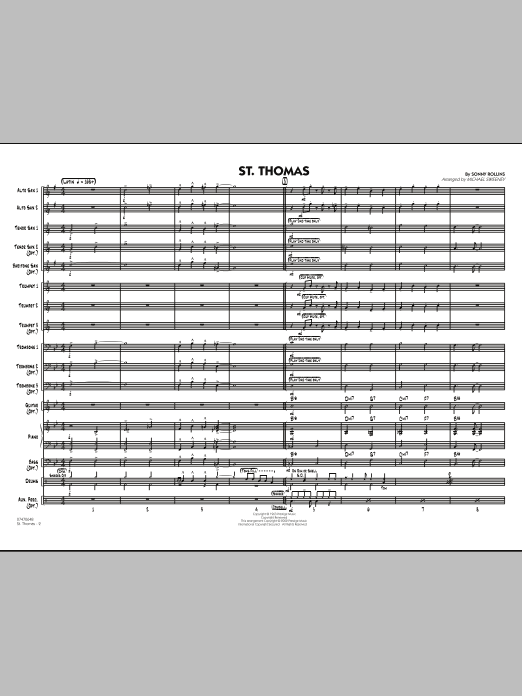

St. Thomas: Jazz Ensemble Conductor Score & Parts
By Sonny Rollins / Arranged by Michael Sweeney
Grade: 1.5
Item: 35-PK00142264
$45.00
Pickup currently not available
Buy Extra Parts (Digital PDF Download)
| Product | Price | Quantity |
|---|---|---|
| St. Thomas - Conductor Score (Full Score) | $7.50 | |
| St. Thomas - Alto Sax 1 | $6.00 | |
| St. Thomas - Alto Sax 2 | $6.00 | |
| St. Thomas - Tenor Sax 1 | $6.00 | |
| St. Thomas - Tenor Sax 2 | $6.00 | |
| St. Thomas - Baritone Sax | $6.00 | |
| St. Thomas - Trumpet 1 | $6.00 | |
| St. Thomas - Trumpet 2 | $6.00 | |
| St. Thomas - Trumpet 3 | $6.00 | |
| St. Thomas - Trombone 1 | $6.00 | |
| St. Thomas - Trombone 2 | $6.00 | |
| St. Thomas - Trombone 3 | $6.00 | |
| St. Thomas - Guitar | $6.00 | |
| St. Thomas - Piano | $6.00 | |
| St. Thomas - Bass | $6.00 | |
| St. Thomas - Drums | $6.00 | |
| St. Thomas - Aux Percussion | $6.00 |
Parts Added to Cart!
Description
Never has there been a version of this Sonny Rollins classic in an arrangement this easy! With ample use of unison lines, a moderate tempo and careful scoring, this one will really cook with young players.


St. Thomas: Jazz Ensemble Conductor Score & Parts isn't in MakeMusic Cloud just yet...but it could be. Let us know you'd like to see it, and you'll help shape what comes next. In the meantime, start a free trial and dive into thousands of interactive titles your students can play along with today.
Request This Title
Tell us you want it.
Start Your Free Trial
Explore everything that's ready to play right now.
Sample Audio
No sample audio found.
Sample Video
No sample videos found.
Additional Details
Publisher:
Hal Leonard
SKU:
35-PK00142264
More about this title
About the Composer: Sonny Rollins
Sonny Rollins stands as one of jazz's most inventive tenor saxophonists and composers. His approach to melody and improvisation has influenced generations of jazz musicians, and his compositions have become standards in the jazz repertoire. Rollins' ability to write simple, memorable themes that also function as vehicles for sophisticated improvisation makes his music particularly valuable in educational settings.
Why we love this
Young ensembles rarely get to play an actual jazz standard that sounds this authentic without requiring advanced reading skills or complex voicings. Michael Sweeney's arrangement keeps the groove intact through unison and simpler harmonic textures, meaning your students can focus on what makes jazz jazz: swing, phrasing, and listening to each other rather than parsing difficult notation.
What to expect
St. Thomas lands somewhere between a blues shuffle and a Caribbean lilt. The melody is instantly recognizable and singable, inviting young players to find their voice on the instrument rather than battle unfamiliar harmonic territory. There's a warmth and accessibility to this tune that makes musicians want to come back to it.
Who it's for
Jazz ensembles at the beginning of their jazz journey, whether in a school band program or community setting. This arrangement works equally well for groups tackling jazz for the first time and for ensembles building foundational repertoire before moving into more complex standards.
How to get the most out of it
- Establish a relaxed groove before worrying about precision. The moderate tempo gives everyone room to breathe; let the rhythm section lock in first, then layer the horns.
- Emphasize the space between phrases. Jazz is as much about what you don't play as what you do, so practice the rests with the same intentionality as the written lines.
- Highlight the melody's call-and-response moments where sections exchange ideas. These interaction points are what make the arrangement feel conversational rather than mechanical.
- Record a rehearsal and listen back as an ensemble. Hearing themselves play a recognizable jazz tune builds investment that written feedback alone cannot achieve.
How to use it
Slot this into a spring jazz concert where you want to showcase what young players have learned without overreaching technically. It also works beautifully as a confidence builder mid-year, giving the group a genuine jazz standard to anchor their developing sense of style and group communication.
Skills your students will build
- Swing articulation and rhythmic feel in jazz context
- Listening and responding to ensemble balance in small group settings
- Reading unison lines with stylistic consistency
- Understanding and executing call-and-response melodic structures
- Maintaining groove while playing against it with subtle syncopation