
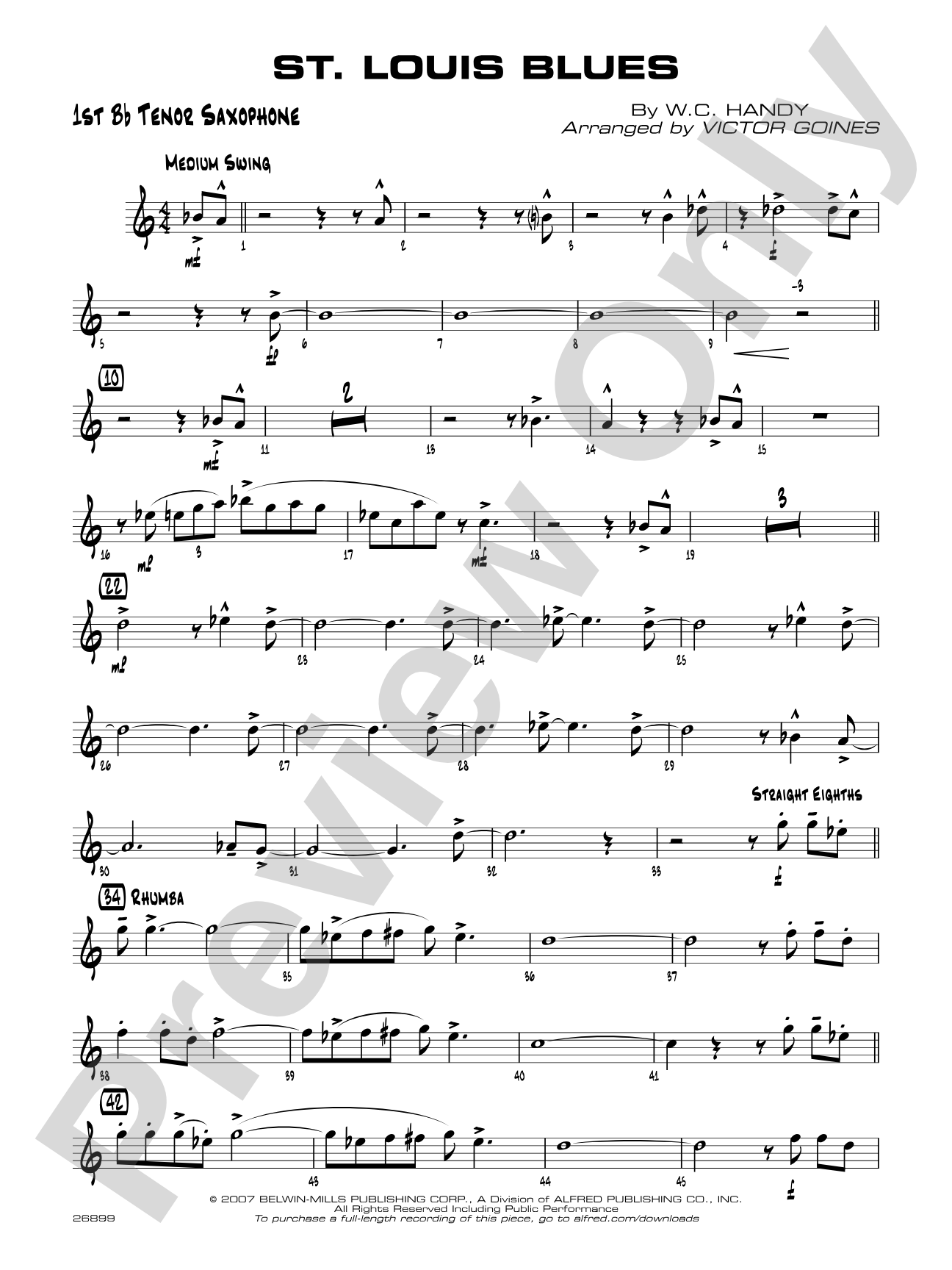

St. Louis Blues: B-flat Tenor Saxophone
By W. C. Handy / arr. Victor Goines
Item: 00-PC-0014809_TX1
$3.00
Pickup currently not available
Description
Composer/arranger/educator Victor Goines has arranged this blues tune by W.C. Handy as a swing with Latin-rumba interludes. A clever update of a classic, check out the stylistic contrasts he writes along with the written solos for trumpet 2 and trombone 1. Lead trumpet range is to written A above the staff. This arrangement is correlated and discussed in the Jazz at Lincoln Center Jazz for Young People Curriculum. An original and creative chart. This title is available in MakeMusic Cloud.


Don't just read it, hear it, play along with it, and watch your students grow with it. In MakeMusic Cloud, St. Louis Blues: B-flat Tenor Saxophone comes alive with professional accompaniment, adjustable tempo, and built-in practice tools that turn solo practice into real progress.
Open in the Player
Jump straight in and assign it today.
Start Your Free Trial
Open this title and explore the full library in minutes.
Sample Audio
1
Audio File
--:--
0:00
0:00
Sample Video
No sample videos found.
Additional Details
Series:
Jazz for Young People Series
Publisher:
Alfred Music
Page Count:
94
SKU:
00-PC-0014809_TX1
More about this title
About the Composer: W. C. Handy
W.C. Handy (1873–1915) shaped American music by legitimizing blues as a concert form and publishing some of the earliest written blues compositions. As a bandmaster, cornet player, and prolific composer, he elevated folk blues traditions into sophisticated sheet music that reached far beyond juke joints and into concert halls, dance floors, and eventually the world. His work bridged vernacular and composed traditions, proving that blues deserved a place alongside European classical forms.
Handy's legacy rests partly on his ear for melody and harmonic sophistication, but equally on his role as a cultural advocate. He published blues during a time when the form was dismissed by many music institutions, and his publications introduced countless musicians and audiences to the blues idiom. "St. Louis Blues" remains his most enduring composition, a testament to his gift for writing music that feels both carefully constructed and deeply rooted in lived experience.
Why we love this
Victor Goines brings his deep Jazz at Lincoln Center sensibility to this masterwork, crafting a chart that honors Handy's original while creating genuine musical drama through stylistic contrast. The swing sections crackle with energy, the Latin-rumba passages shift the ensemble's feel entirely, and the featured solos for trumpet 2 and trombone 1 give your section leaders moments to shine on a song every audience member will recognize. This is a teaching chart that doesn't talk down to students while still being genuinely fun to perform.
What to expect
The piece opens with the unmistakable blues DNA that Handy composed, but Goines refuses to let it sit still. Swing sections feel buoyant and forward-moving, with rhythm section energy that pulls the melody along; then suddenly the Latin-rumba passages shift the ground beneath your feet, introducing new rhythmic textures and a sensual, syncopated feel. The solo spaces carve out room for individual voices to sing, and throughout, there's a sense of playful reinterpretation: you're hearing a beloved tune get turned sideways and discovering it from a fresh angle.
Who it's for
Jazz ensembles at the secondary or college level with players ready to navigate idiomatic swing comping, Latin rhythmic figures, and featured solo work will find this chart both musically rewarding and pedagogically sound. Directors seeking a blues standard that moves beyond a straight 12-bar feel into genuine compositional sophistication can trust Goines's arrangement to engage students while building their understanding of how a classic can be reimagined.
How to get the most out of it
- Establish the swing feel early in rehearsal before tackling the Latin sections; the rhythmic character shifts dramatically, and your ensemble needs clarity on both grooves before combining them.
- Give trumpet 2 and trombone 1 ample time to develop their solos; these voices carry the arrangement's personalized sound, and rushed preparation will underserve the piece's dramatic architecture.
- Balance the lead trumpet's range carefully as it extends to written A above the staff; this note sits high enough to cut through the ensemble, but it should land as a musical peak, not a survival technique.
- Use the stylistic transitions as sectional rehearsal points; the move between swing and rumba requires different articulation, dynamics, and section blend, so isolate and polish each color distinctly.
How to use it
Program this as a centerpiece for a jazz-focused concert or as a bridge between classic blues and contemporary jazz exploration. It works equally well as a statement of jazz tradition early in a season or as a climactic piece that showcases ensemble musicianship and individual artistry. The accessibility of the original melody combined with the arranging sophistication makes it an excellent choice when you want to speak to both jazz-savvy audiences and listeners encountering the form for the first time.
Skills your students will build
- Swing comping and rhythmic feel in ensemble context
- Latin rhythmic patterns and clave-based accompaniment
- Solo preparation and melodic phrasing over changes
- Stylistic shifts and contrasting articulation within a single piece
- Lead trumpet range extension and projection to written A
- Blues form understanding through harmonic and melodic analysis