
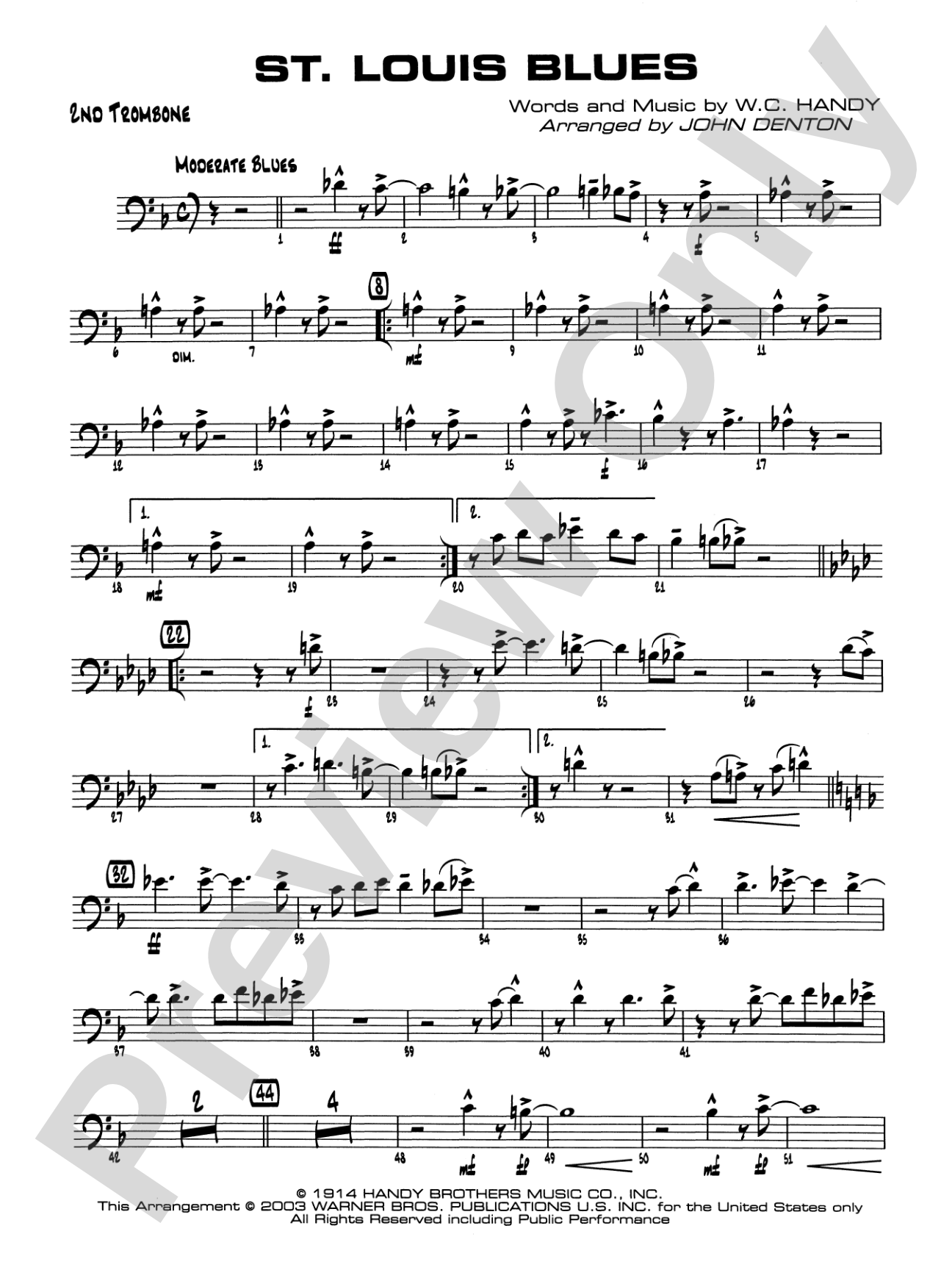

St. Louis Blues: 2nd Trombone
Words and music by W. C. Handy / arr. John Denton
Grade: 3 (Medium)
Item: 00-PC-0002462_TN2
$3.00
Pickup currently not available
Description
Here is a must-have jazz classic that has been performed by virtually every jazz artist from composer W.C. Handy and Glenn Miller to Herbie Hancock. That's because it is a clever and interesting tune - going from major to minor then back to major all the while keeping the blues form. Arranger John Denton creatively sets the groove as a swing shuffle right from the first note and it continues to build. Solo space for tenor sax along with the flexibility of optional parts makes this a winner.


Don't just read it, hear it, play along with it, and watch your students grow with it. In MakeMusic Cloud, St. Louis Blues: 2nd Trombone comes alive with professional accompaniment, adjustable tempo, and built-in practice tools that turn solo practice into real progress.
Open in the Player
Jump straight in and assign it today.
Start Your Free Trial
Open this title and explore the full library in minutes.
Sample Audio
1
Audio File
--:--
0:00
0:00
Sample Video
No sample videos found.
Additional Details
Series:
Jazz Band Series
Publisher:
Alfred Music
Page Count:
98
SKU:
00-PC-0002462_TN2
More about this title
About the Composer: W. C. Handy
W.C. Handy (1873-1958) fundamentally changed American music by legitimizing the blues as a serious musical form. A classically trained cornet player and bandleader, Handy synthesized African American folk traditions with formal composition techniques, creating works that bridged popular song and concert music. His influence on jazz, popular song, and American musical identity remains unmatched.
Handy's most enduring contribution to jazz education is establishing the blues as a harmonic and melodic foundation that generations of musicians learn first. Teachers turn to his work because it teaches authentic blues vocabulary while remaining accessible to ensemble students at all levels.
Why we love this
John Denton's arrangement respects the tune's harmonic sophistication while keeping the ensemble engaged and challenged at Grade 3. The swing shuffle groove feels immediately authentic, and the tonal shift from major to minor gives students a real harmonic concept to follow and discuss. Optional parts mean you can field this ensemble flexibly without sacrificing the arrangement's character.
What to expect
Confident and slightly sophisticated. The shuffle establishes itself right away, giving the ensemble a solid groove to stand on. As the major and minor tonalities play off each other, there's a subtle emotional depth that keeps listeners engaged beyond a simple 12-bar blues.
Who it's for
Directors leading Grade 2-4 jazz ensembles who want an arrangement that sounds professional and feels authentic without overshooting student technical ability. This works for groups with at least one competent tenor sax soloist and a solid rhythm section. The optional parts make it accessible whether you have a full 16-piece band or a smaller combo.
How to get the most out of it
- Lock the shuffle feel from the first note. The groove needs to establish itself clearly in the opening chorus, so have rhythm section and front line rehearse independently until the pocket feels inevitable before bringing them together.
- Shape the tenor sax solo space by having the section support rather than accompany. This is solo time, not a tutti moment, so the ensemble should provide texture and pocket, not fill every space with harmony.
- Balance the tonal shift when moving between major and minor sections. Mark these transitions clearly in rehearsal and use dynamic shaping to highlight the harmonic change, making it a feature rather than a seam.
- Approach the form as storytelling. The blues structure is familiar to your ensemble, but this arrangement adds narrative through its major-minor interplay. Point this out and rehearse it as intentional composition, not just chord changes.
How to use it
This works beautifully as a second-set opener at a jazz concert, especially after a more formal classical selection. It also serves as an excellent anchor piece for a jazz standards curriculum unit, pairing well with student discussions of blues form and how composers use harmonic color to create interest within a traditional structure.
Skills your students will build
- Blues form and 12-bar structure recognition
- Major-to-minor harmonic modulation
- Swing shuffle groove and rhythm section coordination
- Solo space awareness and ensemble support for improvisation
- Part flexibility and optional section reading