St. James Infirmary: Lead Sheet Digital Sheet Music

St. James Infirmary: Lead Sheet Digital Sheet Music

Cab Calloway, Joe Primrose

Item: 00-PS-0002531

Digital Download
$1.99
Description

St. James Infirmary: Lead Sheet Digital Sheet Music isn't in MakeMusic Cloud just yet...but it could be. Let us know you'd like to see it, and you'll help shape what comes next. In the meantime, start a free trial and dive into thousands of interactive titles your students can play along with today.

Sample Audio
No sample audio found.
Sample Video
Additional Details
SKU: 00-PS-0002531

More about this title

About the Artist: Cab Calloway

Cab Calloway (1907-1994) was a bandleader, singer, and entertainer who became one of jazz's most influential figures during the swing era. Known for his showmanship, impeccable sense of rhythm, and distinctive vocal style, Calloway led his orchestra through the 1930s and 1940s, recording dozens of standards and original compositions that defined the era. His ability to bridge entertainment and musicianship made him a model for generations of jazz performers.

Why we love this

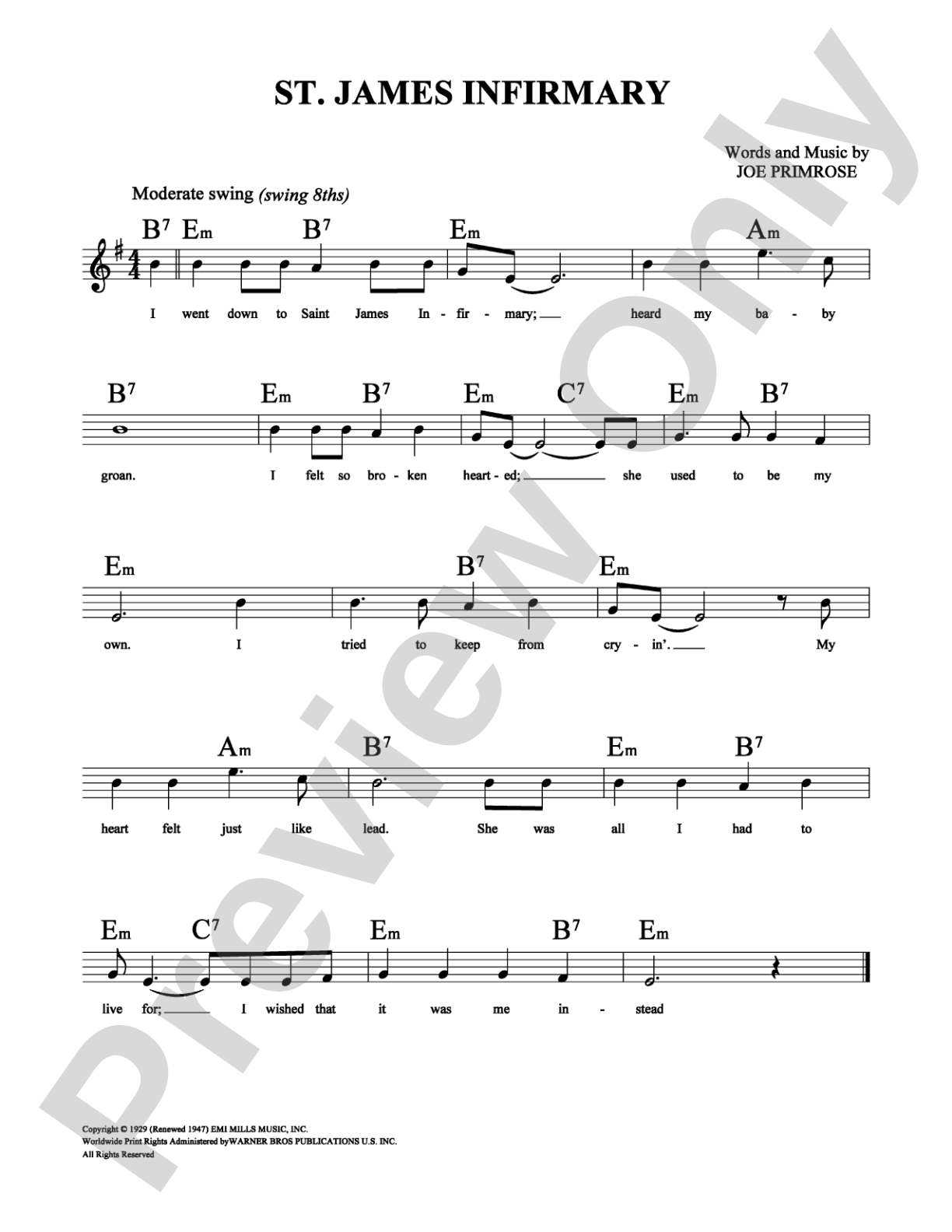
St. James Infirmary is a fixture in jazz curricula because it sits at the intersection of accessibility and authenticity. The lead sheet format lets students see exactly how Calloway's arrangement worked, making it ideal for analyzing swing phrasing, embellishment, and the rhythmic sophistication that separates jazz standards from pop songs. Programming it gives your ensemble a chance to play a piece with genuine historical weight and proven audience appeal.

What to expect

St. James Infirmary carries a wistful melancholy beneath its swinging groove. The melody sits in a minor context with bluesy inflections, giving it an introspective quality even as the rhythm propels forward. Calloway's interpretation balances sophistication with accessibility, creating a tune that feels both timeless and immediately recognizable.

Who it's for

Jazz ensemble members learning to read and interpret lead sheets, either for solo performance or as a reference for section playing. It works well for high school and college jazz programs, and for private students studying jazz standards and Swing Era repertoire. Any musician interested in understanding how a historical recording translates to written form will find value in studying this version.

How to get the most out of it

  • Study how the lead melody sits against the harmonic structure. The tune's strength lies in its simplicity, but the placement of notes relative to chord changes creates the character; don't rush it.
  • Swing the eighth notes with authentic feel. Reference Calloway's recordings to hear how much space he leaves between phrases and how he bends pitch around the beat.
  • Pay attention to dynamics and articulation cues on the lead sheet. Jazz lead sheets often notate subtle shaping that separates a professional-sounding take from a flat one.
  • Explore the harmony underneath the melody. The lead sheet format reveals the chord progression clearly; use this to understand voice leading and harmonic rhythm for your own improvisations or arrangements.

How to use it

Feature this as a small ensemble or solo number in a jazz concert, pairing it with other Swing Era standards to build a cohesive set. It also serves as excellent teaching material in a jazz history or arranging unit, where students can compare the lead sheet to Calloway's original recording and discuss how melody, harmony, and rhythm interact. Consider programming it as a bridge between straight jazz and popular music contexts, since the tune has crossover appeal.

Skills your students will build

  • Reading and interpreting jazz lead sheets with chord symbols and melody line
  • Swing phrasing and rhythmic interpretation in a minor key context
  • Harmonic analysis using the chord progression as a framework for improvisation
  • Understanding the relationship between melody and harmony in jazz standards
  • Stylistic interpretation based on historical recordings and performance practices

You May Also Like