
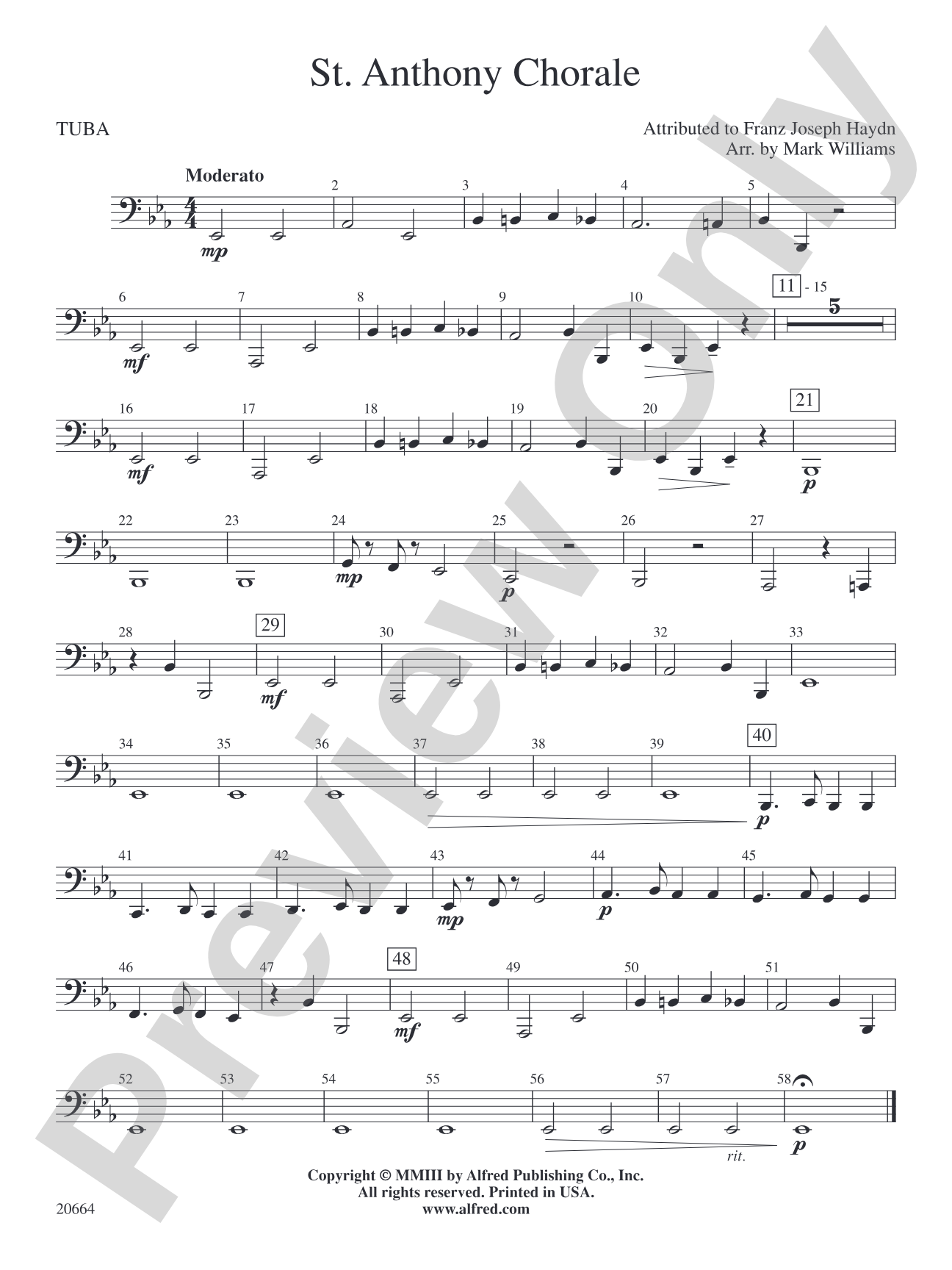

St. Anthony Chorale: Tuba
By Franz Joseph Haydn / arr. Mark Williams
Grade: 1.5 (Easy)
Item: 00-PC-0000424_TB1
$3.00
Pickup currently not available
Description
This beautiful, unique chorale serves as the basis to Johannes Brahms's famous orchestral masterpiece Variations on a Theme of Haydn. (Long attributed to Franz Joseph Haydn, recent scholarship indicates that it was probably written by some other composer of the Classical period.) Correlated with Accent on Achievement, Book 2, page 14, this arrangement is an excellent choice for the developing band.


Don't just read it, hear it, play along with it, and watch your students grow with it. In MakeMusic Cloud, St. Anthony Chorale: Tuba comes alive with professional accompaniment, adjustable tempo, and built-in practice tools that turn solo practice into real progress.
Open in the Player
Jump straight in and assign it today.
Start Your Free Trial
Open this title and explore the full library in minutes.
Sample Audio
1
Audio File
--:--
0:00
0:00
Sample Video
No sample videos found.
Additional Details
Series:
Accent on Achievement
Publisher:
Alfred Music
Page Count:
124
SKU:
00-PC-0000424_TB1
More about this title
About the Composer: Franz Joseph Haydn
Franz Joseph Haydn (1732-1809) was an Austrian composer whose prolific output and structural innovations shaped the Classical era. A master of form and orchestration, Haydn developed the symphony as a vehicle for both virtuosity and emotional expression, influencing countless composers who followed. His work remains central to the concert band repertoire because of its clarity, harmonic sophistication, and enduring appeal to developing musicians.
The St. Anthony Chorale has become one of Haydn's most recognizable themes, thanks largely to Brahms's 1873 orchestral variations. Though Haydn received the attribution for centuries, recent scholarship suggests the theme originated with another Classical-era composer. Regardless of authorship, the melody's elegance and structural integrity make it an ideal vehicle for teaching band arrangement and form.
Why we love this
Mark Williams's Grade 1.5 arrangement opens Brahms's masterpiece to developing bands without sacrificing the melody's inherent dignity or the harmonic interest that makes the St. Anthony Chorale compelling. The alignment with Accent on Achievement, Book 2 means students encounter this work precisely when they have the technical foundation to honor its Classical phrasing and balance. This is the kind of arrangement that teaches young musicians what good writing sounds like.
What to expect
The St. Anthony Chorale unfolds with the quiet confidence of a perfect hymn or processional. Each phrase is measured and contemplative, with harmonic progressions that feel inevitable yet always slightly surprising. There is elegance without bombast here, and a sense of formal balance that students instinctively recognize as "real music."
Who it's for
This is ideal for concert bands in their second or third year of the Accent on Achievement curriculum, or any Grade 1.5 ensemble preparing festival or concert repertoire. It works equally well for honor bands, community ensembles, and all-region programs where developmental musicians need exposure to genuine masterwork literature arranged with intelligence.
How to get the most out of it
- Balance the melody between sections so the chorale's lyrical character emerges clearly; in a Grade 1.5 setting, resist the urge to over-voice the tune with heavy doublings.
- Observe the harmonic rhythm carefully. Classical writing depends on clean attacks and releases that show the underlying structure; sloppy articulation obscures the chord changes.
- Shape phrases with gentle dynamic contours rather than terraced dynamics. Let the melody breathe as a singing line would, even in a band setting.
- Take the tempo at a tempo that allows clear articulation without rushing. Students often hurry through familiar melodies; steady pulse serves the architecture here.
How to use it
Program this early in a concert to establish sophistication and set a reflective tone, or use it as a centerpiece that demonstrates what young musicians can achieve with focused attention to phrasing and style. Its moderate length and Grade 1.5 difficulty make it suitable for festival competition, and its Classical credentials give your program immediate credibility. Pairing it with other Baroque or early Classical works creates a thematic concert block that educates audiences and players alike.
Skills your students will build
- Phrasing and breath placement in non-vocal music
- Harmonic listening and voice-leading awareness
- Articulation precision in Classical style
- Dynamic shaping and restraint
- Reading and interpreting a conductor score matched to individual parts