
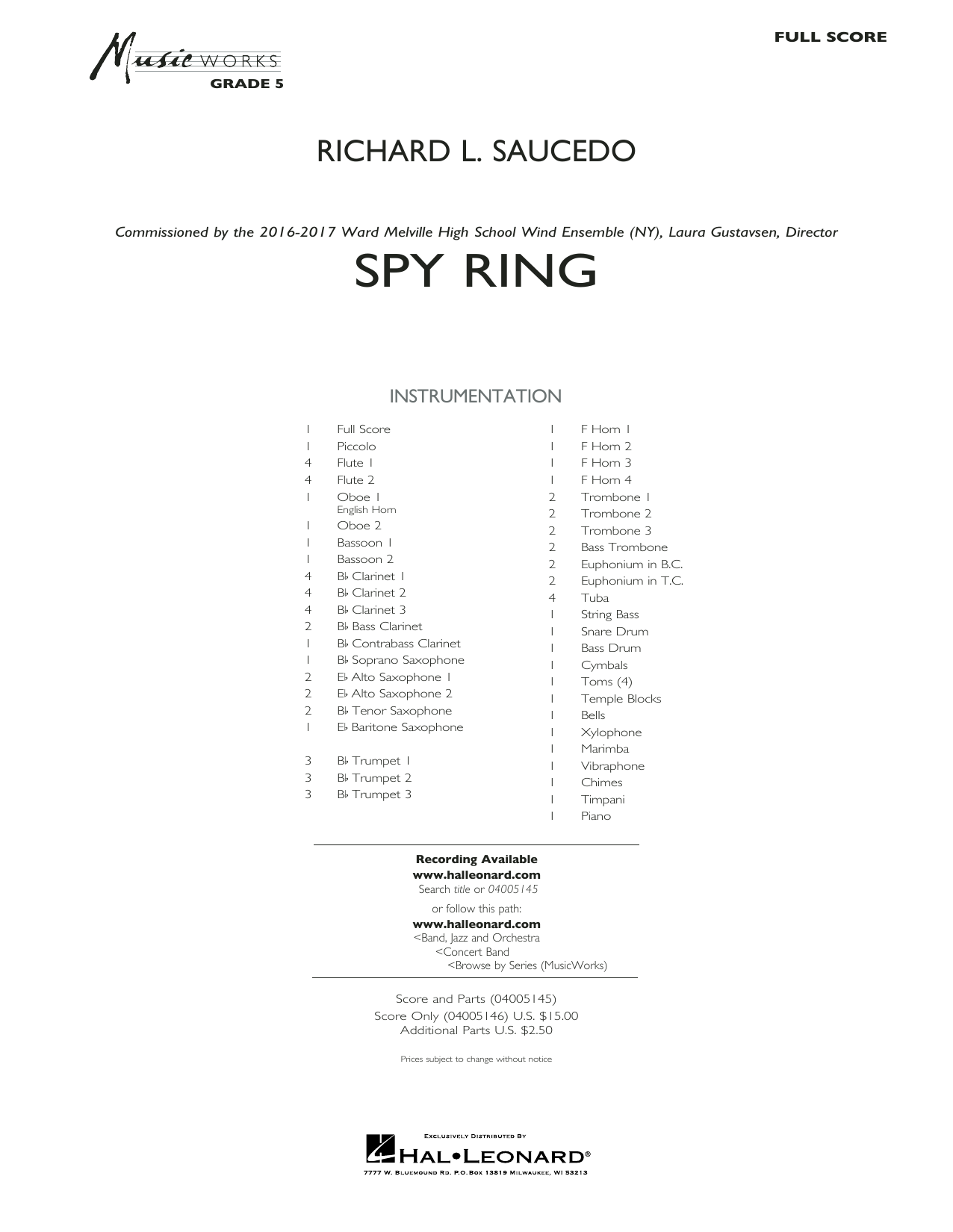

Spy Ring: Concert Band Conductor Score & Parts
By Richard L. Saucedo
Grade: 5
Item: 35-PK00382882
$125.00
Pickup currently not available
Buy Extra Parts (Digital PDF Download)
Parts Added to Cart!
Description
Under orders from General George Washington at the height of the Revolutionary War, a spy ring was organized for the purpose of providing critical information on the movement of British forces in the New York area. This dynamic work for band hints at the sense of danger and intrigue at the heart of this operation. The opening strains are propelled by an underlying rhythmic layer with flashes of color from the winds and percussion. A reflective middle section features soloistic passages with lush harmonies, and offers a calming mood before the fast tempo returns for the dynamic finish. Dur: c. 7:45 (MusicWorks)


Spy Ring: Concert Band Conductor Score & Parts isn't in MakeMusic Cloud just yet...but it could be. Let us know you'd like to see it, and you'll help shape what comes next. In the meantime, start a free trial and dive into thousands of interactive titles your students can play along with today.
Request This Title
Tell us you want it.
Start Your Free Trial
Explore everything that's ready to play right now.
Sample Audio
No sample audio found.
Sample Video
No sample videos found.
Additional Details
Publisher:
Hal Leonard
SKU:
35-PK00382882
More about this title
About the Composer: Richard L. Saucedo

Richard L. Saucedo built Carmel High School's band program into a national powerhouse during his 31 years as Director of Bands and Performing Arts Chairman in Indiana. His ensembles earned consistent recognition at state, regional, and national festivals; the Wind Symphony I appeared at the Music for All National Concert Band Festival three times and claimed the Indiana State Championship in 2013, while the Marching Greyhounds finished in the top ten at the Bands of America Grand National Championship for 17 consecutive years, capturing national titles in 2005 and 2012.
Beyond his work at Carmel, Saucedo has shaped American ensemble music as a freelance arranger and composer across marching bands, concert bands, choral groups, and orchestras. He served as Brass Arranger and Composer for the Cavaliers Drum and Bugle Corps, contributing to five DCI world championships, and currently serves as music ensemble coordinator for the Blue Devils. His contributions to music education earned him Indiana's Bandmaster of the Year award in 1998-99, Outstanding Music Educator in 2010, induction into the Music for All Hall of Fame in 2015, and election to the American Bandmasters Association. He also leads education initiatives for Music for All and Bands of America as a Senior Educational Consultant.
Why we love this
Saucedo captures the narrative arc of espionage with musical clarity: the opening propels forward through rhythmic intensity and wind color, the middle section breathes with reflective solo passages and rich harmonies, and the finale surges back to life. This is storytelling through sound, and your band will feel the dramatic arc in their bones. At grade 5, the writing is accessible without sacrificing sophistication or ensemble cohesion.
What to expect
Tension and intelligence. The opening pulls you into a world of coded messages and careful movement, with percussion and winds trading sharpness and color. The middle section offers refuge in lush, singing harmonies that calm the urgency, giving players a chance to savor ensemble balance. When the tempo returns, you're drawn back into the intrigue with fresh energy and clearer resolve.
Who it's for
Concert bands at the grade 5 level seeking a work with real dramatic scope and narrative drive. Ensembles ready to balance rhythmic precision, lyrical expression, and orchestral color will find this piece rewarding. Directors looking to program something tied to American history and composed by someone with elite ensemble credentials will connect with Saucedo's voice.
How to get the most out of it
- Emphasize the rhythmic foundation in the opening section. Lock your percussion and bass line first, then layer the wind color on top for maximum clarity and drive.
- Shape the reflective middle section by allowing soloists room to breathe. These passages are the emotional heart of the work; resist the urge to rush them.
- Mark the tempo transition back to the fast section clearly in rehearsal. Your ensemble needs a confident pivot point to rebuild momentum for the dynamic finish.
- Balance the harmonic richness in the middle section without letting it muddy. Encourage singers to listen across sections so the lush writing sounds intentional, not accidental.
How to use it
Use this as a centerpiece for a concert exploring American musical storytelling or Revolutionary War history. It pairs well with other programmatic works that build narrative tension. At roughly 7 minutes and 45 seconds, it commands attention without overwhelming your concert structure, making it ideal for mid-program placement where the audience is fully engaged.
Skills your students will build
- Layering rhythmic independence with melodic color and texture
- Balancing ensemble weight across sectional dialogue
- Phrasing through shifts in tempo and harmonic intensity
- Reading and executing dynamic contrast within sustained harmonic passages
- Maintaining rhythmic precision during syncopated patterns