
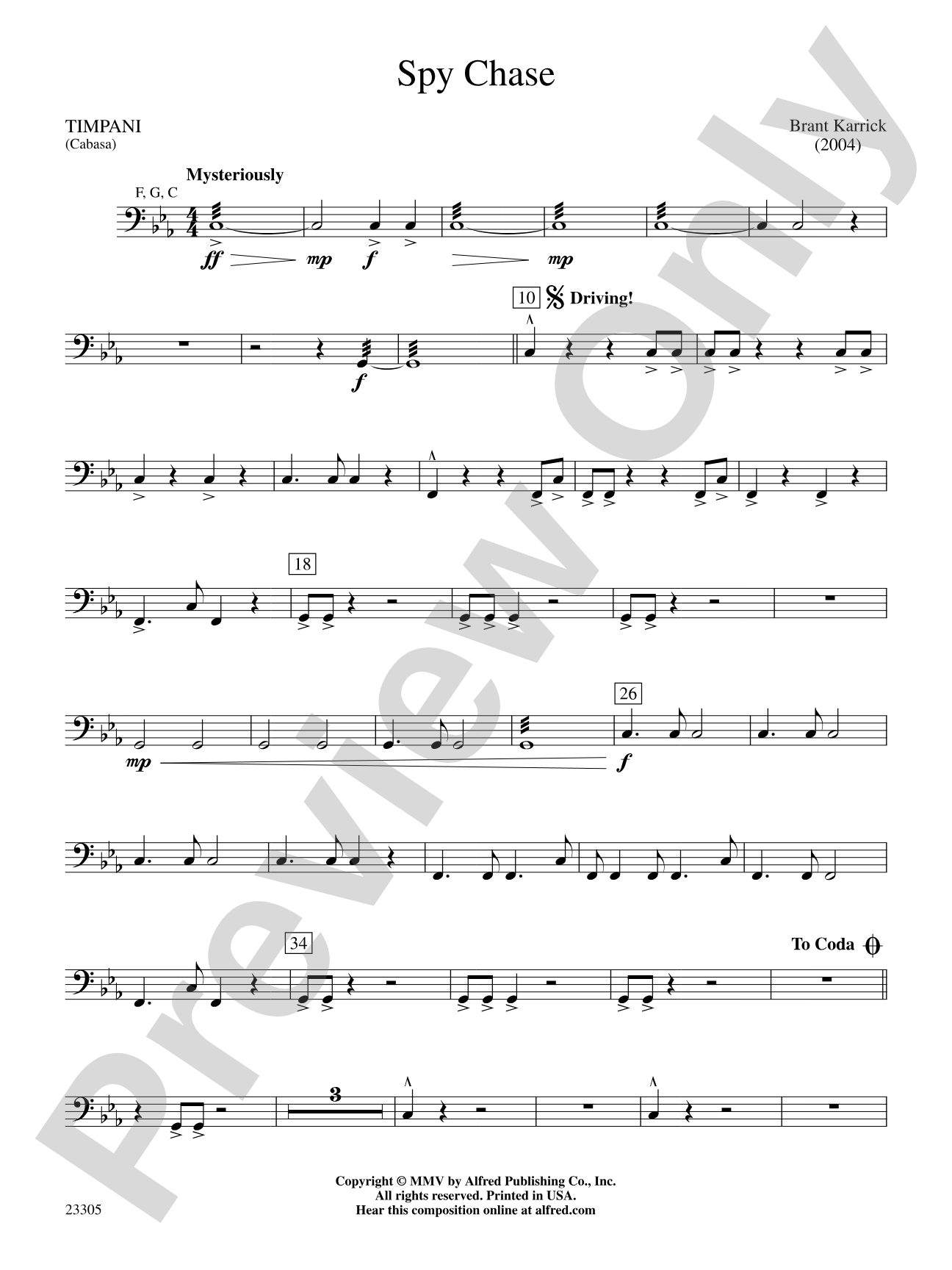

Spy Chase: Timpani
By Brant Karrick
Grade: 2 (Medium Easy)
Item: 00-PC-0000655_TMP
$3.00
Pickup currently not available
Description
"Spy Chase" evokes images of one's favorite secret agent who is about to embark upon a mission placed deep in the field of crime, espionage, and corruption---and of course our hero will always have time for a little romance. The music will sound reminiscent by using familiar "spy chords," a minor triad with added 6th or raised 7th, and the trademark chromaticism associated with the composer's favorite spy movies. This title is available in MakeMusic Cloud.


Don't just read it, hear it, play along with it, and watch your students grow with it. In MakeMusic Cloud, Spy Chase: Timpani comes alive with professional accompaniment, adjustable tempo, and built-in practice tools that turn solo practice into real progress.
Open in the Player
Jump straight in and assign it today.
Start Your Free Trial
Open this title and explore the full library in minutes.
Sample Audio
1
Audio File
--:--
0:00
0:00
Sample Video
Additional Details
Series:
Young Symphonic
Publisher:
Alfred Music
Page Count:
292
SKU:
00-PC-0000655_TMP
More about this title
About the Composer: Brant Karrick

Brant Karrick has shaped band programs across multiple institutions and regions throughout his career. He joined Northern Kentucky University in 2003 as Director of Bands, where he oversees the full band curriculum including conducting, instrumental methods, and music theory, while maintaining an active schedule as a guest conductor, clinician, and adjudicator. His compositions have circulated internationally across the United States, Canada, Europe, South Africa, South America, Japan, and Australia.
Karrick earned his Doctor of Philosophy in music education from Louisiana State University (1994), his Master of Arts in education from Western Kentucky University (1984), and his Bachelor of Music Education from the University of Louisville (1982). He studied trumpet with Leon Rapier and conducting with Frank Wickes, drawing composition instruction from David Livingston, Steve Beck, and Cecil Karrick. A member of NAFME, ASCAP, and the College Band Directors National Association, Karrick divides his time between university administration, teacher preparation, and composition.
Why we love this
Karrick taps into the spy-thriller sound that students recognize and love from film and television, making this an instantly engaging concert choice. The Grade 2 scoring keeps technical demands manageable while the harmonic language (minor triads with added 6ths and raised 7ths) introduces young players to colorful chromatic writing that feels sophisticated without requiring advanced technique. Programming a title like this at festival season or pops concert builds audience excitement and gives your band a genuinely fun piece to perform.
What to expect
You're hearing the musical equivalent of a spy movie montage: sleek, slightly edgy, and propelled by sneaking chromaticism and moody minor harmonies. Moments of suave sophistication give way to urgent, mission-critical drive, punctuated by brief flashes of intrigue and romance that keep the narrative moving.
Who it's for
Concert bands at the middle school level and early high school level will find this accessible and rewarding. It works equally well for seasoned high school programs looking for a lighter, thematically engaging piece that doesn't sacrifice musical substance.
How to get the most out of it
- Balance the chromatic lines carefully across sections; they're the signature sound of the piece, so lean into them without letting them muddy the overall harmonic clarity.
- Shape the dynamic contours deliberately to mirror the narrative tension. This piece lives and dies by pacing and release, so avoid playing it at a single volume.
- Lock the rhythm section together from day one. The spy-thriller feel depends on crisp, driving articulation in the low brass and woodwinds.
- Let the "romance" section breathe. Contrast it intentionally against the mission-driven passages to keep the listener engaged throughout.
How to use it
This pairs naturally with a pops concert or movie-themed concert program. It also serves as an excellent confidence-builder earlier in the season when you're still developing ensemble cohesion; the style and length work without exhausting your musicians. The recognizable musical language makes it a crowd-pleaser that works well as a closer or a showstopper in a varied concert.
Skills your students will build
- Reading chromatic passages in ensemble context
- Balancing harmonic color (minor triads with added 6ths and raised 7ths) across multiple voices
- Executing deliberate dynamic shaping to serve musical narrative
- Maintaining rhythmic precision and articulation in driving sections
- Blending lyrical and energetic textures within a single piece