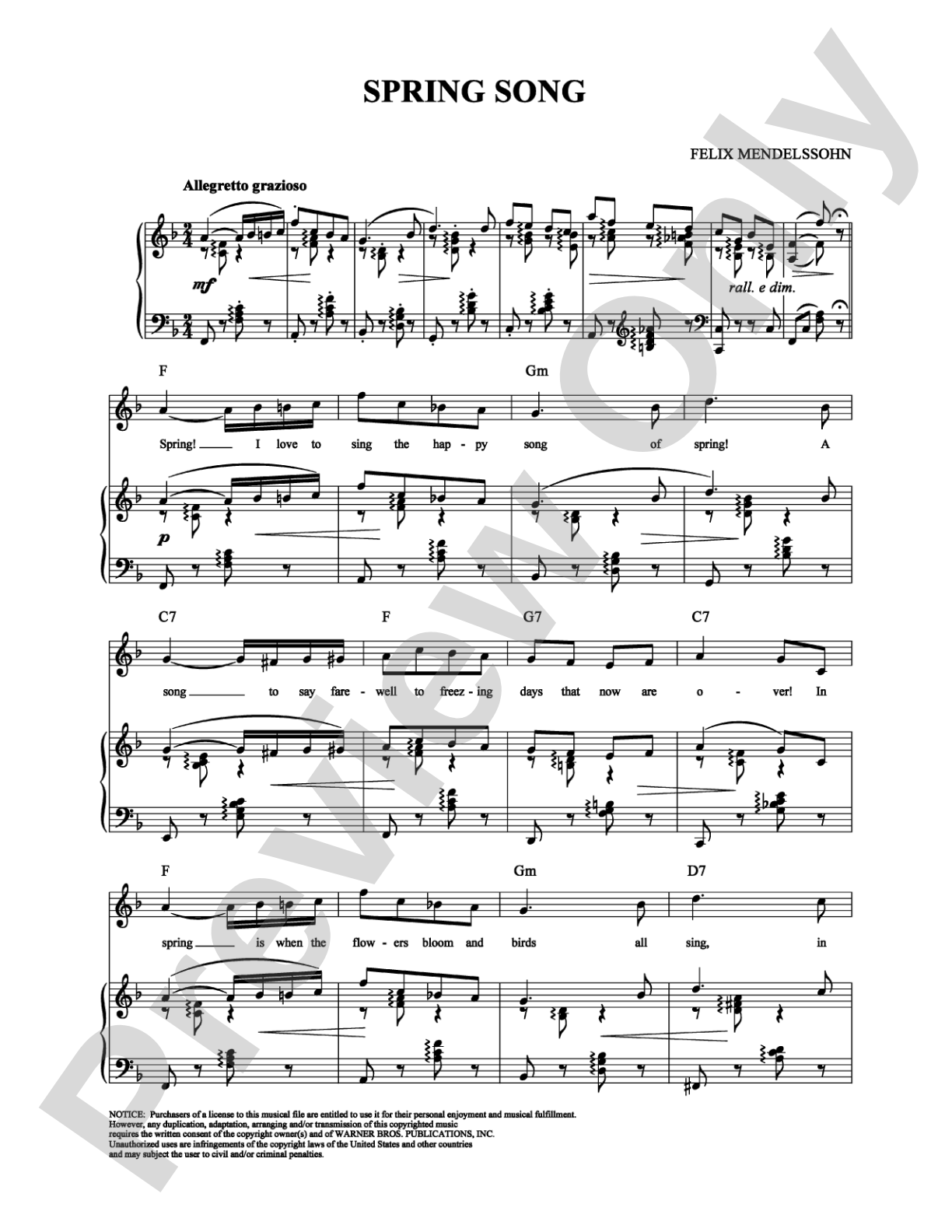
Spring Song: Piano/Vocal/Chords Digital Sheet Music

Spring Song: Piano/Vocal/Chords Digital Sheet Music

Felix Mendelssohn

Item: 00-PS-0000205

Digital Download
$3.99
Description

Spring Song: Piano/Vocal/Chords Digital Sheet Music isn't in MakeMusic Cloud just yet...but it could be. Let us know you'd like to see it, and you'll help shape what comes next. In the meantime, start a free trial and dive into thousands of interactive titles your students can play along with today.

Sample Audio
No sample audio found.
Sample Video
Additional Details
SKU: 00-PS-0000205

More about this title

About the Composer: Felix Mendelssohn

Felix Mendelssohn (1809, 1847) was a composer of remarkable technical facility and emotional directness. His music combines Classical structure with Romantic sensibility, making it accessible to students while remaining artistically substantial. Mendelssohn's Songs Without Words established him as a master of intimate piano writing, and his vocal works showcase his gift for melody and his understanding of the human voice.

Why we love this

Spring Song distills Mendelssohn's gift for tuneful lyricism into a piece that sings equally well on voice and keyboard. The melody is natural and memorable, the accompaniment texturally interesting without overshadowing the line, and the overall arc provides real emotional satisfaction in a compact time frame. For pianists and vocalists alike, it serves as a model for how accompaniment should enhance rather than compete.

What to expect

Spring Song evokes gentle awakening and quiet joy, with a melody that unfolds like sunlight gradually warming a garden. The accompaniment's flowing texture mirrors movement and renewal, while the overall mood remains intimate and reflective rather than celebratory. There is tenderness here, not sentimentality; Mendelssohn's restraint invites the performer and listener into a space of genuine emotional presence.

Who it's for

This arrangement suits vocalists ranging from intermediate high school singers to advanced amateurs seeking a standard repertoire piece with genuine artistic depth. Pianists at intermediate levels or above who want to accompany singing will find it manageable yet rewarding. It works equally well as a solo piano performance for those who prefer the instrumental version.

How to get the most out of it

  • Maintain a singing legato line even through the accompaniment's figuration; the inner melody must float above the keyboard texture, not submerge into it.
  • Shape phrases around the natural arc of the melody rather than rigid measures. Mendelssohn's barlines should guide phrasing, not dictate it.
  • Balance the vocalist's resonance with the piano's treble register. If singing, avoid forcing volume over the accompaniment; instead, lean on focused tone and clear diction.
  • Find the tempo that allows the flowing accompaniment to breathe without rushing. A brisk pace can feel mechanical; too slow loses the character's gentle momentum.

How to use it

This piece makes an ideal lighter moment in a mixed solo recital or art song program, especially when programmed between heavier dramatic works. It also fits naturally into concert programs celebrating Romantic composers or seasonal themes. Because it works in both piano and vocal contexts, it offers flexible programming options depending on your performance lineup.

Skills your students will build

  • Sustaining a singing melodic line over active accompaniment
  • Balance between melody and accompaniment in duo performance
  • Interpretive phrasing in the absence of explicit dynamic markings
  • Coordinated ensemble listening between vocalist and pianist
  • Recognition of Romantic-era song form and character-piece structures

You May Also Like