
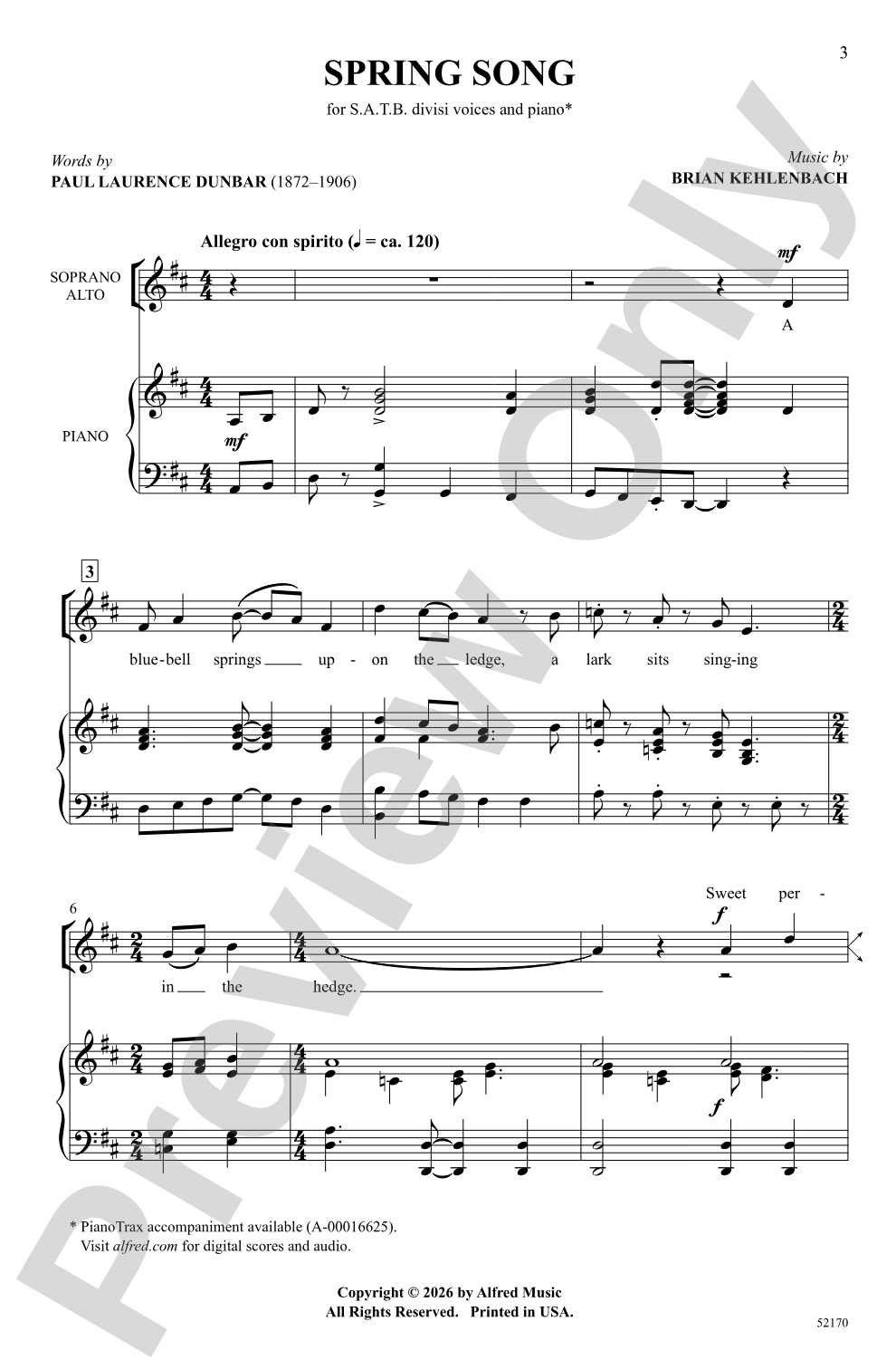
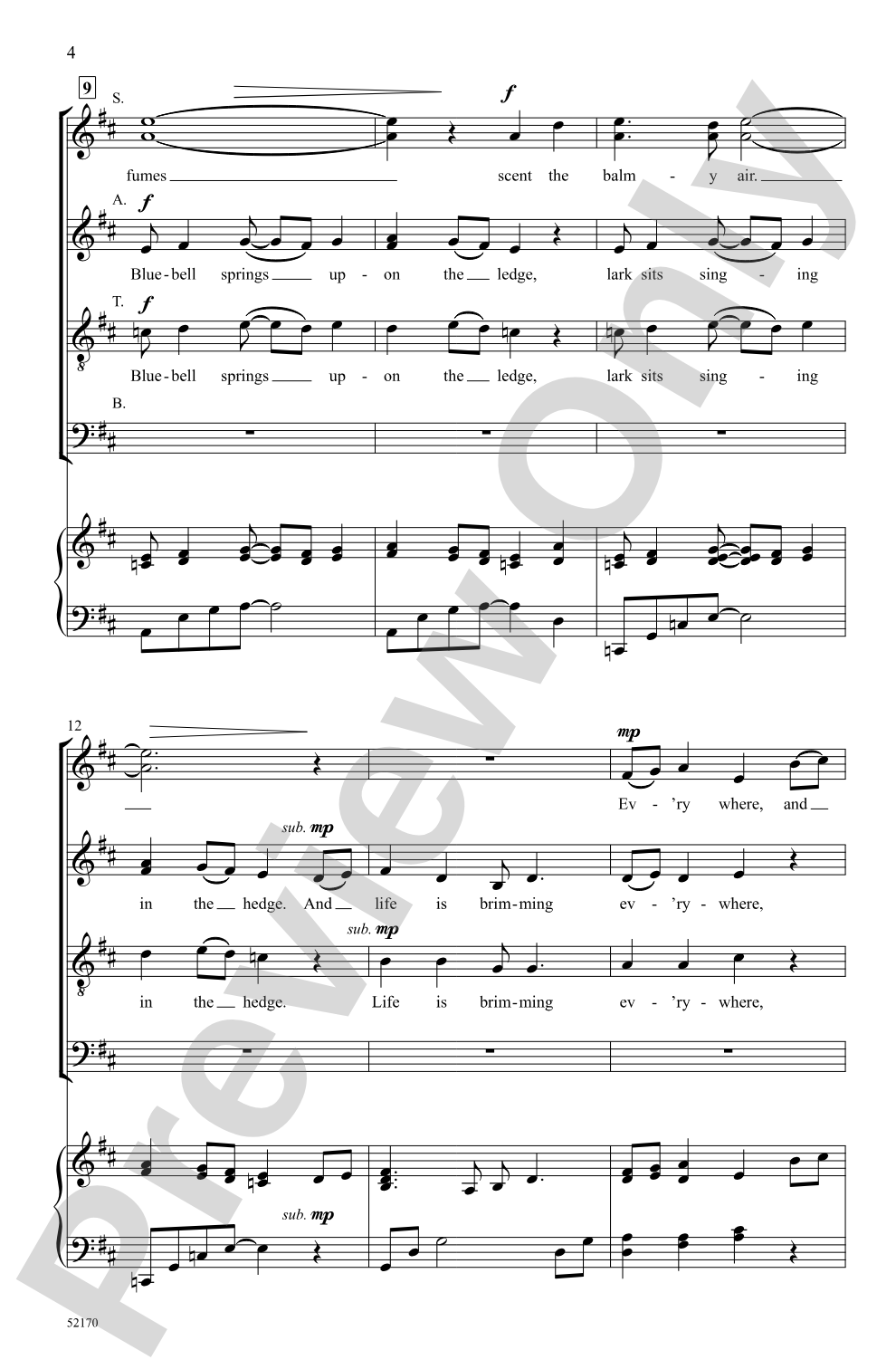
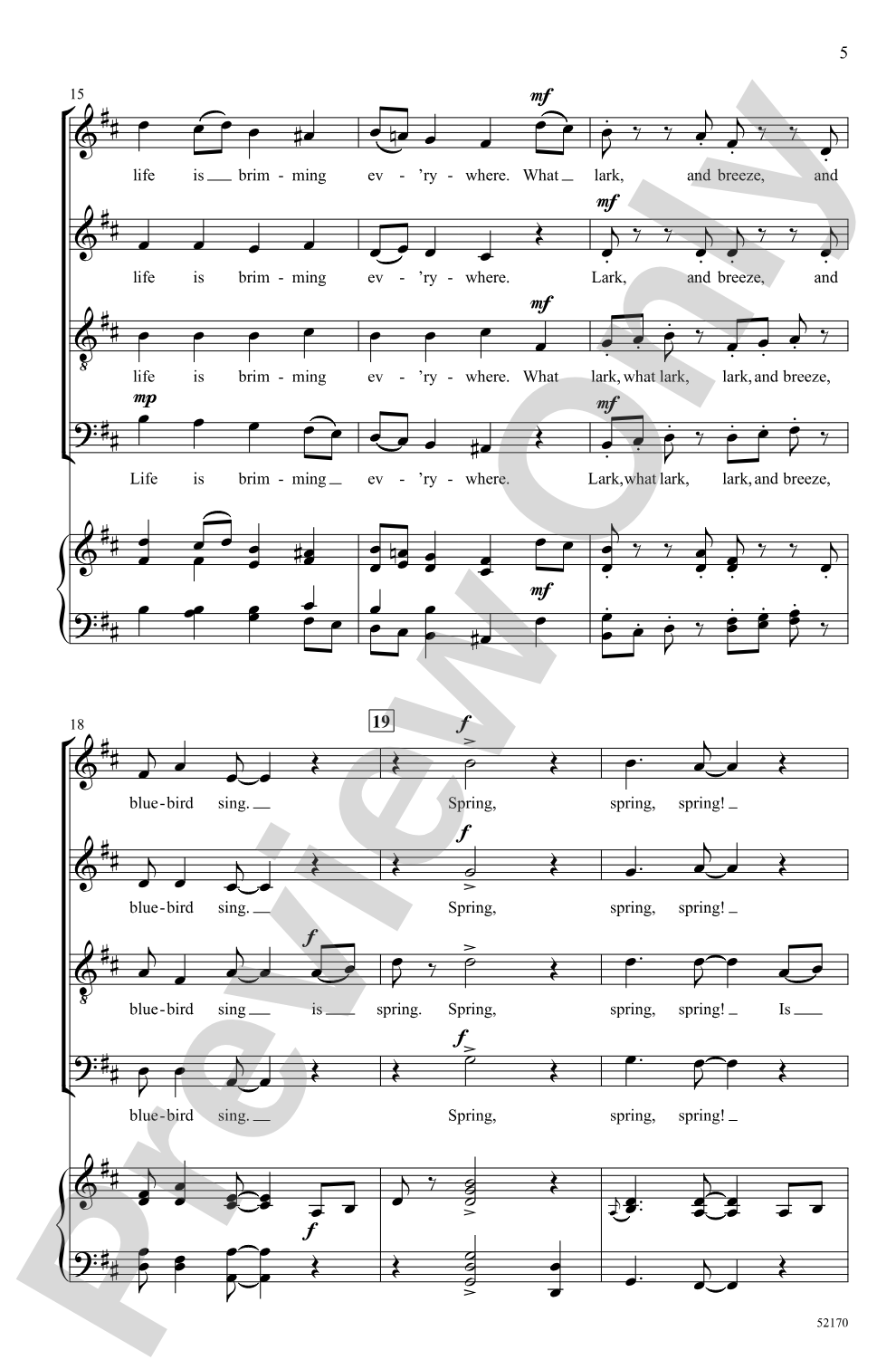

Spring Song: SATB Choral Octavo
Words by Paul Laurence Dunbar, music by Brian Kehlenbach
Item: 00-PO-0007811
$2.60
Minimum order quantity: 20 copies
Pickup currently not available
Related Items
Spring Song: SATB Choral Octavo |
$2.60
|
View |
Description
"Life is brimming everywhere" in this cheerful setting of a text by Paul Lawrence Dunbar, one of the first influential Black poets in American literature. Madrigal-like vocal lines are accompanied by a supportive piano part, creating harmonies as warm as spring itself. The light and breezy refrain is contrasted with an espressivo section, which may be sung a cappella and concludes with an optional solo. A lovely lift for any concert or festival.


Spring Song: SATB Choral Octavo isn't in MakeMusic Cloud just yet...but it could be. Let us know you'd like to see it, and you'll help shape what comes next. In the meantime, start a free trial and dive into thousands of interactive titles your students can play along with today.
Request This Title
Tell us you want it.
Start Your Free Trial
Explore everything that's ready to play right now.
Sample Audio
1
Audio File
--:--
0:00
0:00
Sample Video
Additional Details
Series:
Lawson-Gould
Publisher:
Alfred Music
Page Count:
16
SKU:
00-PO-0007811
More about this title
About the Composer: Brian Kehlenbach

Brian Kehlenbach brings together three distinct musical worlds: composition, performance, and teaching. A classical recitalist and jazz pianist trained at the University of Connecticut and University of Southern California, he writes music that seamlessly fuses jazz harmonies with classical architecture and contemporary sound. His works have been performed at major venues including Carnegie Hall, the LA Philharmonic Green Umbrella series, and festivals across the country.
Kehlenbach has served as both composer and administrator at Santa Ana College, where he teaches in the Music Department and received the Distinguished Faculty Lecturer award in 1999. His publications appear through Cimarron Music Press and Emil Kay Music, reflecting a catalog rooted in his experience as both a performer and a voice in American musical culture.
Why we love this
Kehlenbach understands how to write for singers without sacrificing harmonic interest. The madrigal-like vocal lines stay singable while the piano part moves with real musical substance, and the structural contrast between the breezy refrain and the expressive central section gives your singers genuine dramatic material to explore. Paul Lawrence Dunbar's text grounds the piece in a literary tradition many audiences will recognize.
What to expect
Warm and unhurried, like walking outside after winter. The piece opens with brightness and ease, then deepens into something more reflective and intimate before returning to that sunny character. There's genuine lyricism here, not just niceness.
Who it's for
Treble and lower voices singing together in SATB formation, from high school through community and collegiate choirs. The accessible vocal ranges and supportive piano writing make this workable for choirs still building harmonic confidence, while the literary text and structural sophistication reward more experienced ensembles.
How to get the most out of it
- Shape the light refrain with clean diction and buoyant phrasing; let the piano's breezy accompaniment guide your tempo choices.
- Prepare the espressivo section with attention to individual line independence before bringing sections together, since madrigal writing asks each voice to carry its own melodic weight.
- If you use the optional solo, rehearse it separately from the full ensemble to ensure it reads clearly without overwhelming the texture when voices rejoin.
- The a cappella option in the middle section offers a chance to highlight vowel blend and intonation; consider using this as a bridge to the climactic material that follows.
How to use it
Program this alongside other settings of American poetry or texts celebrating nature and renewal, especially in spring concerts or festivals where you want a piece that feels both substantial and approachable. The optional solo gives you flexibility to feature a soloist if your program calls for one, or to keep it fully choral if you prefer.
Skills your students will build
- Singing independent melodic lines in four-part harmony with clear textural roles
- Shaping phrases with attention to text expression and poetic meaning
- Balancing individual vocal lines within madrigal texture
- Maintaining secure intonation in a cappella sections
- Responding to piano accompaniment while maintaining harmonic integrity