
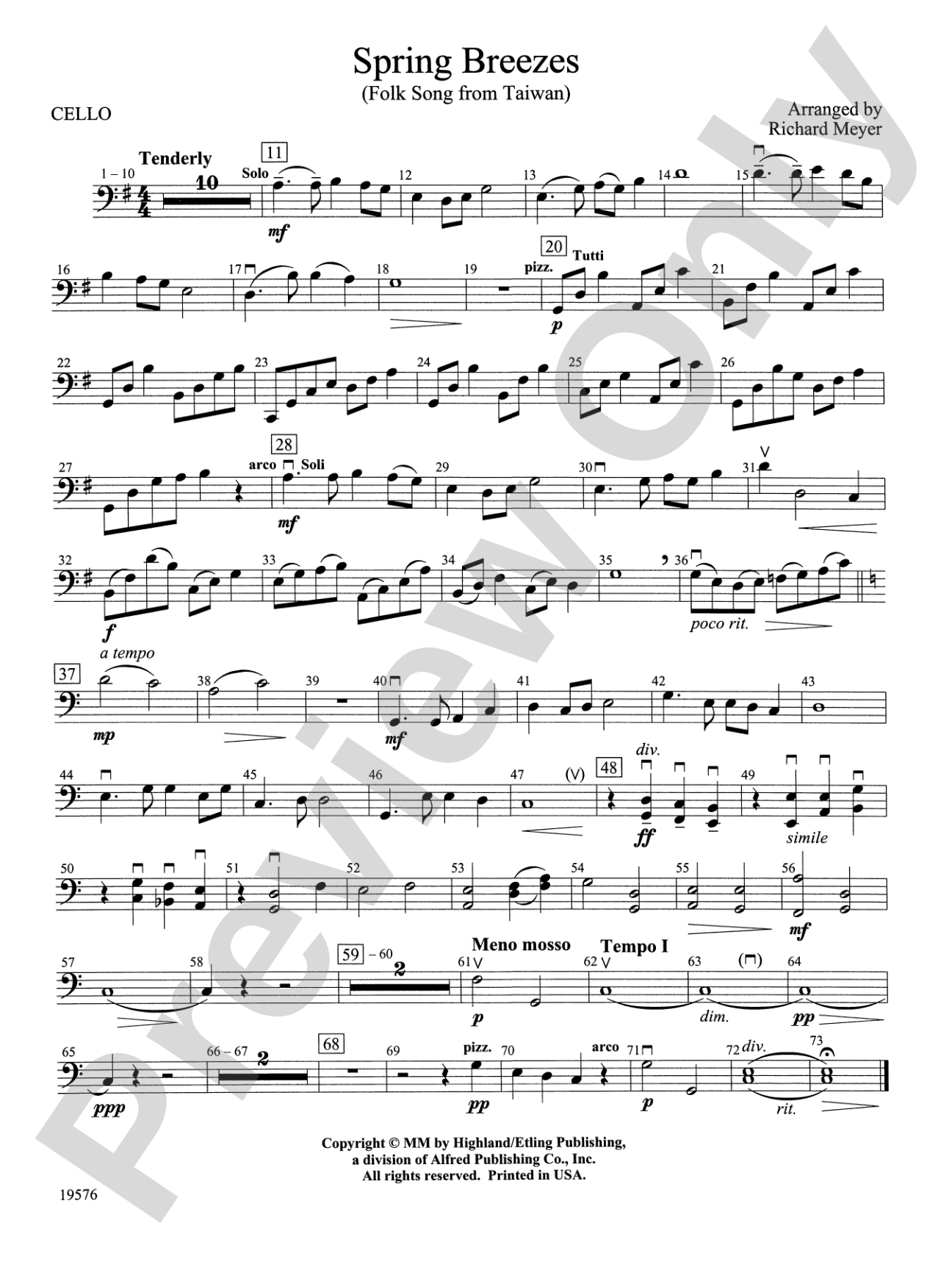

Spring Breezes: Cello
Folk Song from Taiwan / arr. Richard Meyer
Grade: 2
Item: 00-PC-0000345_VC1
$5.99
Pickup currently not available
Description
This very creative settings of the extremely popular Taiwanese folk song has been designed to help the student orchestra develop a sensitive and lyrical style. Accompanied by lush, modern-sounding harmonies, the simple, yet beautiful, melody is passed from section to section, and even used canonically. With solos for violin and cello, Spring Breezes also features an important accompaniment part for harp or piano. This title is available in MakeMusic Cloud.


Don't just read it, hear it, play along with it, and watch your students grow with it. In MakeMusic Cloud, Spring Breezes: Cello comes alive with professional accompaniment, adjustable tempo, and built-in practice tools that turn solo practice into real progress.
Open in the Player
Jump straight in and assign it today.
Start Your Free Trial
Open this title and explore the full library in minutes.
Sample Audio
1
Audio File
--:--
0:00
0:00
Sample Video
No sample videos found.
Additional Details
Series:
Highland/Etling String Orchestra
Publisher:
Alfred Music
Page Count:
66
SKU:
00-PC-0000345_VC1
More about this title
About the Arranger: Richard Meyer

Richard Meyer brings three decades of string education experience to his work as a composer and arranger. He spent 22 years building the orchestra program at Oak Avenue Intermediate School in Temple City, California, expanding it from 29 to 200 students, while also overseeing the district's elementary string curriculum. His "Giving Bach" program, launched in 2009, pioneered interactive concert models that reached underserved student populations across Southern California and earned national recognition for its impact.
Beyond the classroom, Meyer has conducted the Pasadena Youth Symphony Orchestra for 16 years and appeared as a clinician at the A.S.T.A. National Conference, regional orchestral conferences, and university string workshops. His catalog includes nearly 200 published compositions and arrangements, and he served as string editor for Alfred Publishing Company for 16 years. Meyer co-authored the String Explorer Series and Sight-read It for Strings, establishing himself as a trusted voice in string pedagogy.
Why we love this
Meyer's arrangement transforms a beloved folk melody into a masterclass in section writing and lyrical ensemble playing. The way soloists emerge from the texture and the melody passes between parts naturally teaches orchestral balance and transparency without requiring advanced technical facility. At Grade 2, this piece gives every student a moment to shine while developing the listening skills that define mature string playing.
What to expect
Gentle and flowing, with a sense of openness that comes from the melody drifting across the ensemble like air currents. The modern harmonic language beneath the folk tune creates an unexpected warmth, balancing simplicity with sophistication.
Who it's for
Grade 2 string orchestras and intermediate ensembles ready to work on expressive, sustained tone and sectional independence. This arrangement invites students to listen actively as melody moves around the orchestra, building skills in both leadership and support.
How to get the most out of it
- Bring out the harp or piano accompaniment in early rehearsals so violinists and cellists hear the harmonic foundation supporting the solos. This reference point makes entrances clearer and intonation steadier.
- Shape the canon passages with dynamic restraint. Since the melody repeats across sections, resist the urge to push volume and instead use slight rubato and tone quality to highlight the imitative texture.
- Rehearse the transition moments where the melody passes between sections separately. Mark a clear breath point and establish agreement on vibrato intensity so the handoff feels seamless rather than choppy.
How to use it
Program this in a spring concert pairing it with other world folk traditions to create a cultural program, or use it as a centerpiece for a chamber-focused rehearsal block that emphasizes listening and balance. The contest/festival designation makes it equally strong for evaluation performances where you want to showcase musical maturity alongside technical accomplishment.
Skills your students will build
- Sustaining lyrical lines with consistent tone quality and vibrato
- Following and executing a melodic line as it passes through multiple sections
- Playing supportive accompaniment roles that balance without overwhelming soloists
- Reading and executing canon passages with rhythmic precision
- Coordinating with harp or piano accompaniment to maintain ensemble unity