

Spotted Pony: Bass Educational Pack
American Fiddle Tune
Traditional Fiddle Tune / arr. Bob Phillips
Grade: 1
Item: 00-PC-0019278_SB_EDPAK
$3.00
Pickup currently not available
Description
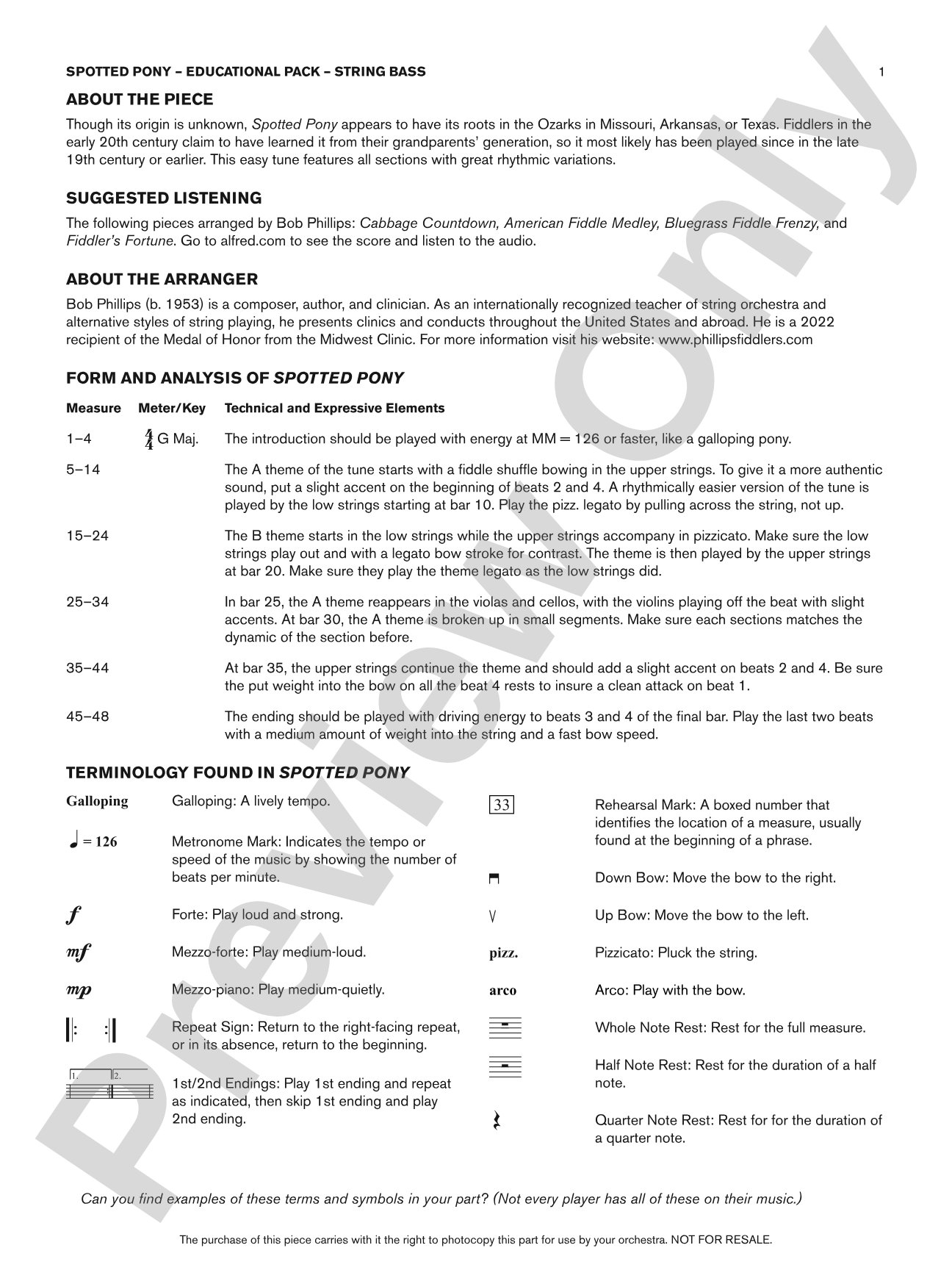
This easy tune features all sections with clever rhythmic variations. Readily accessible and as easy to put together as any Bob Phillips fiddle tune arrangement, the traditional melody appears in all sections and may be taught aurally. Though its origin is unknown, Spotted Pony appears to have roots in the Ozarks in Missouri, Arkansas, or Texas. Fiddlers in the early 20th century claim to have learned it from their grandparents' generation, so it most likely has been played since the late 19th century or earlier. (2:20) Correlates to Sound Innovations, Book 1, Level 4.


Don't just read it, hear it, play along with it, and watch your students grow with it. In MakeMusic Cloud, Spotted Pony: Bass Educational Pack comes alive with professional accompaniment, adjustable tempo, and built-in practice tools that turn solo practice into real progress.
Open in the Player
Jump straight in and assign it today.
Start Your Free Trial
Open this title and explore the full library in minutes.
Sample Audio
1
Audio File
--:--
0:00
0:00
Sample Video
Additional Details
Series:
Sound Innovations for String Orchestra
Publisher:
Alfred Music
SKU:
00-PC-0019278_SB_EDPAK
More about this title
About the Arranger: Bob Phillips

Bob Phillips (born 1953) has shaped string education for decades through his work as a composer, arranger, and pedagogue. His career spans extensive classroom teaching, curriculum development, and conductor training; he built the Saline, Michigan string program into a nationally recognized model serving over 700 students across all levels and musical styles. Beyond the classroom, Phillips founded the Saline Fiddlers Philharmonic, which became known internationally for its performances of folk and contemporary music, appearing at the White House and The Midwest Clinic multiple times annually.
Phillips has published more than 200 works for orchestras and bands and authored the complete six-level Sound Innovations series along with groundbreaking eclectic style collections (Fiddlers Philharmonic, Jazz Philharmonic, Rock Philharmonic, and others). His instructional DVDs and clinics have trained thousands of music teachers. An ASCAP award-winning composer, he has served as resident conductor and arranger for major festivals and as assistant conductor for youth orchestras across the United States, including all-state programs and Blue Lake Fine Arts Camp.
Why we love this
Phillips captures the spirit of a centuries-old fiddle tune while making it immediately playable for young orchestras. The arrangement distributes the melody across all sections so students hear themselves playing something recognizable and authentic from the very first rehearsal, and the rhythmic variations keep every player engaged rather than relegated to accompanimental figures.
What to expect
Spotted Pony carries the warm, communal character of a tune played at gatherings and passed down through family memory. Its straightforward melody and clear pulse invite students to play with ease and conviction, creating the feeling of participating in living folk tradition rather than merely reading notes from a page.
Who it's for
First-year string orchestras and Grade 1 ensembles ready to venture beyond classical repertoire. Directors seeking accessible repertoire that teaches authentic musical traditions while building foundation skills will find this piece requires minimal rehearsal time but delivers outsized musical reward.
How to get the most out of it
- Teach the melody by ear before assigning parts; students will connect more deeply to a tune passed down through generations when they learn it the way fiddlers do
- Balance the rhythmic variations between sections so the familiar shape of the tune remains clear even as different groups ornament it
- Use the 2:20 duration as a rehearsal benchmark; if your tempo feels rushed or dragging, compare to the recorded reference
How to use it
Program this alongside other Sound Innovations repertoire to show students the range of musical styles available at their level, or use it as a contest or festival selection where judges appreciate both technical accessibility and authentic cultural content. It serves equally well as a concert opener that engages audiences unfamiliar with string music.
Skills your students will build
- Playing a recognizable melody with phrasing and musicality
- Executing rhythmic variations while maintaining ensemble unity
- Understanding folk tradition and aural learning methods
- Balancing individual part independence with sectional blend