
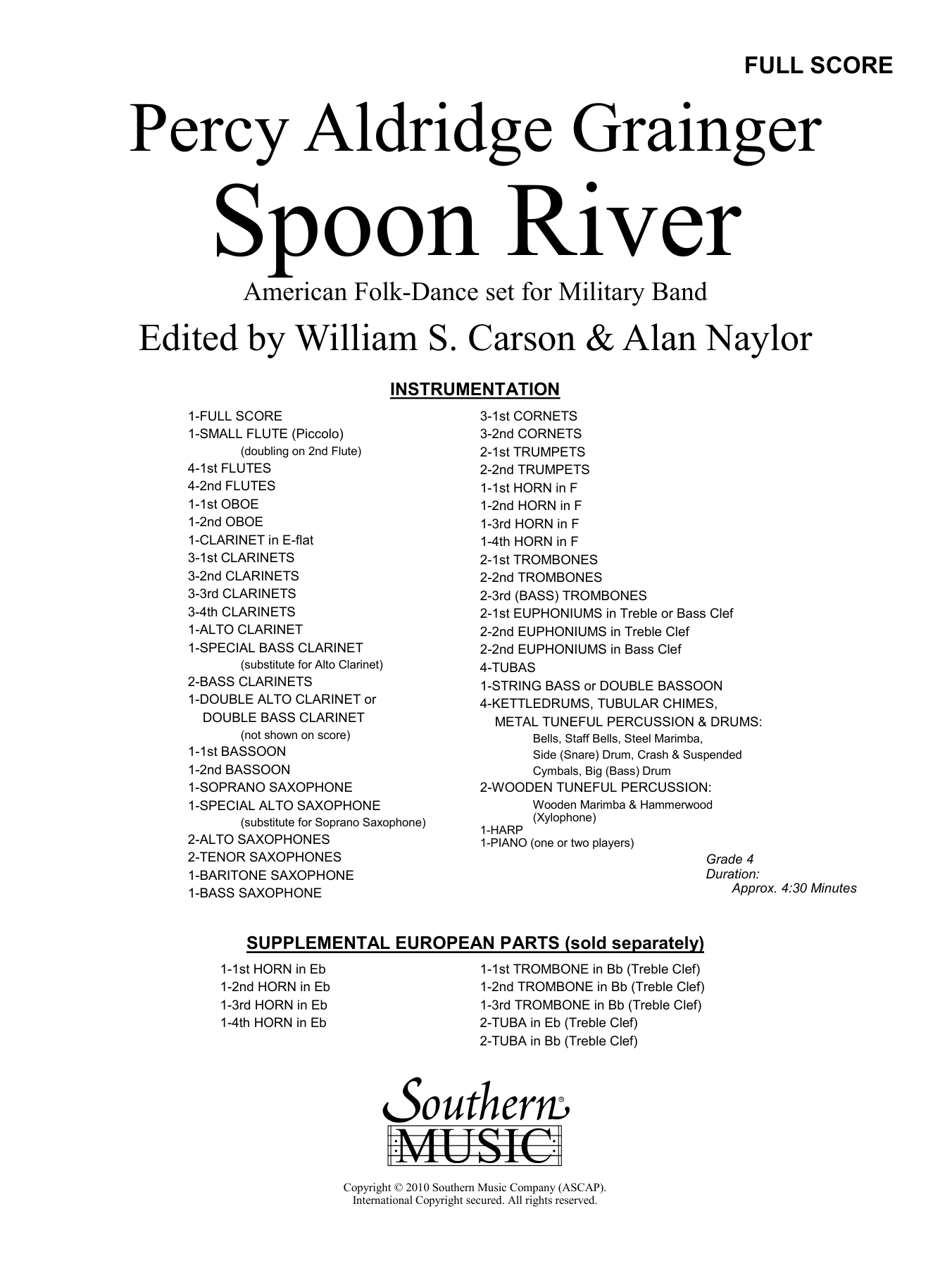

Spoon River: Concert Band Conductor Score & Parts
By Percy Grainger / Arranged by Alan Naylor / Arranged by William Carson
Grade: 4
Item: 35-PK01469984
$150.00
Pickup currently not available
Buy Extra Parts (Digital PDF Download)
Parts Added to Cart!
Description
This American folk-dance set for concert band is based on the tune "Spoon River", which a Captain Charles H. Robinson heard in 1857 being played by a rustic fiddler at a country dance in Brandford, Illinois. Passed to Grainger through poet Edgar Lee Masters in 1914, it is a very archaic tune in character; typically American, yet akin to certain Scottish and English dance-tune types. Grainger aims in his original setting at preserving a pioneer blend of lonesome wistfulness and sturdy persistence. This edition for band seeks to maintain the Grainger sound, while offering bands instrument substitutions for those that have become less common and making small additions such as clearer dynamics.


Spoon River: Concert Band Conductor Score & Parts isn't in MakeMusic Cloud just yet...but it could be. Let us know you'd like to see it, and you'll help shape what comes next. In the meantime, start a free trial and dive into thousands of interactive titles your students can play along with today.
Request This Title
Tell us you want it.
Start Your Free Trial
Explore everything that's ready to play right now.
Sample Audio
No sample audio found.
Sample Video
No sample videos found.
Additional Details
Publisher:
Hal Leonard
SKU:
35-PK01469984
More about this title
About the Composer: Percy Grainger
Percy Grainger (1882-1961) was an Australian-American composer and pianist whose innovative approach to folk music collection and arrangement shaped early twentieth-century concert music. Trained in Frankfurt and Berlin, Grainger became fascinated with preserving authentic folk melodies, traveling throughout England and Scandinavia to record traditional singers and musicians. His arrangements for band and orchestra transformed simple folk tunes into sophisticated works without sacrificing their essential character, proving that vernacular music could command the same artistic attention as art-music composition.
Grainger's legacy rests partly on his philosophy that great music exists everywhere, waiting to be discovered and honored. Rather than "improve" folk material through heavy orchestration, he preserved the melodic integrity and emotional directness of his sources while providing imaginative instrumental contexts. His work influenced generations of musicians to value folk traditions as serious artistic resources.
Why we love this
Grainger's Spoon River demonstrates how an honest folk melody can sustain an entire concert work without manufactured drama. The arrangement maintains clarity and accessibility across all instrument parts while never condescending to the material; band members consistently report enjoying the lyrical simplicity and the way each voice participates meaningfully in the texture. Programming this piece builds repertoire that audiences recognize as distinctly American while introducing students to one of the era's most thoughtful approaches to folk-music arrangement.
What to expect
A journey through frontier memory, balancing melancholy homesickness against the resourceful optimism of pioneer life. The archaic melody carries weight and dignity without sentimentality; its Scottish and English ancestry sounds simultaneously foreign and deeply familiar, like a tune your grandmother's grandmother might have danced to.
Who it's for
Concert bands at Grade 4 seeking substantive American repertoire that challenges musicianship without requiring extended technical passages. This work appeals to ensembles aiming to include folk traditions in their programming and to conductors who value Grainger's distinctive compositional philosophy.
How to get the most out of it
- Balance the melody between sections rather than assigning it exclusively to one group; Grainger's orchestration distributes the tune across instruments specifically to create variety and reveal new colors with each phrase.
- Observe the dynamic markings carefully as guides to phrase shaping. The clearer dynamics in this edition make it easier to sculpt the piece's emotional arc and avoid the monotony that can result from timid underplaying.
- Listen to the recorded accompaniment if available to grasp the rhythmic character of the country dance tradition; understanding the idiomatic swing and lilt of the original fiddler's interpretation informs how you conduct the ensemble through the sectional transitions.
- Shape phrases with the harmonic progression in mind. Grainger's voice leading often guides you toward natural phrase breaths that may not coincide with obvious melodic boundaries.
How to use it
Pair this with other American folk-based concert pieces to create a program that celebrates vernacular traditions as serious art music. Its Grade 4 difficulty and moderate length make it ideal for mid-season programming when your ensemble has developed ensemble cohesion but before the technical demands of spring repertoire.
Skills your students will build
- Sustaining long melodic phrases while maintaining clarity across multiple instrumental lines
- Responding to dynamic markings as compositional devices that shape phrasing and form
- Recognizing folk melody characteristics and how they differ from art-music compositional strategies
- Balancing transparency with fullness in four-part harmonic textures
- Adapting articulation to support a lyrical rather than brilliant musical character