
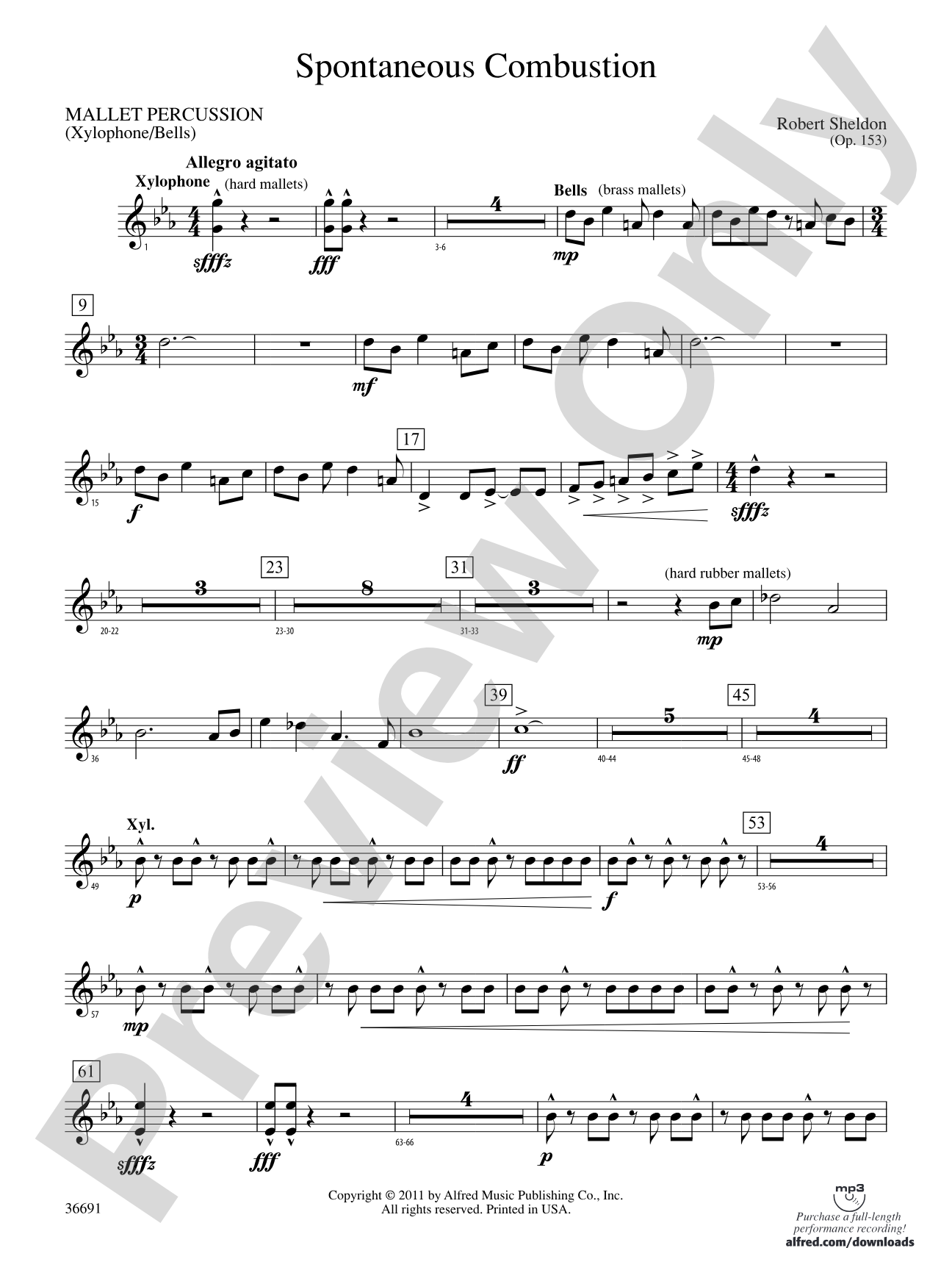

Spontaneous Combustion: Mallets
By Robert Sheldon
Grade: 3 (Medium)
Item: 00-PC-0015119_M1
$3.00
Pickup currently not available
Description
A fast-paced tour-de-force for developing bands, "Spontaneous Combustion" explodes out of the starting blocks and keeps moving relentlessly to the last note. Presented in a minor key with shifting tonalities and tuneful melodies, this musical juggernaut eventually yields to a major key, which only amplifies its inherent energy. Mixed meters and bombastic percussion help to drive the piece to the very end. This title is available in MakeMusic Cloud.


Don't just read it, hear it, play along with it, and watch your students grow with it. In MakeMusic Cloud, Spontaneous Combustion: Mallets comes alive with professional accompaniment, adjustable tempo, and built-in practice tools that turn solo practice into real progress.
Open in the Player
Jump straight in and assign it today.
Start Your Free Trial
Open this title and explore the full library in minutes.
Sample Audio
1
Audio File
--:--
0:00
0:00
Sample Video
No sample videos found.
Additional Details
Series:
Young Symphonic
Publisher:
Alfred Music
Page Count:
262
SKU:
00-PC-0015119_M1
More about this title
About the Composer: Robert Sheldon

Robert Sheldon stands among the most widely performed composers in wind band repertoire today. His works appear on contest and concert programs internationally, and he has earned recognition from the American School Band Director's Association, Phi Beta Mu, and ASCAP for compositions that combine technical sophistication with genuine musical substance. Beyond writing, Sheldon serves as lead author of Sound Innovations for Concert Band, shaping how young musicians learn foundational skills.
As a guest conductor, clinician, and commissioning composer, Sheldon maintains an active presence across the United States and abroad, having worked in Japan, Canada, Italy, Germany, Australia, and China. His music has been performed at Carnegie Hall, Orchestra Hall, Boston Symphony Hall, the Sydney Opera House, and the Kennedy Center. VanderCook College of Music awarded him an honorary doctorate in 2020.
Why we love this
Sheldon knows exactly how to build energy and sustain momentum in a Grade 3 ensemble without sacrificing musicality. The shift from minor to major, combined with the metric complexity and percussion writing, gives your band a vehicle that feels genuinely exciting to play while remaining pedagogically sound for developing musicians.
What to expect
Spontaneous Combustion lives up to its title: it sprints from the opening and never looks back. The minor key tonality and jagged metric shifts create a sense of controlled chaos, until the triumphant modulation to major key unleashes a final burst of jubilant energy. Throughout, the orchestration crackles with percussion color and forward motion.
Who it's for
Grade 3 concert bands with solid fundamentals and growing rhythmic sophistication. This work rewards sections that have mastered basic intonation and can sustain musical lines while navigating metric changes, making it ideal for mid-level ensembles ready to tackle contemporary band writing.
How to get the most out of it
- Keep the opening attack crisp and unified across all sections; this piece demands immediacy from the first notes to establish its relentless pace.
- Balance the percussion strategically, especially in the busier passages, so the rhythmic drive enhances rather than overwhelms the melodic content.
- Attend carefully to the tonal shift from minor to major, treating it as a genuine harmonic and emotional pivot rather than just a change of key signature.
- Lock the mixed meter sections early in rehearsal; once students internalize the shifting time signatures, the propulsive feel clicks into place quickly.
How to use it
Program this as a concert opener or as a set closer to send the audience out on an adrenaline rush. It also works powerfully in a contest or festival setting where a Grade 3 ensemble needs to demonstrate both technical skill and musical maturity. The length and difficulty level make it a substantial yet achievable challenge for spring concert repertoire.
Skills your students will build
- Reading and performing mixed meters (3/4 and 4/4 shifting)
- Maintaining ensemble cohesion during metric modulation
- Playing with rhythmic precision and forward momentum in fast tempos
- Balancing melodic lines against active percussion accompaniment
- Executing smooth harmonic transitions between tonal centers