
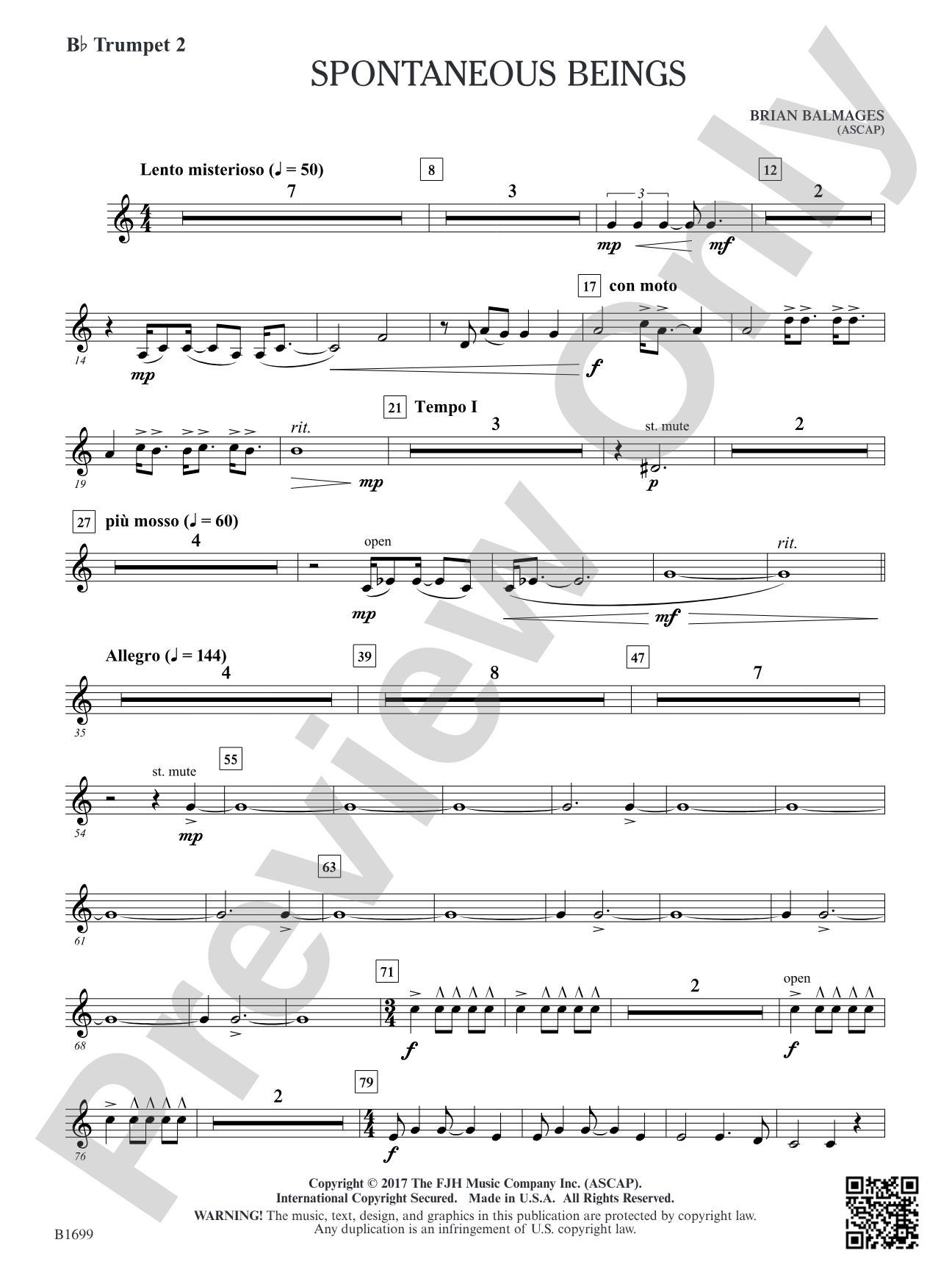

Spontaneous Beings: B-flat Trumpet 2
By Brian Balmages
Grade: 3
Item: 98-PC-DB1699_T2
$7.00
Pickup currently not available
Description
Based on oral history of the Anishinaabeg, this piece draws its name from Ojibwe historian Basil Johnston, who offered the literal translation of the name as “Spontaneous Beings.” Based on authentic folk music and steeped in tradition, the piece relies heavily on traditional percussion instruments (with optional substitutes suggested). Very approachable, yet extremely powerful.


Discover MakeMusic Cloud: thousands of interactive titles your students can play along with today.
Sample Audio
1
Audio File
--:--
0:00
0:00
Sample Video
Additional Details
Series:
FJH Concert Band
Publisher:
The FJH Music Company, Inc.
SKU:
98-PC-DB1699_T2
More about this title
About the Composer: Brian Balmages

Brian Balmages has established himself as a composer and conductor working across orchestral, band, and chamber repertoires at the highest levels. His works have been performed by ensembles ranging from professional symphony orchestras to elementary school groups at venues including Carnegie Hall, the Kennedy Center, Sydney Opera House, and Toronto Centre for the Arts. He received the A. Austin Harding Award from the American School Band Directors Association, won the 2020 NBA William D. Revelli Composition Contest for Love and Light, and holds membership in the American Bandmasters Association.
Balmages has received the inaugural James Madison University Distinguished Alumni Award from the School of Visual and Performing Arts and was commissioned by the University of Miami to compose music for the inauguration of its 6th president. His music was performed at the 2013 Presidential Inaugural Prayer Service attended by President Obama and Vice President Biden. As a conductor, he maintains regular engagements with all-state, regional, university, and professional ensembles worldwide. Currently, he serves as Director of MakeMusic Publications and Digital Education for Alfred and MakeMusic.
Why we love this
Balmages captures the essence of Anishinaabeg cultural music while writing something genuinely accessible for Grade 3 ensembles. The piece balances authenticity with approachability, allowing young musicians to explore meaningful cultural content without technical barrier. The emphasis on traditional percussion (with practical alternatives) makes this programmable for most concert band settings, yet the compositional depth rewards careful listening and honest preparation.
What to expect
The music draws you into a reflective, grounded space rooted in Ojibwe musical tradition. Despite its simplicity of approach, the piece carries genuine power through its connection to lived cultural history and the integrity of its folk sources.
Who it's for
Concert band directors seeking repertoire that honors Indigenous music traditions while remaining well within Grade 3 technical and reading demands. This piece suits ensembles that value cultural education and want meaningful programming beyond purely Western European sources.
How to get the most out of it
- Balance the traditional percussion instruments in the mix; these carry the cultural narrative and should never disappear into the texture even when the full band plays.
- Attend to phrasing as you would in a lyrical work; the folk music roots mean this piece breathes rather than drives forward mechanically.
- Spend rehearsal time on the optional percussion substitutes if traditional instruments are unavailable, ensuring the replacement maintains the intended timbre and character.
How to use it
Program this as a concert centerpiece or as a building block in a culturally diverse concert that might include works from multiple traditions. The Grade 3 accessibility makes it suitable for early-season performances while its cultural weight allows it to anchor a program thematically around Indigenous music, multicultural perspectives, or the power of oral tradition in contemporary composition.
Skills your students will build
- Respect for non-Western musical traditions and compositional approaches
- Ensemble balance with prominent percussion and sustained wind textures
- Expressive phrasing rooted in folk music characteristics
- Cultural context and history as foundation for musical interpretation