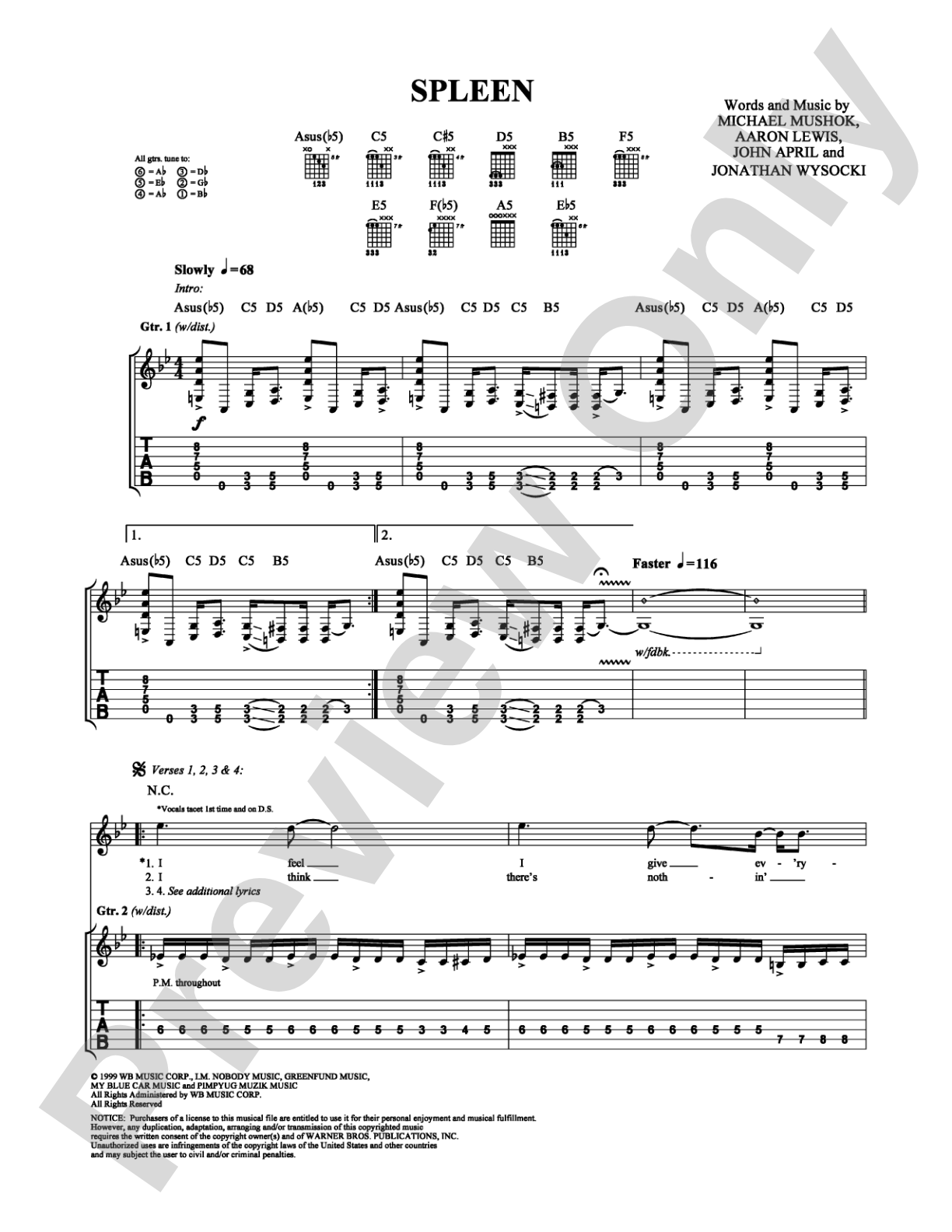
Spleen: Guitar TAB Digital Sheet Music

Spleen: Guitar TAB Digital Sheet Music

Staind, John April, Jonathan Wysocki, Michael Mushok, Aaron Lewis

Item: 00-PS-0008149

Digital Download
$2.99
Description

Spleen: Guitar TAB Digital Sheet Music isn't in MakeMusic Cloud just yet...but it could be. Let us know you'd like to see it, and you'll help shape what comes next. In the meantime, start a free trial and dive into thousands of interactive titles your students can play along with today.

Sample Audio
No sample audio found.
Sample Video
Additional Details
SKU: 00-PS-0008149

More about this title

About the Artist: Staind

Staind emerged from Springfield, Massachusetts in the 1990s as one of the defining voices of post-grunge alternative rock. The band, led by vocalist and guitarist Aaron Lewis, built a reputation for introspective songwriting and acoustic-driven arrangements that balanced heavy rock elements with genuine emotional vulnerability. Their 1996 debut album and subsequent releases established them as skilled instrumentalists capable of moving between stripped-down arrangements and fully orchestrated production.

Lewis and the band have maintained a presence in rock music for decades, touring regularly and continuing to write material that resonates with listeners who value craftsmanship and authenticity in songwriting. Their influence extends across multiple generations of rock and alternative musicians who study their approach to melody, dynamics, and emotional restraint.

Why we love this

"Spleen" showcases the kind of restrained, melodic guitar work that makes Staind's catalog so instructive for players developing their own voice. The arrangement balances fingerstyle technique with rhythmic precision, offering intermediate players a genuine song to work toward rather than a exercise disguised as music. Students studying this piece learn how dynamics and space shape emotional impact, not just how to play notes.

What to expect

"Spleen" carries the quiet intensity of late-night reflection. The guitar work creates an intimate, almost introspective quality, with open space between phrases that lets each note breathe. Despite its name, the piece moves with a kind of resigned grace, the kind of mood that lives in minor keys and fingerstyle fingerings.

Who it's for

This TAB suits intermediate electric or acoustic guitarists who want to work on fingerstyle technique within a real song context. It's ideal for players exploring 1990s alternative rock and those interested in how restraint and simplicity can create emotional depth. Solo guitarists and ensemble players alike will find value in understanding Staind's approach to texture and space.

How to get the most out of it

  • Focus on muting and dampening between phrases; the silence is as intentional as the notes. Clean articulation of rests prevents the piece from losing its contemplative quality.
  • Work the fingerstyle pattern slowly until the alternating bass and melody feel independent from each other. Record yourself playing the bass line alone, then layer the melody over it.
  • Pay attention to any dynamics marked in the TAB. Dynamics in a song like this often drive the emotional arc more than tempo changes do.
  • Listen closely to the original recording while you learn; the tonal choices and effects matter. Note where the guitar sits in the mix and how the sustain of each note impacts the overall feel.

How to use it

This works well as a solo piece in a contemporary music showcase or mixed recital, offering contrast to more technical or virtuosic fare. It's also valuable in a lesson setting where students are transitioning from strict rhythm section work into more expressive, independent playing. Consider pairing it with other Staind compositions or songs from the post-grunge era to build a thematic program exploring 1990s songwriting.

Skills your students will build

  • Fingerstyle technique with alternating bass-melody patterns
  • Dynamic control and sustain management on electric guitar
  • Reading and interpreting TAB notation accurately
  • Sense of space and restraint in phrasing
  • Translating recorded performances into personal interpretation

You May Also Like