
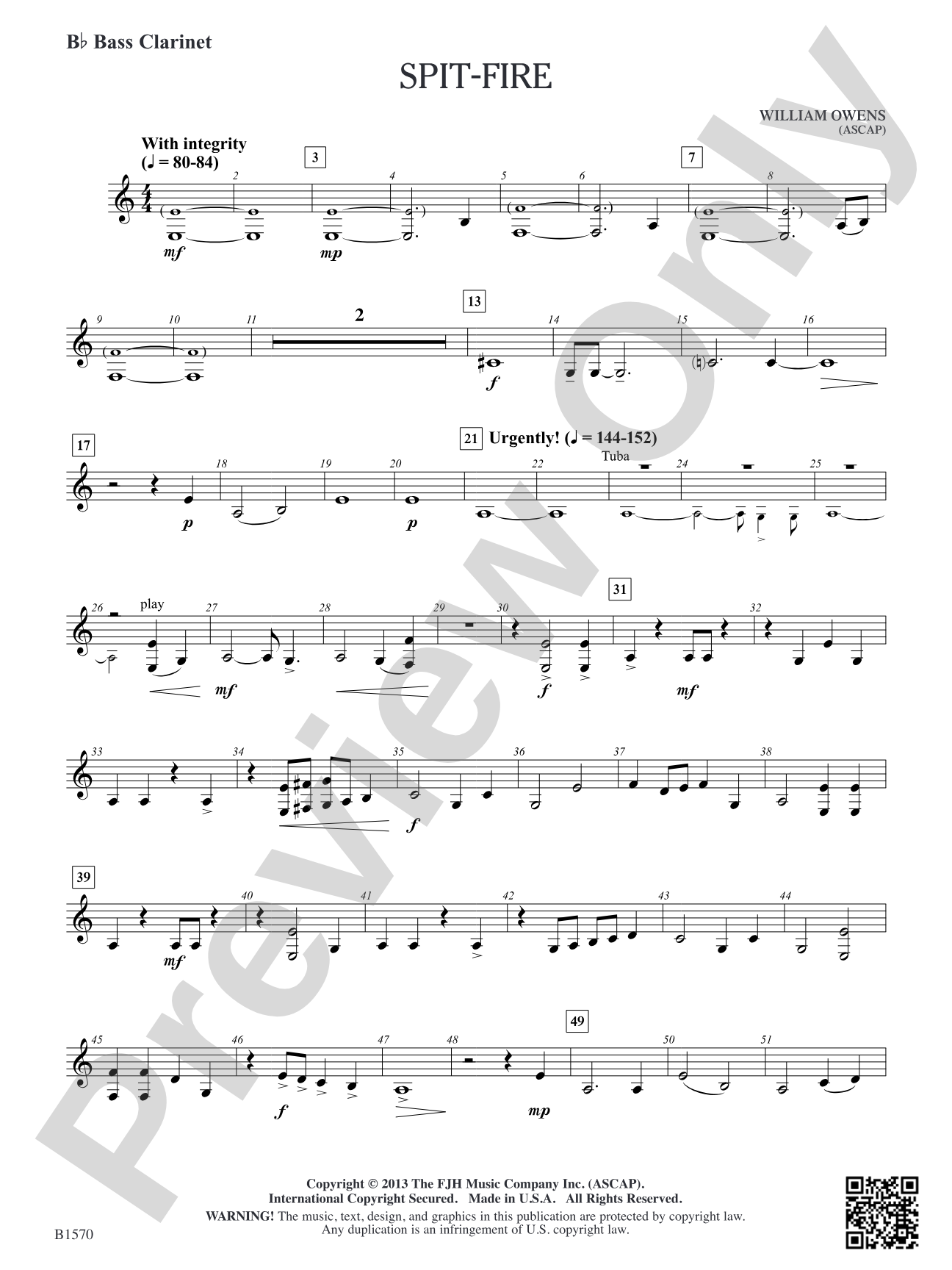

Spit-Fire: B-flat Bass Clarinet
By William Owens
Grade: 2.5
Item: 98-PC-DB1570_BC
$7.00
Pickup currently not available
Description
The exploits of the legendary Tuskegee Airmen come alive in this musical tour-de-force! The opening militaristic theme pays homage to these heroes as they approach their aircraft and prepare to take flight. The music suddenly spikes in tempo and leads into an intense aerial battle, with brass and percussion replicating the sounds of fighter jets and artillary. Ultimately, the music careens to an explosive conclusion. Sensational!


Don't just read it, hear it, play along with it, and watch your students grow with it. In MakeMusic Cloud, Spit-Fire: B-flat Bass Clarinet comes alive with professional accompaniment, adjustable tempo, and built-in practice tools that turn solo practice into real progress.
Open in the Player
Jump straight in and assign it today.
Start Your Free Trial
Open this title and explore the full library in minutes.
Sample Audio
1
Audio File
--:--
0:00
0:00
Sample Video
No sample videos found.
Additional Details
Series:
FJH Young Band
Publisher:
The FJH Music Company, Inc.
SKU:
98-PC-DB1570_BC
More about this title
About the Composer: William Owens

William Owens brings three decades of classroom experience to his compositional work. A Gary, Indiana native and VanderCook College of Music graduate, he has established himself as a trusted voice in young band literature through over 300 published works since 1993. His pieces appear on state required lists across the country and serve as teaching staples in countless programs.
Owens has earned recognition from the Texas Bandmasters Association, his alma mater, and professional organizations including ASCAP and Phi Beta Mu International. After 30 years as a band director in Texas, he continues to compose and clinician throughout North America, drawing on his deep understanding of what works in the rehearsal room and what inspires student musicians.
Why we love this
Spit-Fire captures the drama and urgency of its subject without resorting to bombast or oversimplification. At grade 2.5, Owens delivers genuine excitement through smart orchestration: the militaristic opening establishes character, the tempo shift into aerial combat keeps players engaged and challenged, and the explosive finale sends audiences out energized. This is concert band writing that respects both the historical moment and the young musicians performing it.
What to expect
Spit-Fire opens with military precision and purpose, honoring brave pilots preparing for combat. Energy surges as the music transforms into sonic chaos: jet engines roar, artillery cracks, and instruments trade rapid figures that mirror the intensity of aerial combat. The piece resolves in a thrilling, high-octane finale that leaves both players and listeners breathless.
Who it's for
Grade 2.5 concert bands ready for musically substantive repertoire with historical weight. The piece rewards groups with developing ensemble control and clear articulation while remaining accessible enough that musicianship, not technical virtuosity, drives the performance.
How to get the most out of it
- Shape the opening militaristic theme with precise articulation and dynamic control. The reverence of the approach to the aircraft sets up the intensity that follows, so resist rushing even as the energy builds.
- Highlight the brass and percussion writing during the aerial battle section. These parts carry the musical action, so balance the inner voices to let the dogfight scenario sing through without drowning out the harmonic foundation.
- Communicate the accelerating tempo shifts clearly through conducting. Young ensembles thrive when they understand the narrative arc, so mark the exact tempo changes in parts and rehearse the transitions until they feel inevitable rather than jarring.
- Build toward the explosive conclusion with sustained pressure across the full band. The payoff should feel earned, not sudden, so gradually increase intensity in the final section rather than waiting until the very last measures.
How to use it
Program this as a concert centerpiece that carries genuine emotional weight without requiring advanced technical demands. Its patriotic character and compelling narrative make it ideal for Veterans Day events, military appreciation concerts, or programs exploring American history. The piece also works beautifully as a closing selection on a concert, as its explosive conclusion leaves a lasting impression.
Skills your students will build
- Executing rapid articulation changes within a single phrase
- Maintaining ensemble cohesion through tempo shifts and accelerations
- Balancing dynamic layers in densely scored sections
- Interpreting programmatic music with precise rhythmic control
- Responding to conducting cues for sudden textural changes