
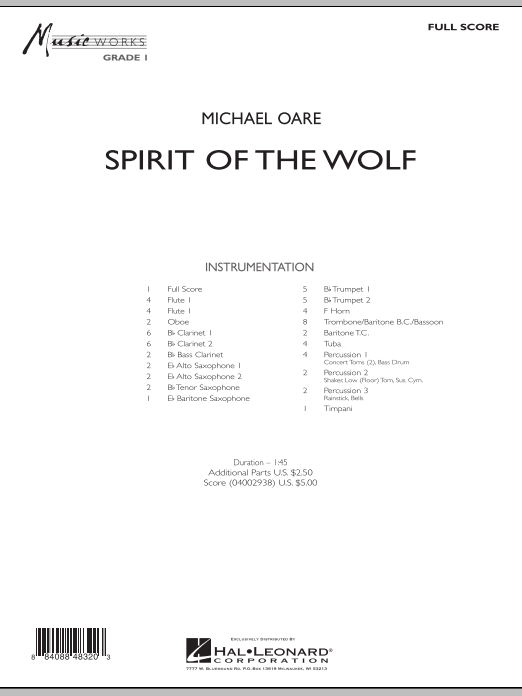

Spirit Of The Wolf: Concert Band Conductor Score & Parts
By Michael Oare
Grade: 1
Item: 35-PK00157517
$55.00
Pickup currently not available
Buy Extra Parts (Digital PDF Download)
Parts Added to Cart!
Description
In this evocative work for beginning bands, Michael Oare draws upon imagery and sounds of the Native American "wolf dance" for inspiration. A flute solo sets the opening mood, followed by dramatic full band statements accompanied by a driving percussion ostinato. Dur: 1:20


Spirit Of The Wolf: Concert Band Conductor Score & Parts isn't in MakeMusic Cloud just yet...but it could be. Let us know you'd like to see it, and you'll help shape what comes next. In the meantime, start a free trial and dive into thousands of interactive titles your students can play along with today.
Request This Title
Tell us you want it.
Start Your Free Trial
Explore everything that's ready to play right now.
Sample Audio
No sample audio found.
Sample Video
No sample videos found.
Additional Details
Publisher:
Hal Leonard
SKU:
35-PK00157517
More about this title
About the Composer: Michael Oare

Michael Oare holds degrees in both composition and music education from Old Dominion University and has spent his career as a classroom educator, composer, and conductor. For 33 years, he directed bands at Great Bridge Middle School in Chesapeake, Virginia, where his ensembles maintained superior ratings on state assessments for three consecutive decades while performing grade 3 and 4 repertoire. His compositions have earned recognition in GIA Publications' Teaching Music Through Performance series, and he has received the National Band Association's Citation of Excellence twice.
Beyond his school work, Oare serves as conductor of the Bay Youth Orchestras of Virginia Concert Band and performs with the Virginia Wind Symphony. He holds membership in ASCAP and Phi Beta Mu, was named Chesapeake Public Schools' Middle School Teacher of the Year in 2016, and remains active in state and national music education organizations.
Why we love this
Oare captures the essence of Native American movement and music in a way that feels authentic without patronizing his young performers. The opening flute solo immediately sets a distinct character while remaining accessible to beginning musicians, and the driving percussion ostinato gives your rhythm section real work to do from measure one. This is the kind of Grade 1 piece that teaches genuine musicality rather than just note reading.
What to expect
The opening is intimate and reflective, with the solo flute painting a quiet landscape. Once the full band enters with its dramatic statements and the percussion begins its driving pulse, the music takes on energy and purpose, evoking movement and tribal identity without resorting to stereotypes.
Who it's for
Beginning band directors looking for repertoire that combines cultural substance with genuine pedagogical value. This work suits ensembles in their first or second year of playing together, as it demands solid fundamentals without requiring advanced technique.
How to get the most out of it
- Balance the flute solo against the rest of the band so the opening melodic gesture breathes; young flute players often rush when they have the spotlight.
- Lock in the percussion ostinato early in rehearsals. This rhythmic anchor gives the rest of the band confidence and defines the piece's character.
- Shape the full band statements dynamically. These moments have impact only if they contrast with the quieter passages, so resist the urge to play everything at the same volume level.
- Lean into the imagery during final rehearsals. Asking students to think about movement and energy helps them understand why the rhythm and phrasing matter.
How to use it
Open a concert with this piece to establish an artistic tone from the first notes. At 1:20, it pairs well with longer works and gives audiences a moment of genuine connection before moving into more substantial repertoire. Alternatively, use it in a unit exploring cultural music traditions or as a standalone performance for community events.
Skills your students will build
- Balancing solo and ensemble textures
- Maintaining steady rhythm against a driving ostinato
- Dynamic shaping and contrast within short phrases
- Sustained tone production on opening solo passages
- Listening and blend within full band statements