
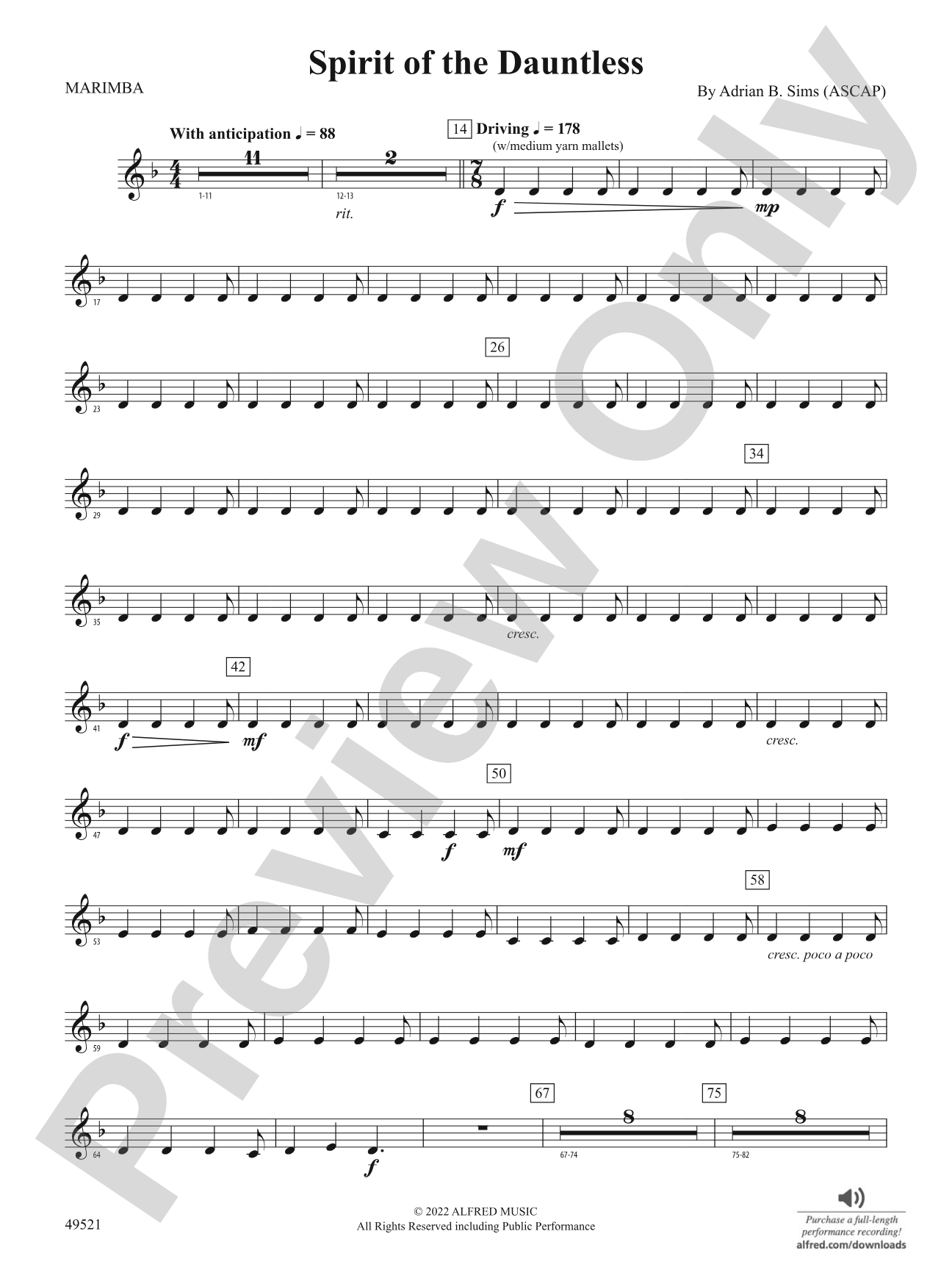

Spirit of the Dauntless: 2nd Mallet Percussion
By Adrian B. Sims
Grade: 4
Item: 00-PC-0018814_M2
$3.00
Pickup currently not available
Description
Spirit of the Dauntless by Adrian B. Sims, is an anthem of power and courage. The ideas develop as our hero moves through different challenges and landscapes---some foreboding, and some treacherous. Some moments depict challenges and struggles while others are filled with triumph. Powerful musical statements bring the work to a rousing finish, concluding our hero's fearless journey. (4:24) This title is available in MakeMusic Cloud.


Don't just read it, hear it, play along with it, and watch your students grow with it. In MakeMusic Cloud, Spirit of the Dauntless: 2nd Mallet Percussion comes alive with professional accompaniment, adjustable tempo, and built-in practice tools that turn solo practice into real progress.
Open in the Player
Jump straight in and assign it today.
Start Your Free Trial
Open this title and explore the full library in minutes.
Sample Audio
1
Audio File
--:--
0:00
0:00
Sample Video
Additional Details
Series:
Alfred Concert Band
Publisher:
Alfred Music
SKU:
00-PC-0018814_M2
More about this title
About the Composer: Adrian B. Sims
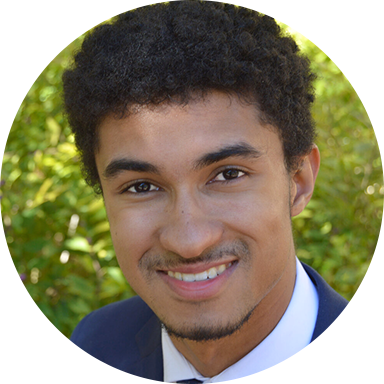
Adrian B. Sims (b. 2000) grew up in Seattle, Washington, and went on to graduate from Catonsville High School in Maryland in 2018. His compositions have earned recognition at The Midwest Band and Orchestra Clinic, landed on the Bandworld Top 100 List, and won awards through the Maryland Music Educators Association Young Composers Project and the Make Music Young Composers Contest. As both conductor and educator, he has led performances of his own works across Maryland schools.
Beyond composition, Sims is an accomplished trombonist who has performed in orchestral, jazz, and concert band settings. His high school years included multiple selections to the Maryland All-State Band and performances alongside the Baltimore Symphony Orchestra. He currently studies dual degrees in Music Education and Composition at The University of Maryland while performing in the university's top ensembles. His musical development has been shaped by mentors including Dr. Robert Gibson, Professor of Composition at Maryland, and composer Brian Balmages.
Why we love this
Sims crafts a narrative arc that feels genuinely earned, avoiding the trap of constant bombast by balancing foreboding and triumph so that the final powerful statements land with real impact. The Grade 4 orchestration sits comfortably for developing concert bands without sacrificing compositional sophistication or the distinctive musical voice of a young composer whose work has already proven itself on competitive festival stages.
What to expect
A journey through adversity toward hard-won resolve. The piece moves through moments of genuine uncertainty and foreboding, then builds toward powerful affirmation, creating emotional stakes that keep listeners invested in the hero's progress. By the final measures, triumph feels deserved rather than arbitrary.
Who it's for
Grade 4 concert bands looking for substantial concert repertoire with genuine dramatic arc and modern compositional voice. This work suits both festival programming and concert hall performances where you want students to engage with a composer's specific musical ideas rather than a generic setting.
How to get the most out of it
- Shape the contrasting landscapes deliberately: underscore the foreboding sections with restrained dynamics and tight articulation, then unleash full ensemble energy in the triumphant passages. This creates genuine architectural contrast rather than relying on volume alone.
- Clarify the hero's journey through careful sectional balance. Keep melodic lines exposed enough that listeners can follow the developing ideas across the ensemble, especially when the theme passes between instrumental colors.
- Use the recorded accompaniment (available through MakeMusic Cloud) as a rehearsal tool to lock tempo relationships between contrasting sections, then rehearse without it to ensure the band internalizes the pulse during transitions.
How to use it
Program this as a concert centerpiece or festival selection where you want to showcase your band's ability to execute contrasting moods and sustained musical lines. The 4:24 duration positions it well alongside lighter opener selections or as a standalone feature that demonstrates growth in ensemble maturity.
Skills your students will build
- Executing sustained dynamic control across extended phrases
- Balancing melody and accompaniment voices within sectional arrangements
- Interpreting contrasting compositional moods (foreboding versus triumphant)
- Following and maintaining a dramatic narrative arc over a four-minute work
- Responding to contemporary compositional language and orchestration choices