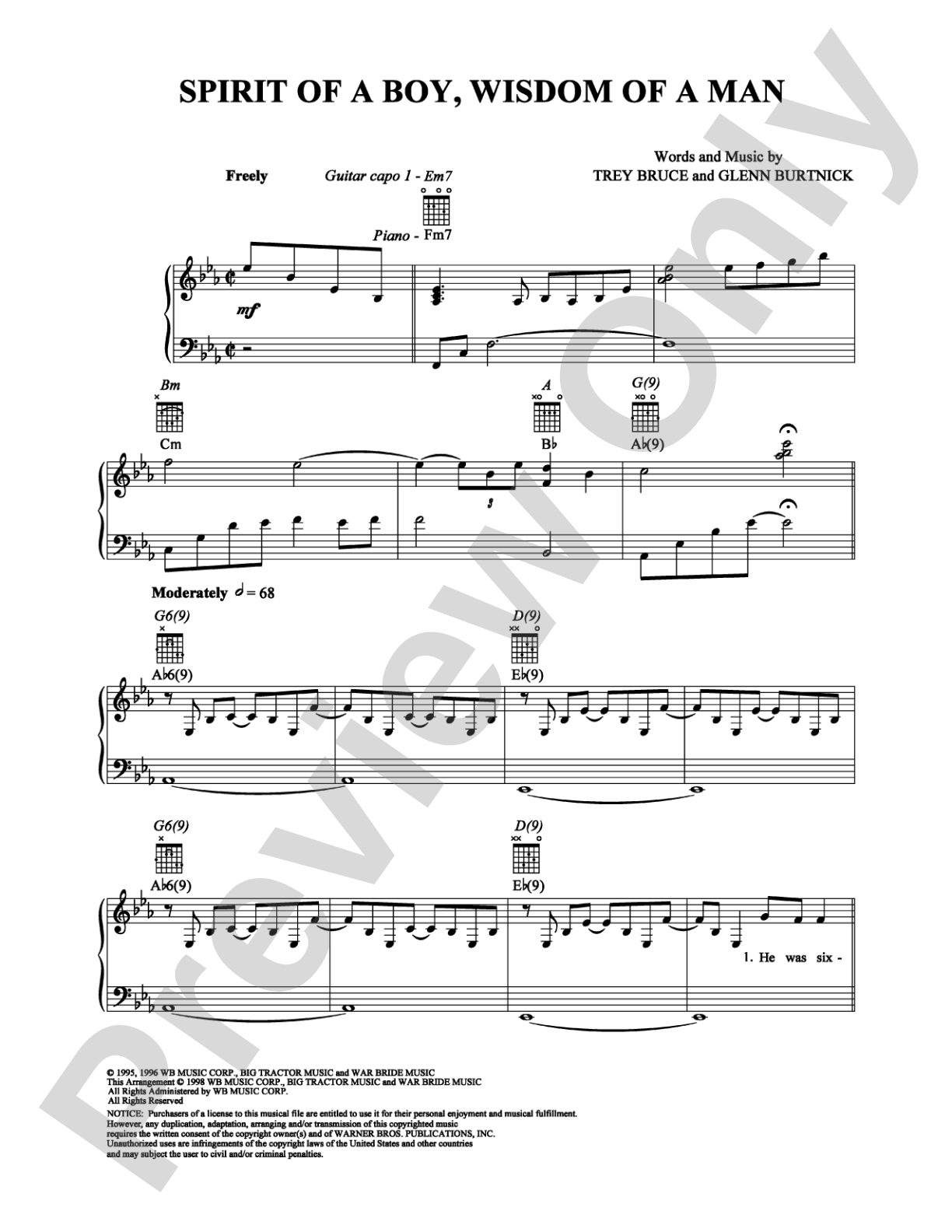
Spirit of a Boy, Wisdom of a Man: Piano/Vocal/Chords Digital Sheet Music

Spirit of a Boy, Wisdom of a Man: Piano/Vocal/Chords Digital Sheet Music

Randy Travis, Trey Bruce, Glenn Burtnick

Item: 00-PS-0005994

Digital Download
$3.99
Description

Spirit of a Boy, Wisdom of a Man: Piano/Vocal/Chords Digital Sheet Music isn't in MakeMusic Cloud just yet...but it could be. Let us know you'd like to see it, and you'll help shape what comes next. In the meantime, start a free trial and dive into thousands of interactive titles your students can play along with today.

Sample Audio
No sample audio found.
Sample Video
Additional Details
SKU: 00-PS-0005994

More about this title

About the Artist: Randy Travis

Randy Travis emerged as one of country music's most influential voices in the 1980s, bringing a traditional baritone and neo-traditional sensibility to a genre that had drifted toward pop production. His work across three decades established him as a skilled interpreter of heartfelt narratives, often exploring themes of redemption, loss, and personal growth. For music educators, his catalog offers direct access to authentic country songwriting and vocal phrasing that rewards careful study of dynamics and emotional restraint.

Beyond his commercial success, Travis has remained a working musician and recording artist, demonstrating a commitment to the craft that extends far beyond his initial commercial peak. His willingness to tackle complex emotional territory through song makes his material valuable for students learning how to color lyrics with genuine feeling rather than technical display.

Why we love this

This song sits squarely in the country ballad tradition while offering substantive lyrical content about masculinity and growth that resonates beyond genre boundaries. Piano/vocal/chords arrangements like this one give students a complete performance framework without over-arrangement, letting the story and the voice carry the weight. Directors appreciate how the country idiom here demands real vocal control and phrase shaping rather than volume.

What to expect

The song carries the weight of reflection and hard-won perspective. There's dignity in the minor-key vulnerability here, paired with the kind of straightforward melody that lodges in memory. The arrangement respects both the piano and voice equally, creating space for genuine emotional communication rather than technical display.

Who it's for

Singers performing country repertoire or exploring how to authentically interpret songs rooted in narrative and emotion will find this arrangement direct and workable. Pianists accompanying vocalists in a country or crossover context can use this to understand how simple harmonic support can enhance rather than overshadow a strong vocal performance.

How to get the most out of it

  • Shape the melody around the lyrical phrases rather than musical measures; country ballads live in the spaces between strict timing, so allow breathing room where the story needs to land
  • Work the piano accompaniment as a conversation partner with the vocal line. Listen for moments where the chords should support quietly and others where they can swell to match emotional peaks
  • Pay attention to articulation choices in the verses. Many country singers use subtle catch-breaths and slight delays that feel natural conversationally rather than metrically perfect
  • Color the harmony by choosing when to play full chords and when to voice them more sparsely. This song's emotional arc benefits from restraint in the quieter moments

How to use it

This works well in recitals focused on American songwriting traditions or in mixed-genre programs exploring how country ballads function as narrative storytelling. Pairing it with other songs that examine personal transformation or reflection creates a cohesive thematic arc. It also serves singers preparing auditions or recital programs that value authenticity and emotional clarity over virtuosity.

Skills your students will build

  • Phrasing lyrics naturally across musical phrases rather than metrically
  • Voicing piano chords to support rather than dominate the vocal line
  • Using vocal dynamics and tone color to convey emotional shifts without oversinging
  • Understanding country ballad conventions around rhythm, timing, and conversational delivery
  • Coordinating accompaniment and melody in a duo context with equal partnership

You May Also Like