
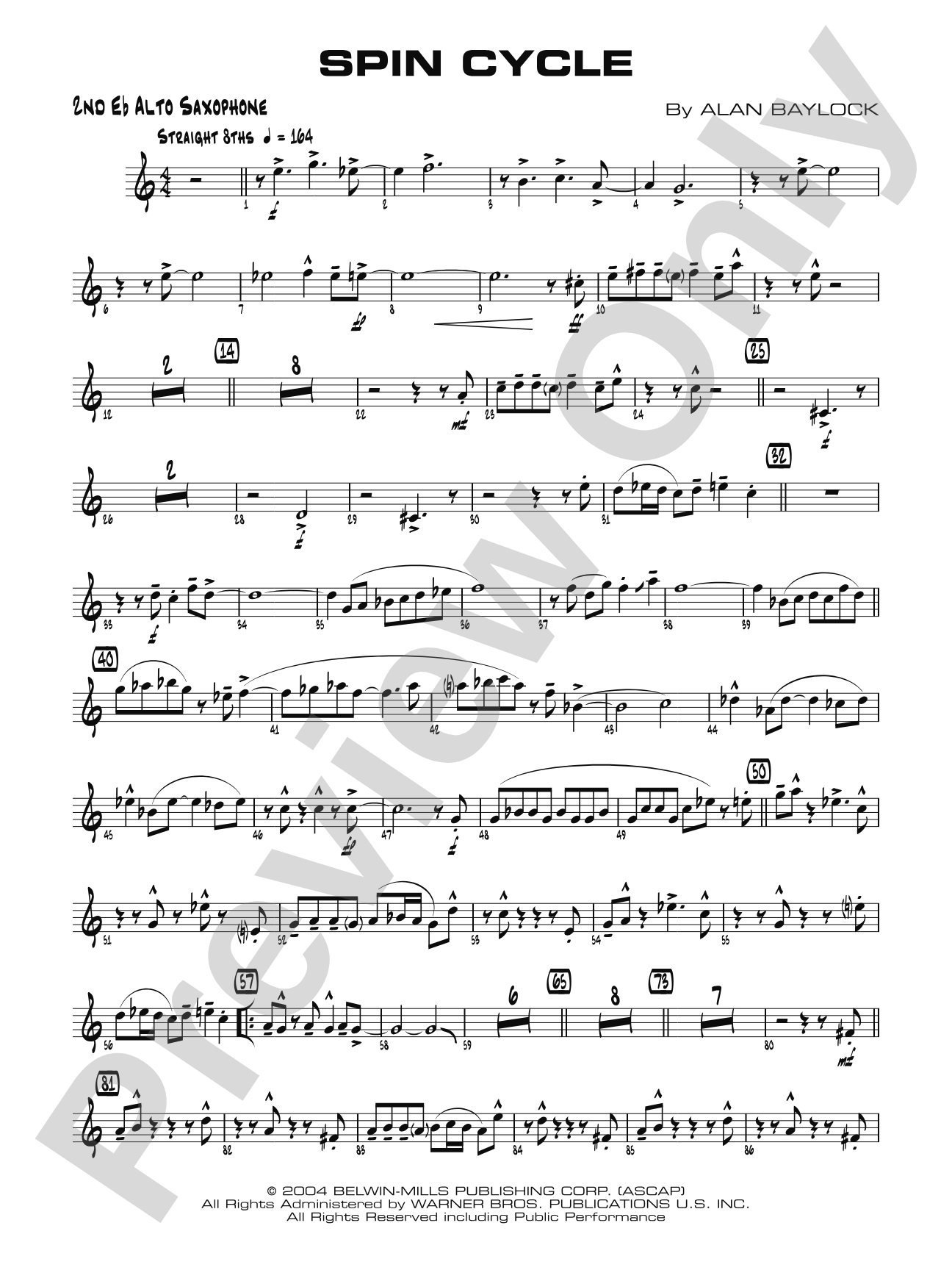

Spin Cycle: 2nd E-flat Alto Saxophone
By Alan Baylock
Grade: 4.5 (Medium Advanced / Difficult)
Item: 00-PC-0017271_AX2
$3.00
Pickup currently not available
Description
Contemporary, fresh, and energized, Spin Cycle is composed and arranged by Alan Baylock, staff arranger for the USAF Airmen of Note. He describes this chart as a half-time funk chart with a catchy melody and lots of fun ensemble sections for the entire band. This is a very hip chart that will be a highlight of every festival and concert. Tenor sax and guitar have solo space, and the wah-wah guitar and the rest of the rhythm section is featured on the groove throughout the chart. (3:28)


Don't just read it, hear it, play along with it, and watch your students grow with it. In MakeMusic Cloud, Spin Cycle: 2nd E-flat Alto Saxophone comes alive with professional accompaniment, adjustable tempo, and built-in practice tools that turn solo practice into real progress.
Open in the Player
Jump straight in and assign it today.
Start Your Free Trial
Open this title and explore the full library in minutes.
Sample Audio
1
Audio File
--:--
0:00
0:00
Sample Video
No sample videos found.
Additional Details
Series:
Premier Jazz Series
Publisher:
Alfred Music
Page Count:
84
SKU:
00-PC-0017271_AX2
More about this title
About the Composer: Alan Baylock

Alan Baylock has shaped the sound of contemporary jazz through decades of composing, arranging, and teaching at the highest levels. His 20-year role as Chief Arranger for the USAF Airmen of Note established him as a master of the big band idiom, and he now directs the Grammy-nominated One O'Clock Lab Band at the University of North Texas while leading his own jazz orchestra. His work has been recorded and performed by an extraordinary range of artists spanning jazz luminaries, classical soloists, and cross-genre collaborators including Melissa Aldana, Michael Brecker, Paquito D'Rivera, and many others.
Beyond his prolific output as a composer and arranger, Baylock is deeply committed to expanding opportunity in jazz education and publishing. He has guest-conducted over 100 ensembles at professional, collegiate, and high school levels, served as Jazz Composer-in-Residence at Shenandoah University, and directed the National Jazz Workshop's All-Star Big Band. In 2022, he co-founded Brava Jazz Publishing with arranger Annie Booth, a publishing venture dedicated to amplifying the voices of women composers and arrangers in big band jazz.
Why we love this
Baylock brings the polish and swagger of his USAF Airmen of Note experience to this funk-driven chart without sacrificing the sophisticated ensemble writing that distinguishes it at festivals and concerts. The groove never quits, the solos (tenor and guitar) feel natural and achievable, and there's genuine space for the entire band to shine rather than doubling parts endlessly. It's the kind of contemporary arrangement that reminds audiences why jazz ensemble is worth their time.
What to expect
Fresh, propulsive, and undeniably hip. The half-time funk groove pulls you in immediately, and the catchy melody rewards careful listening while the ensemble sections invite the whole band into the party. There's energy and sophistication in equal measure—never cute or oversimplified, but never inaccessible either.
Who it's for
Jazz ensembles at the Grade 4.5 level (high school advanced to community college) with solid chops and a rhythm section that can lock into modern funk feels. Directors seeking a contemporary piece that programs well at festivals and concert settings without requiring specialized extended techniques or experimental approaches.
How to get the most out of it
- Lock the wah-wah guitar and rhythm section into a tight pocket first; let that groove anchor everything else, since the chart lives or dies on how solid the half-time funk feel sits.
- Give the tenor saxophonist room to breathe during the solo section—this is not a chart where the solo feels tacked on, so encourage phrasing that trades energy with the band.
- Balance the catchy melody so it cuts through the ensemble textures without overwhelming the funk foundation; think spotlight rather than solo versus accompaniment.
- Use the full 3:28 to build dynamics and intensity; resist the urge to play the whole thing at one energy level, even when the groove is infectious.
How to use it
Program this as a strong centerpiece or closer on a festival or concert set where you want to demonstrate versatility and contemporary sensibility alongside more traditional repertoire. The groove and catchy elements make it an excellent audience connector after a ballad or more complex modern work.
Skills your students will build
- Playing in a modern funk feel with consistent half-time rhythm
- Balancing solo space with ensemble support
- Reading and executing tight ensemble figures at fast tempos
- Translating contemporary compositional language (wah effects, groove-based textures) into section and individual sound
- Responding to dynamic and textural cues that build intensity over the course of a longer form