
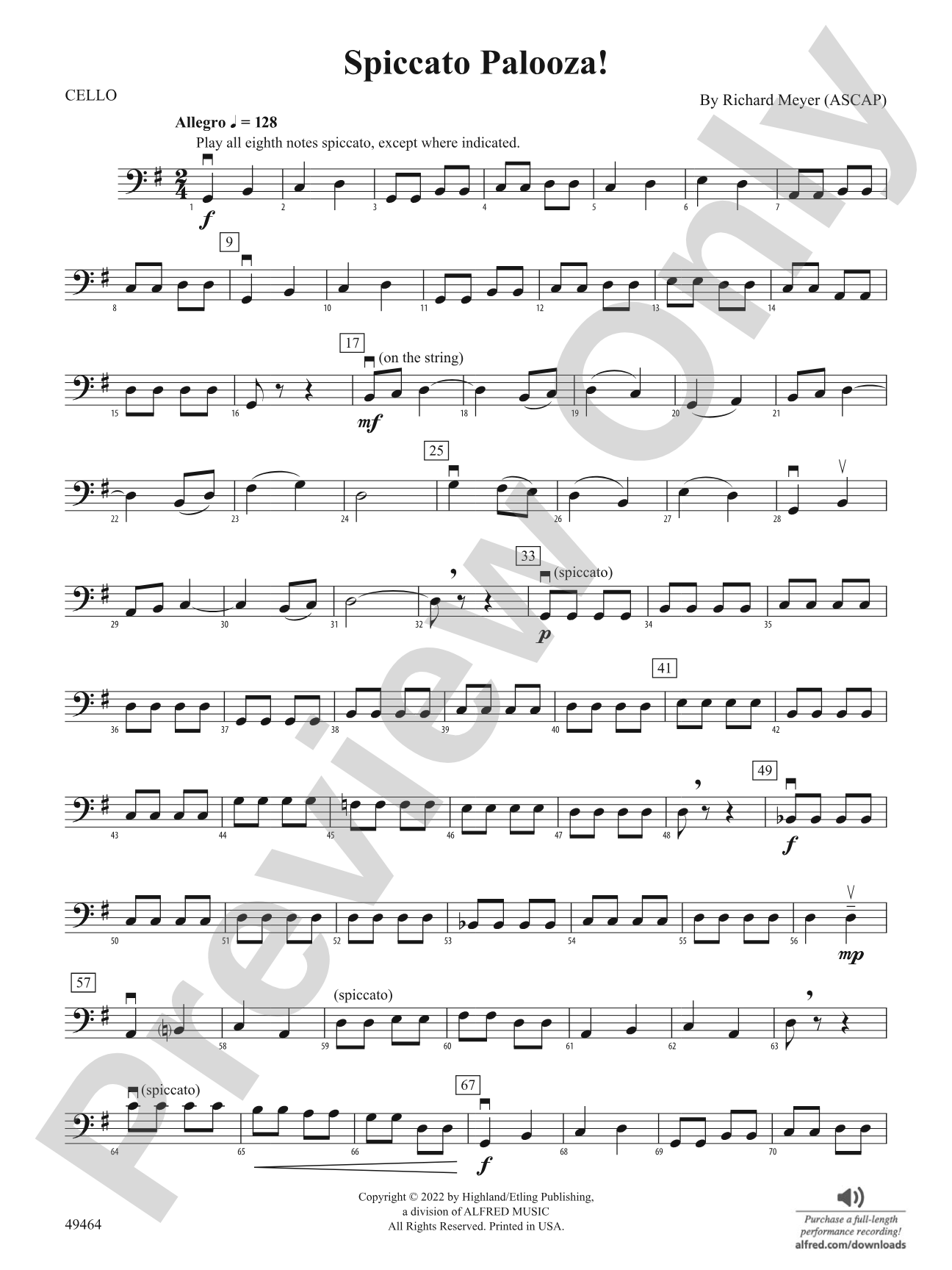

Spiccato Palooza!: Cello
By Richard Meyer
Grade: 2
Item: 00-PC-0018782_VC1
$3.00
Pickup currently not available
Description
Written to help students develop their spiccato bow stroke, this energetic piece is a joyful celebration from the very first measure. The left hand challenges are minimal, allowing the players to focus on controlling their bow on and off the string. A contrasting call-and-response "B" section in minor mode briefly slows the pace down before the party resumes again. Over time, the overall tempo can be increased as the students become more and more proficient with this all important bow technique. Correlated to Sound Innovations, Book 2, Level 2. (2:30)


Don't just read it, hear it, play along with it, and watch your students grow with it. In MakeMusic Cloud, Spiccato Palooza!: Cello comes alive with professional accompaniment, adjustable tempo, and built-in practice tools that turn solo practice into real progress.
Open in the Player
Jump straight in and assign it today.
Start Your Free Trial
Open this title and explore the full library in minutes.
Sample Audio
1
Audio File
--:--
0:00
0:00
Sample Video
Additional Details
Series:
Sound Innovations for String Orchestra
Publisher:
Alfred Music
SKU:
00-PC-0018782_VC1
More about this title
About the Composer: Richard Meyer

Richard Meyer spent 35 years teaching strings in public schools, including 22 years directing the orchestra program at Oak Avenue Intermediate School in Temple City, California. During his tenure there, he expanded the program from 29 students to 200 and oversaw the district's elementary string curriculum. He conducted the Pasadena Youth Symphony Orchestra for 16 years, leading performances across North America, Europe, and Australia.
Beyond the classroom, Meyer has established himself as a nationally recognized composer with over 190 published works and arrangements. He served as string editor for Alfred Publishing Company for 16 years and co-authored widely used string method resources including the String Explorer Series and Sight-read It for Strings. His "Giving Bach" initiative, launched in 2009, brought interactive concerts to special needs and underserved students throughout Southern California and gained national recognition for its community impact. Meyer has been a featured clinician at major conferences and workshops, including the A.S.T.A. National Conference and state honor orchestra clinics.
Why we love this
Meyer wrote this piece with the specific pedagogical reality of Grade 2 students in mind. The minimal left-hand demands mean beginners can direct all their mental energy toward the spiccato stroke itself, without fighting awkward position shifts or complicated fingering patterns. The structural design also gives you a real tool for assessment: you can gradually accelerate the tempo throughout the year as control improves, turning a single piece into a concrete measure of technical growth.
What to expect
A celebratory romp from start to finish, full of rhythmic energy and forward motion. The main theme bounces with joy; when the minor-mode B section arrives, the mood gentles into something more reflective before the excitement returns and carries the piece home.
Who it's for
Grade 2 string orchestras ready to move beyond short spiccato etudes into a full piece that integrates the technique into a musical performance. This works well for orchestras that have completed basic bow control and are prepared to sustain spiccato articulation across longer phrases.
How to get the most out of it
- Start at a tempo where the spiccato stroke feels relaxed and controlled; focus on a consistent vertical bow motion rather than speed. Once your players can execute clean articulation for two full minutes, gradually increase the tempo by small increments over several rehearsals.
- Use the B section's minor-mode call-and-response to reinforce listening between sections. Have the responding group watch the leading group closely rather than counting, so they react together rather than mechanically entering on beat one.
- Highlight the contrasting character between A and B by adjusting dynamics and articulation clarity. Keep A bright and energetic with crisp spiccato; let B settle into a calmer, more connected sound before the return.
- Ensure your ensemble maintains a steady pulse during the spiccato passages. A conductor who gives a clear, unwavering beat helps young players lock into rhythm while managing bow independence.
How to use it
Program this early in a concert to showcase a specific technical milestone your orchestra has achieved. It also works well in a festival or contest setting designed to highlight Grade 2 ensembles, since it sits solidly in the Sound Innovations curriculum and demonstrates measurable bow technique development.
Skills your students will build
- Controlled spiccato bow stroke with consistent pressure and contact point
- Sustaining spiccato articulation across multiple measures and phrases
- Listening and responding to call-and-response textures
- Maintaining ensemble pulse while managing independent bow technique
- Interpreting contrasting musical moods (major bright versus minor reflective)